ROUND THE WORLD.—4

6%

S. D. A. Publishing Association · Battle Creek, Mich. · Jan 22, 1890

FromThe Youth’s Instructor, Vol. 38, No. 4.

Read the full edition

ROUND THE WORLD.—4.

THE CANARY ISLES TO CAPE TOWN.
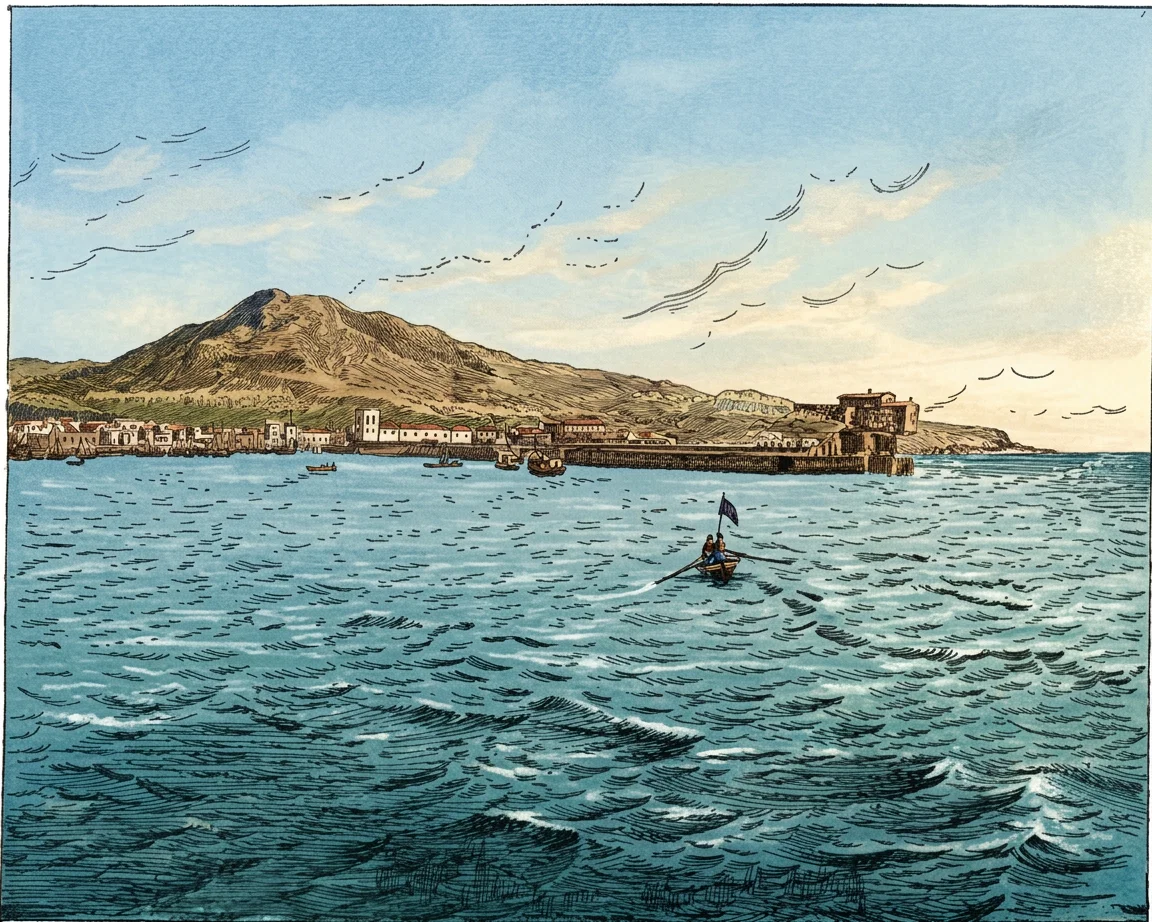
The Canary Islands are about twenty-seven in number, and lie fifty miles off the northwestern coast of Africa. Gran Canaria, with its capital, Las Palmas, is the largest and most important of the group, the only feature outside of it being Mount Teneriffe, a lofty, volcanic peak, which can be seen for many miles by passing ships. Even in the hottest weather there is always snow on its summit. The islands became the property of Spain years ago, and have been under that power ever since.
Scarce had the ship come to anchor, when we were surrounded by well-nigh a hundred boats laden with fruit, canary birds, wicker chairs, and other curiosities. Their owners, a motley gang of Spaniards, Africans, and mulattoes, literally swarmed up the side, and in none too harmonious tones vied with one another in advertising their wares.
A large party of us went ashore, where there were a host of little native ponies, followed by quaint conveyances, to take us up to Las Palmas, which lies on the side and at the base of a lofty mountain some four miles from the landing-place. The climate is remarkably salubrious and the soil very fertile. Las Palmas has been much frequented as a health resort by European and English people. There are many lovely trees and tropical fruits; the cypress, palm, banana, aloe, pomegranate, and vine flourish abundantly. We passed by many villas surrounded by beautiful gardens filled with flowers of varied hues. There are hedges of geraniums, growing from three to five feet tall, and covered with a profusion of scarlet blossoms.
The native men are a vicious-looking lot, each one carrying a sharp poniard, which he draws on the slightest provocation. The women are dressed a good deal after the Oriental style, and may often be seen carrying large earthen vessels of water on their heads, much the same as is represented in pictures of Bible times.
The houses are built of limestone, painted white, and almost all of them are one-storied and flat-roofed. The streets are narrow, paved, and remarkably clean. Many of the larger residences are constructed in the form of a hollow square, having a court-yard in the center, filled with palm, orange, or lemon trees. This makes a cool and pleasant place in which to sit during the heat of the day. There are no fine store buildings, and such as do exist have no glass in the windows; there is only a large square hole, and the goods are placed on receding shelves for exhibition. It is difficult to find souvenirs at Gran Canaria, as there is nothing manufactured on the island save smoking pipes and walking sticks. Canary birds are plenty in this their native home, but the fanciers ask more for them than one pays in either England or America, on the plea that it is worth much more to take one direct from the island.
We visited the government buildings, which are small but prettily decorated inside. There is also a museum, which contains nothing of much interest. But the sight at Gran Canaria is the Roman Catholic cathedral, a large limestone building, which has stood the storm and shine of many a year. Its top is ornamented with a number of towers and minarets.
Restored with AI
The windows are of stained glass, and the interior is almost as dark as the religion of those who worship there. It contains several chapels ornamented with magnificent carvings of oak and other wood. The walls are covered with life-size oil paintings; prominent among them is a representation of the Saviour bearing the cross to Calvary. The expression of calm resignation on that holy face is so perfectly portrayed that one almost imagines it alive.
At the end of the choir chancel in the nave is a revolving lectern, on which are placed the sacred books. These consist of portions of the Bible and church prayer-book hand-painted on vellum sheets. There is also a book filled with music painted in the same manner. As we gazed upon them, we thought what a wonderful amount of patient toil it must have taken to paint and put together these books, and what a contrast they form to the printing-presses of modern days. The altar is placed in an alcove at the east end. Its top, sides, and front are covered with solid silver, beaten and hammered out in many beautiful designs. At the rear is a magnificent fresco of the Son of God ascending in the cloud to heaven, while beneath are the men of Galilee gazing after his receding form.
Upon leaving the cathedral, we visited the fruit market, and were then driven back to the jetty. We did not visit the famous cave of Attylla, which lies on the other side of the island, as time was limited; moreover, the occupants of it, who are descendants of Spanish outlaws, do not have a very enviable reputation; in fact, we were warned against visiting it except in large parties, as some who have done so have never returned.
At three P. M. all were aboard again, as the captain had declared he would sail at that hour, and wait for nobody. He did not, however; and we whiled away the moments by throwing pennies into the water, and watching the little native boys dive for them. They seldom miss a coin, and generally secure it long before it has time to reach the bottom. Sometimes they will dive underneath a large steamer, and come up on the other side.
By and by we were off again, and soon there was nothing in sight save the restless billows. For seventeen long days the good ship sailed along. On August twenty we crossed the equator. That night the north star was viewed for the last time, and on the next the southern cross was in sight. At this point of the journey the sailors had a good deal of fun at the expense of the less educated class of passengers, telling them that they would feel the ship give a tremendous jerk as she crossed the line, and that they would have to watch the compasses closely; for as soon as we were over, the needle would turn and point to the south.
In tropical waters the sea around the vessel at night looks like a lake of liquid fire. This is caused by phosphorus in the water; and for a considerable distance it also forms a lighted path in the wake of the ship. During the day the air is filled with flying fish. They never rise more than a few feet above the water, and when tired, dive out of sight in a moment. Sometimes the sailors catch them by placing down in the water a net containing a lantern; to this bait they will flock in great numbers.
On the last day of summer land is in sight. Speed on, good ship, speed on! With every throb of the propeller, every waft in the drawing sail, we near the haven. All are weary for land once more, and the regret we feel at leaving this staunch friend will still be tempered with satisfaction at the thought that once more activity can take the place of our lengthened present inaction. P. T. M.