It may prove of interest to many of the INSTRUCTOR readers to learn a little about the newly-opened iron fields of the South.
Restored with AI
Restored with AI
Perhaps the South was never considered as industrious and enterprising as the North, and this might continue to be true were it not for the vast mines of iron and coal which have lately been opened here, awakening the people to the fact that their worn-out farms are underlaid with a wealth they had not even dreamed was theirs.
Where only a few years ago were the low-spreading farm-houses of the planters, or the remains of little log-cabins, the homes of the slaves, are now erected great, towering furnaces and rolling-mills, whose smoke-stacks and flaming lights speak of another life to this people. For cities sprang up as if by magic, Northern capitalists came and invested, railroads were laid, and even the country itself varied its name, and is now termed by all “the new South.”
A person unaccustomed to iron furnaces, on coming into one of these cities by night, will suppose the whole place on fire; but instead, he would find he was only passing the coke ovens, or perhaps the furnaces, whose puffing, snorting, and roaring are kept up night and day. To enjoy fully a visit here, one should go at night, as the displays are then seen in all their grandeur.
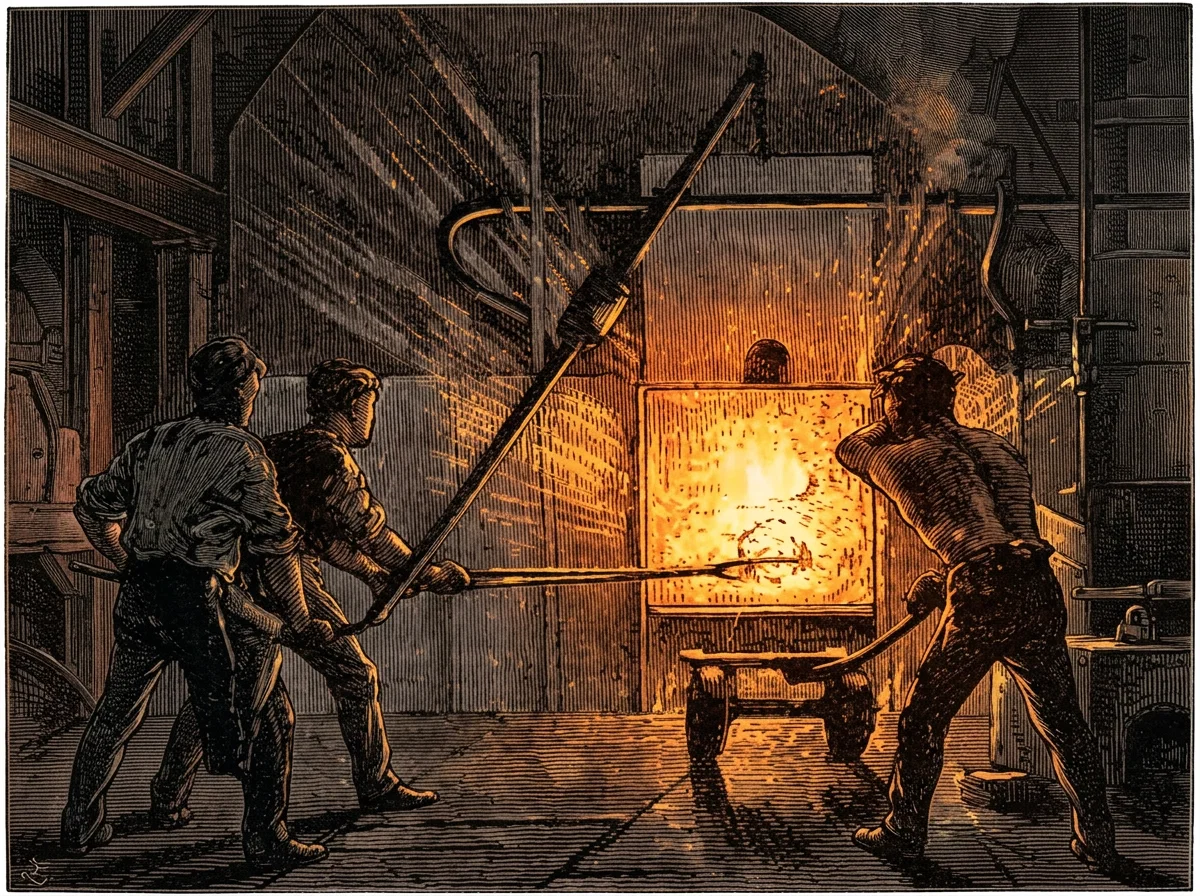
The most important part of a furnace plant is the big furnace itself,—a kind of immense iron chimney, lined with fire-brick. In starting a furnace, a quantity of wood is stacked in the base of this great chimney, which seems a miniature tower of Babel; next a quantity of coke is put on, then a layer of ore mixed with limestone, then coke again, then another layer of ore, and so on.
The workings of these furnaces are said to be simple, and every part works in perfect harmony with every other part. When all is in readiness, the wood is lighted. After ten or twelve hours, perhaps, the blast is turned on from the blowing machines, thus creating a draft. After the wood is lighted, the coke begins to burn, the ore and limestone to melt, and a quantity of gas forms in the top of the chimney. This gas, which is conducted from the top of the chimney by pipes, is used as fuel in heating the boilers that furnish steam to run the blowing engines. The blowing engines force great volumes of ore into the hot-blast stoves, and from the stoves into the furnace.
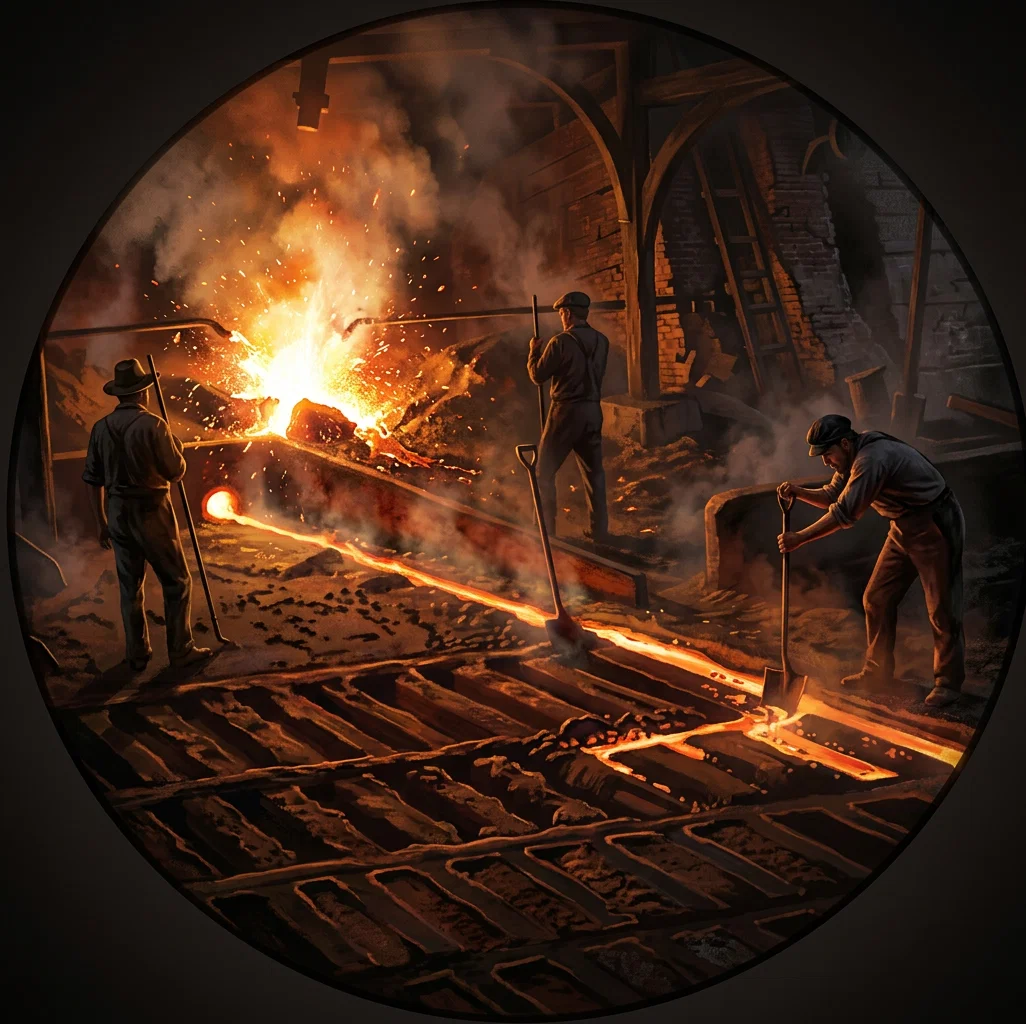
But the most interesting and beautiful part to us was the “drawing off.” In front of the furnace is a large bed of sand, made into trenches. When the ore has all melted, it is run into the trenches from the furnace. As down flows the fiery and beautiful iron river, happy, singing negroes stand ready to place a spade at the end of each mold after it is filled, so that no more iron may run into that one. After the iron molds are full, the iron is cooled with water; and before it is fairly cold, the men are busy stacking it on one side ready for shipping or to be used in the rolling-mills. This is now called “pig-iron.”
But in melting all this mass of ore, there is a great deal of dross. This is lighter than the pure iron, and floats on the top; so it is easily drawn from the furnace through an aperture above that through which the iron is allowed to escape. This dross is called “slag,” and is used for many things,—on railroad beds, for foundations for walks, and is not unfrequently made into pretty dishes.
Day after day and night after night the work is carried on, the new industry waking up and infusing new life into this part of the nation. E. M. O.