FOR THE INSTRUCTOR

8%

S. D. A. Publishing Association · Battle Creek, Mich. · Jul 31, 1889

FromThe Youth’s Instructor, Vol. 37, No. 31.

Read the full edition

FOR THE INSTRUCTOR

HOW PIG-IRON IS TREATED.
WHO has not stood and watched the blacksmith hammer iron into different shapes on the anvil? How pliable the hot iron seems, as the blows of the hammer fall upon it in rapid succession. Only a few moments ago that finely rounded horseshoe was but a shapeless piece of metal; it seemed, however, to take its present form so naturally by being hammered, that one almost thinks he could easily do the same with a piece of iron. He would, however, change his mind after the first trial; for it needs some skill to shape iron into a desired form.
Restored with AI
Restored with AI
But the metal as we saw it coming from the blast furnace, and left in the form of pig-iron, could not be drawn out in this way, even by a skillful blacksmith, because it is not adapted to such manipulations. It must beforehand be put through a purifying process, to remove from it those elements which make it so brittle as to forbid its being shaped under the hammer. The process by which this is accomplished is called “puddling,” and is done by throwing the pigs into a hot furnace, which has an opening in the front, through which a long bar is thrust to poke and stir the melted mass, in order to have every part of it come to the surface, and in contact with a purifying flame.
By this process the carbon, a substance which is more mineral than metal in its nature, and the silicon, a dark brown substance which forms the base of flint or quartz, becomes oxidized, that is, have the acids and salt removed. The metal being free from these, continued puddling causes a further separation of matter which is a combination of sulphide and phosphide.
These impurities worked out, the puddler vigorously works upon the glowing liquid with his rod, to remove other impurities, which come away in the form of cinder. By this time the whole mass comes to the point at which the pure iron separates into little lumps, about which fine jets of gas appear to dance. The man then turns and rolls his rod at a rapid rate, until he collects these small balls into larger lumps of fifty or sixty pounds each, when they are removed from the furnace.
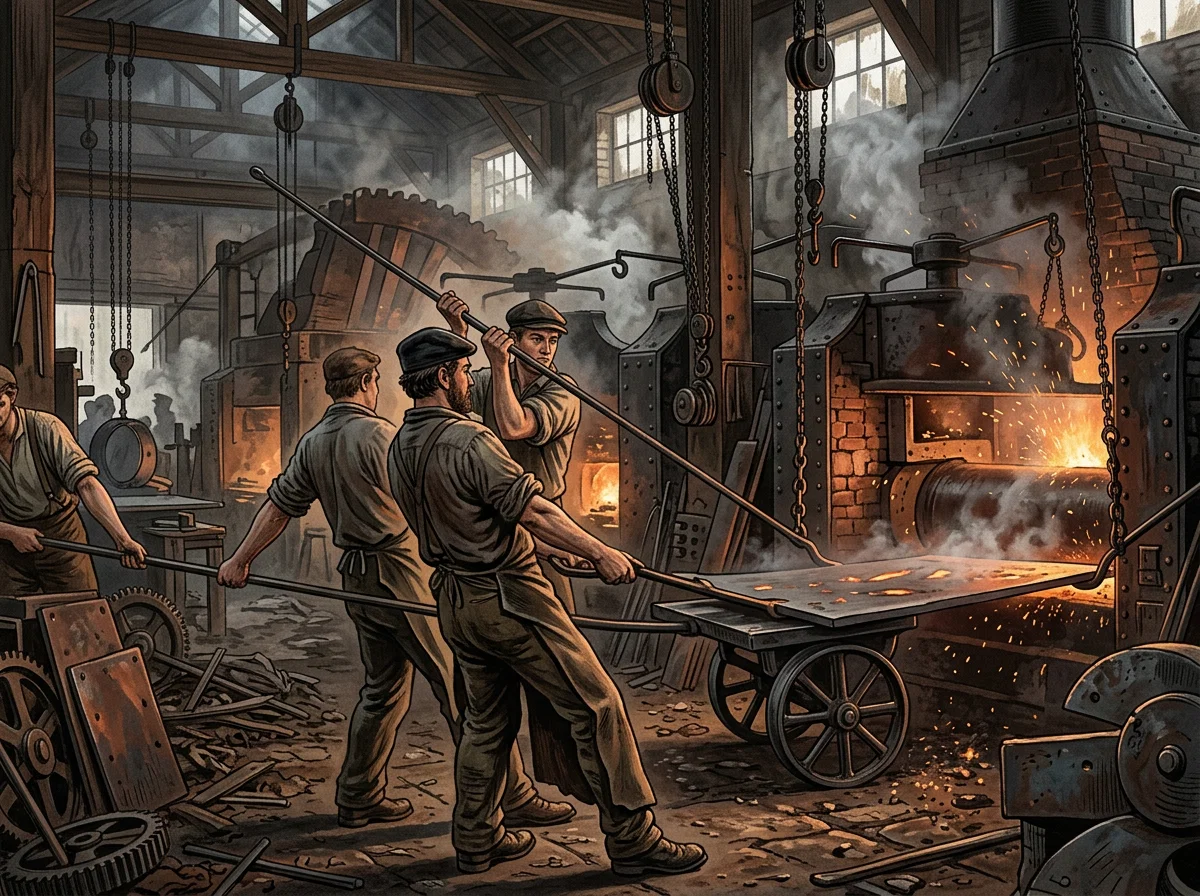
The removal of one of these huge fire balls is worth seeing. At a given signal, a boy lifts, by a lever, the heavy iron door in the front of the furnace, and the lump of red-hot iron is seized by some tongs, swung upon a small car, and carried to where a massive steam hammer beats it into an oblong piece. It is then taken and passed between monstrous rollers, first flatwise, and then edgewise, until it is in the form of a long, flat bar. This is cut up into short pieces, and made up into tight bundles. These are put into another furnace, and brought to a welding heat, and again subjected to the steam hammer and the rolling process, where they are rolled into all shapes for the market. Some come through as round, and some flat, bar-iron, and still another lot will be a bar in the form of an L; while much of it, perhaps, will be rolled into larger plates, to be used in making steam-boilers, or to be put on to the outside of ships of war as armor plates.
The accompanying picture shows how this plate-rolling process is performed. In the center of the cut, two men are seen, one holding the end of a heavy, broad plate of iron, which rests on a pair of wheels, while the other man is working a bar of iron suspended by a chain near a plate of metal. On the opposite side is seen another lever suspended in the same way, but the man supposed to be working it is not shown in the picture. The end of these levers is put under the edge of the iron plate as it comes through the rolls, to keep it from falling to the floor, and to guide it back again between the rollers, as each piece of plate must pass through the rollers many times, in order to bring it to the desired thickness.
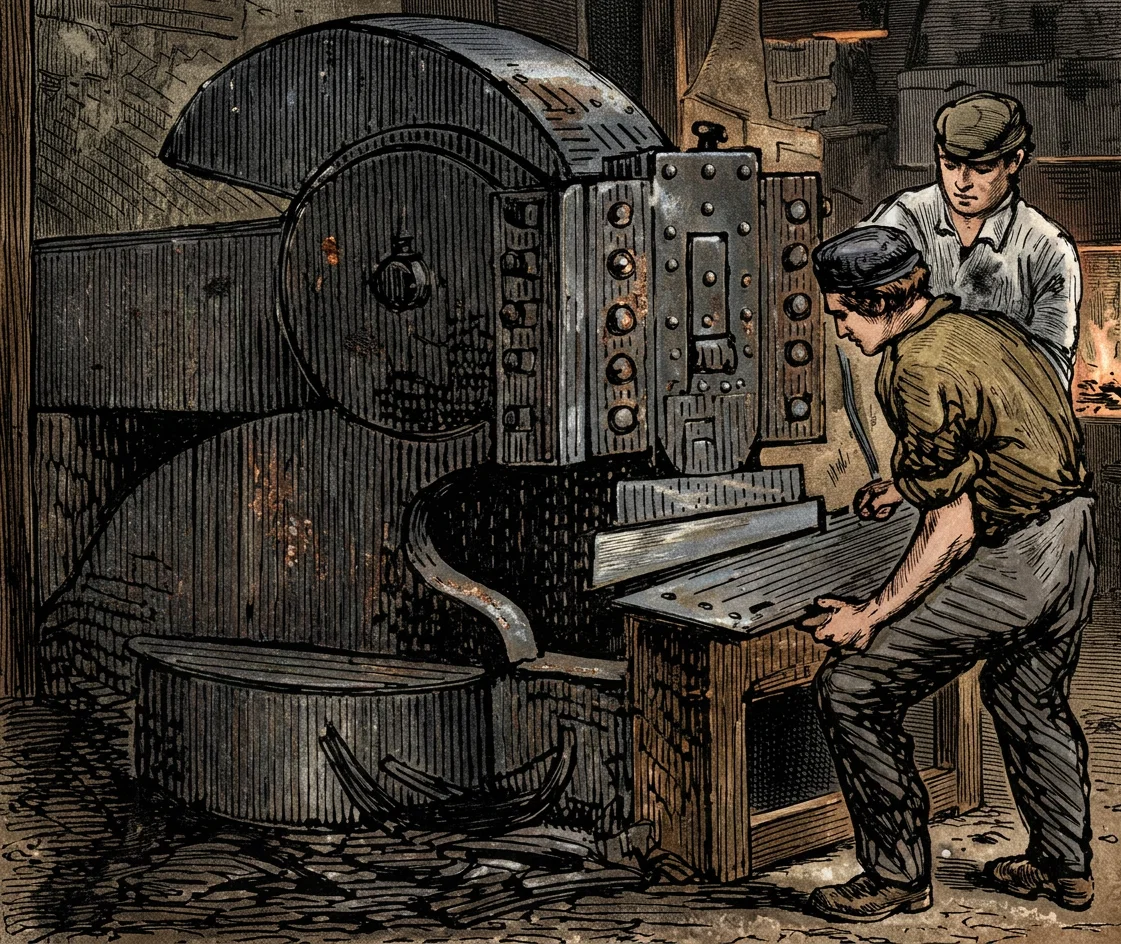
After passing all these journeys back and forth through the rollers, the solid bar of iron has become a long, ragged-edged, helpless-looking strip of reddish-white metal, which is then hurriedly seized upon, and carried over to a ponderous pair of shears, where its rough edges are clipped as easily as you would clip a piece of card-board. After being cut into smaller pieces, these are taken to another machine, where their final rolling is secured. Some of them are rolled out very thin, and coated with zinc, for roofing and other purposes. In this form they are called galvanized sheet-iron. Others are rolled into various thicknesses, and used in making steam-boilers and covering for the sides and bottoms of ships. Such plates, or strips, are taken to a piercing-machine, where, as seen in the upper left-hand corner of the engraving, their edges are pierced with holes at regular intervals, that they may be fastened together with iron bolts.
J. O. C.