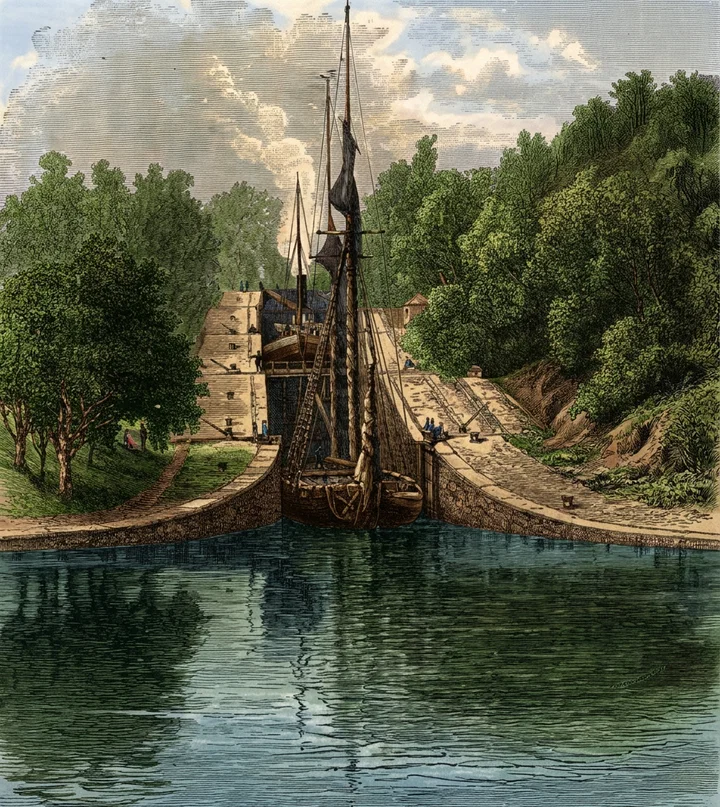
A MOST delightful trip is that from Stockholm to Guttenborg by way of the Gotha Canal. This wonderful piece of engineering was first conceived by a thoughtful bishop who lived in the reign of Gustaf Vasa, almost four centuries ago. This generous king favored the enterprise, and under Charles IX. the work was begun. Notwithstanding the persevering efforts of both king and people, aided by the highest genius, the work was so hindered by natural impediments, desolating war, and home discords, that it was not until the year 1800 that the first vessel passed through the canal. Since then, it has been enlarged and improved until large vessels may now be seen stalking through the country like apparitions. The canal is ten feet deep, generally forty-eight feet wide at the bottom and eighty-eight feet at the surface; and the locks, of which there are seventy-four in its entire course of about 260 miles, are one hundred and twenty-three feet in length and twenty-four in width. It opens up a lively commerce with the many cities and towns on its banks and on the shores of the great lakes through which it passes.
It is one of the most romantic water-courses in the world, and being thrown across the zone of the country from the Baltic on the east to the Cattagat on the west, is often called the “blue ribbon of Sweden.”
From Stockholm we skirt along the southern shore of the beautiful Lake Mälar to Södertelge, then taking a course almost due south, we come in about two hours out upon the waters of the Baltic, whose salt breezes we enjoy for nearly sixty miles.
Turning inland again, we follow the windings of the canal through a wild yet beautiful country, and press steadily westward over beautiful lakes, past cities, towns, and mountains. Crossing Vettern, with its distant spires and fertile shores, and rapidly descending from one rocky plateau to another, we sail out on the broad expanse of Lake Vener, into which four-and-twenty rivers pour their waters from the heights of the surrounding provinces. As we turn southward, one of the first features which attract our attention is Kinne-kulle hill, rising in the blue of the distance, and soon after we catch a glimpse of Leckö castle, lifting its venerable towers and battlements in the background. Many historical remembrances cluster round this old castle, and as we approach, it seems to frown upon us with patriarchal dignity.
Passing through a rocky channel between two islands, we continue our journey to Venersborg at the southern extremity of the lake. Then gliding down the Gotha River, we come to the mouth of the canal that is to take us around the Trollhetta, one of the most beautiful series of falls and rapids in the Old World.
Entering the canal, we move quietly through parks and orchards, past little red farm-houses, tasty country residences embosomed in broad lawns studded with flower-beds and shrubbery, and stately mansions, while we listen to the distant roar of the cataract.
A better appreciation of that part of the route already passed over may be gained from the following beautiful description by Fredrika Bremer, the noted Swedish author. After calling the entire journey a poem, she says:—
“Through the interior of the country, where primeval mountains open for us their gates, we are borne up on invisible arms, higher and higher, from plateau to plateau, till we reach at length the uninhabited primeval forest, the bosom of wild mountain lakes. Then we silently break our way through the heart of the solid granite rocks, and are lowered from them into enchanting lakes which we had just seen lying like mirrors far below our feet, set in frames of fertile country gemmed with towers and castles and cottages; then speed on through glorious parks, whose leafy trees familiarly caress us in passing, with their green boughs; then emerge into a wide, wild country, in which the giants of nature wrestle, without, however, disturbing or impeding our way. “Thus we are borne on into the bosom of the loveliest scenery, and out upon the broad, calm, yet animated waters of the river Gotha; and all this whilst a whole world of ancient memories and present romance accompanies us on the journey with its vala-song; its battles; its runes, sagas, and legends; its heroes’ graves and landmarks; giant caldrons and holy wells; ancient castles, ruins, and so-called convents; or the erections of the present day, in factories and forts, splendid gentlemen’s seats, and small cottages beneath the shade of fir-trees—all in perpetual and ever-varying change.”
We have hardly stepped ashore at the town of Trollhetta, when a troop of little urchins surround and bewilder us, crying all in one breath, “Will Mister see the falls? I know the way everywhere; I can tell you about everything.” We scatter a few öre among the boys, and while they are scrambling to pick them up, we take a little foot-path leading to the falls.
Crossing a frail bridge, we find ourselves on the little isle of Gullö. What a feeling of awe and solemnity takes possession of us as we look up to the wood-covered mountains around us, and then down into the boiling, seething abyss below, where the powerful volumes of water seem struggling together, as they hiss and foam, and at last are dashed into spray and mist on the rocky bed below.
After spending a few moments contemplating this grand scene, we follow the stream for over half a mile, to view with wonder and admiration the Toppö and Helvete falls, and then return to our steamer, which we find ready to continue the journey. Below the falls we find the river as still as if never a ripple had stirred its quiet bosom, when in reality its waters have hardly ceased to hiss and boil for nearly a mile.
And thus we pass along between flowery banks and green meadows until we come in sight of the long, low line of hills that mark the sea-coast.
C. A. VIKMAN.