ROUND THE WORLD.—9

10%

S. D. A. Publishing Association · Battle Creek, Mich. · Feb 26, 1890

FromThe Youth’s Instructor, Vol. 38, No. 9.

Read the full edition

ROUND THE WORLD.—9.

WHEN the Huguenot refugees first came to the Cape of Good Hope, the land was infested with wild animals of almost every description. And even now there are parts of the Orange Free State and the Transvaal where lions and tigers are found in large numbers. One of our party had the privilege of hearing an old lion-hunter relate some of his experiences. He stated that in one sense lions were perhaps not as dangerous as tigers; for when you meet a lion, it does not always mean that you must fight for your life, but with a tiger, a meeting means death either to him or to the hunter. If, upon meeting a lion that has not tasted human flesh, the hunter keeps perfectly quiet, not moving a muscle or raising his gun, the lion will frequently retire a few steps, and then make a bound, as if he were going to spring on his foe. But if the hunter looks him straight in the eye all the time, and keeps perfectly still, he will fall a few yards short in his leap. Then he will retire as before, only this time going back a little farther, and making another spring. This he will repeat several times, each time drawing farther away, till he has placed a goodly distance between him and his enemy, whereupon he will turn and run off. But if he means fight, there is only one chance of safety, that is to shoot him down the first shot. If wounded, he will close in deadly combat, and will fight as long as he can hold out, and that is generally long enough to dispose of his antagonist. His skull is so thick that only by chance will a bullet pierce it. There are two places, and only two, where, if he is hit, death will immediately follow; one is right in the eye, and the other behind the ear. The hunter generally goes alone, and relies on his sure shooting to save himself.
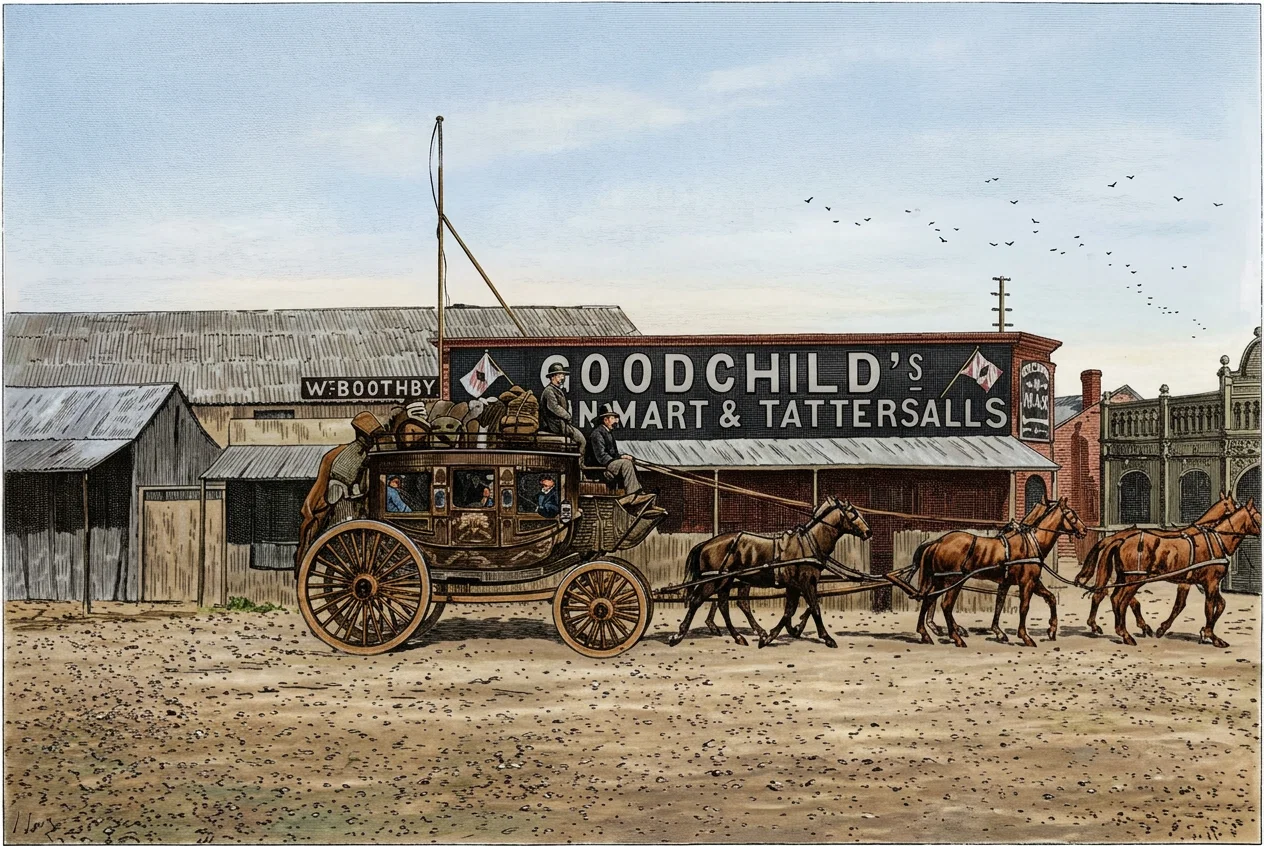
OFF FOR THE GOLD MINES.Restored with AI
OFF FOR THE GOLD MINES.
In many cases the lion seems to take pity on mankind. We were told of one case where the family had all left the house, with the exception of a little child, who was playing on the floor with some coals of fire. All at once a lion entered, and began coolly to survey the premises. He approached the child, looked him all over, but did not harm him, and the little one, for no known reason, took up one of the dying embers and placed it on the lion’s head. The beast soon turned and went out, and the wind fanned the coal into a flame, so that his shaggy mane was soon on fire. Fire will terrify the lion, as it does all other animals, and he rushed off to the woods, leaving the child to continue its play.
African tigers regard man as their mortal enemy, and when they see him, they always spring, with the intention of striking him to the earth, and then dispatching him. When a lion springs on a man, it means death; he never misses. But the tiger is not so sure, and very often goes wide of the mark. Tigers frequently carry off sheep, and kill the cattle of farmers. They are very quick in their movements, and are exceedingly cunning and sly. They do not seem to possess the noble disposition of the lion, but will make an attack whether they are hungry or not. Many other wild animals formerly inhabited the colony, but with these two the early settlers had the greatest struggles.
There is a bird, a native of South Africa, called the secretary, which is noted for its method of disposing of snakes. When one is sighted, the secretary rises in the air, then comes down with a swoop on its prey, catches him in his bill, and begins to ascend. When the snake becomes too heavy for his captor, he drops him, makes another swoop, and seizes him again, working in this way till he has killed the snake.
Another curious bird is the honey guide. There are several species, and they belong to the cuckoo family. These birds are remarkable for the trust which they repose in mankind, and the manner in which they act as guides to the bee’s nest. When a Kaffer hears this bird utter a peculiar cry, sounding like “cherr, cherr,” he looks out for the singer, and goes in the direction of the voice. The bird, seeing that the man is following, approaches the bee’s nest, uttering its encouraging cry, and not ceasing till the nest is found. The Kaffer places great reliance on the bird, and never eats all the honey, but makes a point of leaving some for the bird who has directed him to that feast of which he is so fond.
The honey bird voluntarily seeks the aid of man, because otherwise it would be unable to get at the bee combs, which are made in hollow trees, and are thus protected in secure fortresses, which the bird could not penetrate without the assistance of some being stronger than itself. The bird would rather have the comb than the honey, a disposition which the Kaffer is very willing to make.
The honey bird does not always lead to honey. It sometimes leads the unsuspecting Kaffer to a lion or a tiger, but he can generally tell to what it is leading him. If it is to a nest, the bird will fly at a considerable height from the ground, but if to an animal, it keeps much nearer to the earth. There is also a large weasel, called the “honey ratel,” which acts in a similar way.
We took a sketch of an up-country coach, the only means of conveyance through the land whose animals we have been describing. F. T. M.