FLORA'S PARTY

3%

S. D. A. Publishing Association · Battle Creek, Mich. · Feb 26, 1890

FromThe Youth’s Instructor, Vol. 38, No. 9.

Read the full edition

FLORA'S PARTY.

“MAMMA,” exclaimed Flora Reynolds, “do come quick! If Aunt Margaret isn't the loveliest woman that ever was! Just see what she has sent me for my birthday,—a whole basketful of apples, oranges, pop-corn balls, and a few bunches of California grapes.”
Flora held up a beautiful basket of fruit for her mother to admire.
“How kind she is to remember you. I expect she knew that you would have few presents this year, and Aunt Margaret always tries to do her kind deeds to those who really need them. Truly, when she makes a feast, she calls in the poor.”
Flora looked at her mamma as though she was puzzled to know what she meant, and then said, “Now, mamma, I know what I will do. I don’t want to eat all this fruit alone. Can’t I have a party, and invite—let’s see—Nellie and Josie Ray, and Alice Brownwell? They are all such nice girls. I’ll take my little play table and dishes, and cut the fruit up, and we’ll have a splendid time. You know they always invite me to their parties.”
Restored with AI
Mrs. Reynolds sat still, turning the fruit around slowly, and looking very sober.
“Please, mamma, why don’t you say ‘Yes’?” asked Flora, a little impatiently.
“Flora, I was thinking of your having your party somewhere else, and with somebody else, who very likely cannot invite you to a party.”
“What do you mean, mamma?”
“Do you remember last week when we passed by our washerwoman’s house, how we saw a little pale face pressed up against the window? Do you remember what you said then,—how you wished you could do something to cheer up the little cripple? Seems to me I see a beautiful chance for you now.”
Mrs. Reynolds saw a shade of disappointment creep into Flora’s face.
“Do you mean that I ought to give her my fruit, and not have a party?” she asked.
“Yes; don’t you think it would really be a better way to dispose of these beautiful things to give them to a little girl who seldom sees such things, who has none of the pleasures you and these other girls have? They have plenty of nice fruit, and are not sick either. Why not go to Jessie Axtell’s, and have your party with her? I know it would do her good. But do just as you please. I don’t want to make you do it, if it does not please you; for it would only be a forced kindness, and that is very empty.”
Mrs. Reynolds went out to the kitchen, and Flora sat down by the window with her face on her hand. She looked gloomy and disappointed, and put her basket of fruit behind her.
“I wish Aunt Margaret hadn’t sent it,” she murmured. “I don’t want to give it to a girl I don’t know. Mamma might have thought of something else for her; for on birthdays people always ought to do as they please.”
“I gave my life for thee, My precious blood I shed, That thou might’st ransomed be, And rescued from the dead; I gave, I gave my life for thee, What hast thou given for me?”
Flora heard her mother singing the words at her work, and she felt still more uncomfortable.
“Well,” she said, “I guess I’d better give up my fruit. But if this isn’t giving up something for Him, I don’t think there are many folks that give up anything.”
Flora’s face was not very bright when she told her mother she was going to take her fruit to the little cripple.
“Of course I couldn’t have a good time now, anyhow, even if I kept it and had my party, because I should just be thinking about that pale face at the window all the time; but I don’t expect to have a good time anyway.” The tears filled her eyes, and Mrs. Reynolds’ face grew as sad as her daughter’s.
“My dear child,” she said, “you are not to give grudgingly nor of necessity. The Lord loveth a cheerful giver; that is what the good Book says. And it says, too, that when we make a feast, we are to call in those who cannot recompense us again. When Jesus has his great feast in heaven, he will not invite just the rich; but he will invite those who have had his sweet spirit, and who have followed him here on earth. Now, Flora, if Jesus had had this basket of fruit given to him, don’t you think he would have thought of little Jessie the first thing? And how do you know but what he put it into Aunt Margaret’s head to send it to you, so that you could carry his love and his gift to Jessie for him?”
“O mamma, do you think he did?”
“Yes, I do believe it. He says we are his stewards, that is, we are the ones who have charge of his goods, and he wants us to do the very best we can with them for him.”
Flora’s face began to grow brighter. “Well, then, mamma, I am not going to disappoint him to-day.”
Mrs. Reynolds smiled as she saw her little girl hurrying down the walk with a bright smile on her face. It did not take Flora long to reach the house where Mrs. Axtell lived. She was out of breath after she had climbed the stairs, and when Mrs. Axtell let her in, she had to sit down on a chair without saying what she had come for. After a little she told her that she had come to have a birthday party with Jessie.
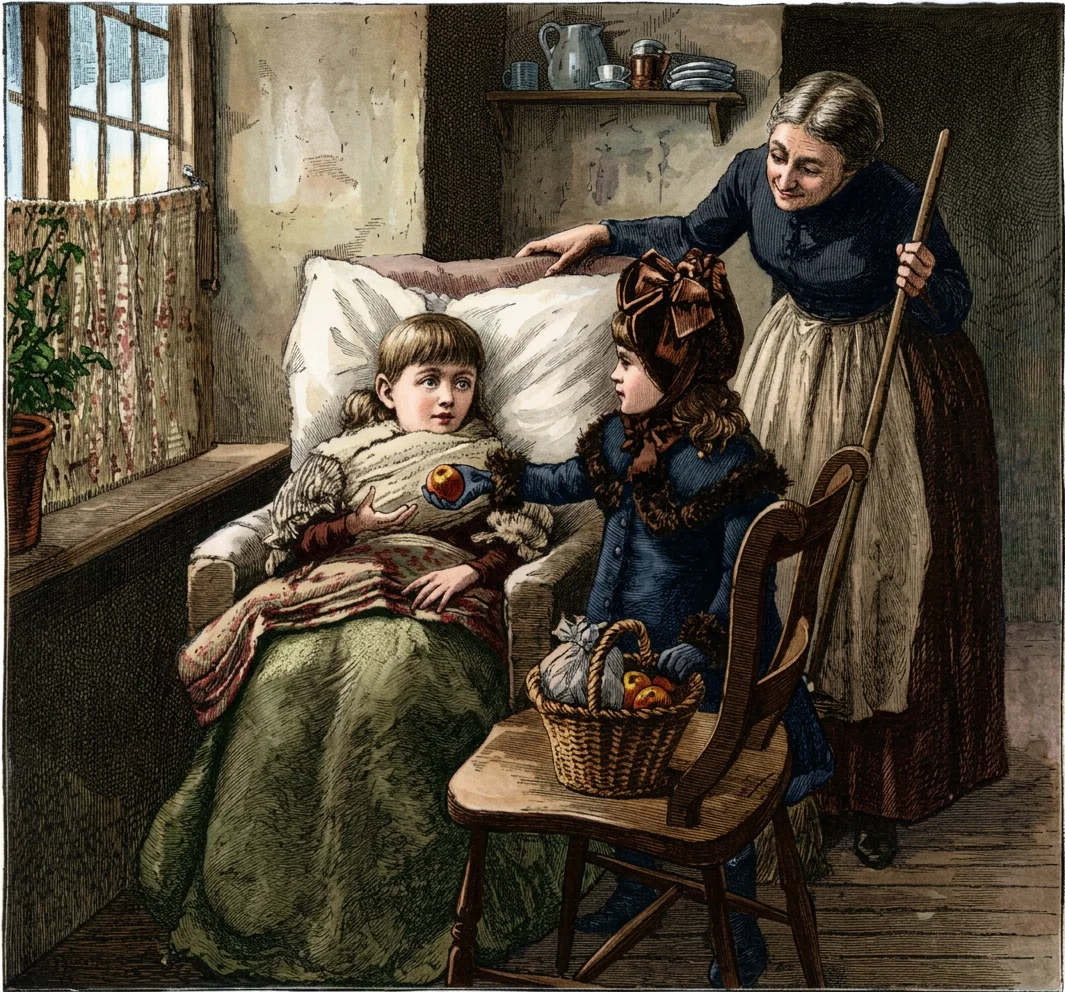
Mrs. Axtell took her into the next room, where Jessie was sitting in a large chair by the window, looking so pale and sad.
“This is Flora Reynolds,” said Mrs. Axtell, “and she says she has come to have a birthday party with you.”
How the pale face did brighten as Flora uncovered her basket and put an orange into Jessie’s hand. Flora told her all about Aunt Margaret and about what her mother had said,—that maybe Jesus had given the fruit to her to carry to Jessie,—and what a splendid time they did have together!
Mrs. Axtell made them some cookies, and gave them some dishes, and Flora and Jessie cut up the apples and oranges and divided the grapes and pop-corn. They couldn’t eat all the fruit, but when Flora came away, she left it with Jessie. When she bade her good-by, Jessie put her arms around her neck and kissed her, and told her how much good she had done her.
“Of course I liked the apples and oranges, because I do believe, just as you say, that Jesus sent them to me; but I think he sent you with your love, and that has done me so much good right here,” she said, laying her hand on her heart.
Mrs. Axtell, too, thanked Flora for coming, and told her how lonely her little girl was sometimes. Flora told her she would come often after that; and when she bounded into her home that afternoon, her mother knew, before she had said a word, that she had had a good time.
“O mamma, she is just the dearest, sweetest child you ever saw, and I never had such a happy time in my life. I hope Jesus will send me lots of good things to carry to poor little Jessie. I think it’s splendid to be his steward, and I’m truly sorry I was so mean and selfish. Now I’m going to look over all my playthings, and find the nicest things I can to give away. And, mamma, I’m going to be a cheerful giver, too; for I love the Lord, and I want him to love me.”
FANNIE BOLTON.