THE AMERICAN INDIAN

10%

S. D. A. Publishing Association · Battle Creek, Mich. · Sep 11, 1889

FromThe Youth’s Instructor, Vol. 37, No. 37.

Read the full edition

THE AMERICAN INDIAN.

PART IV.—BURIAL OF THE DEAD, AND CAMP SCENES.
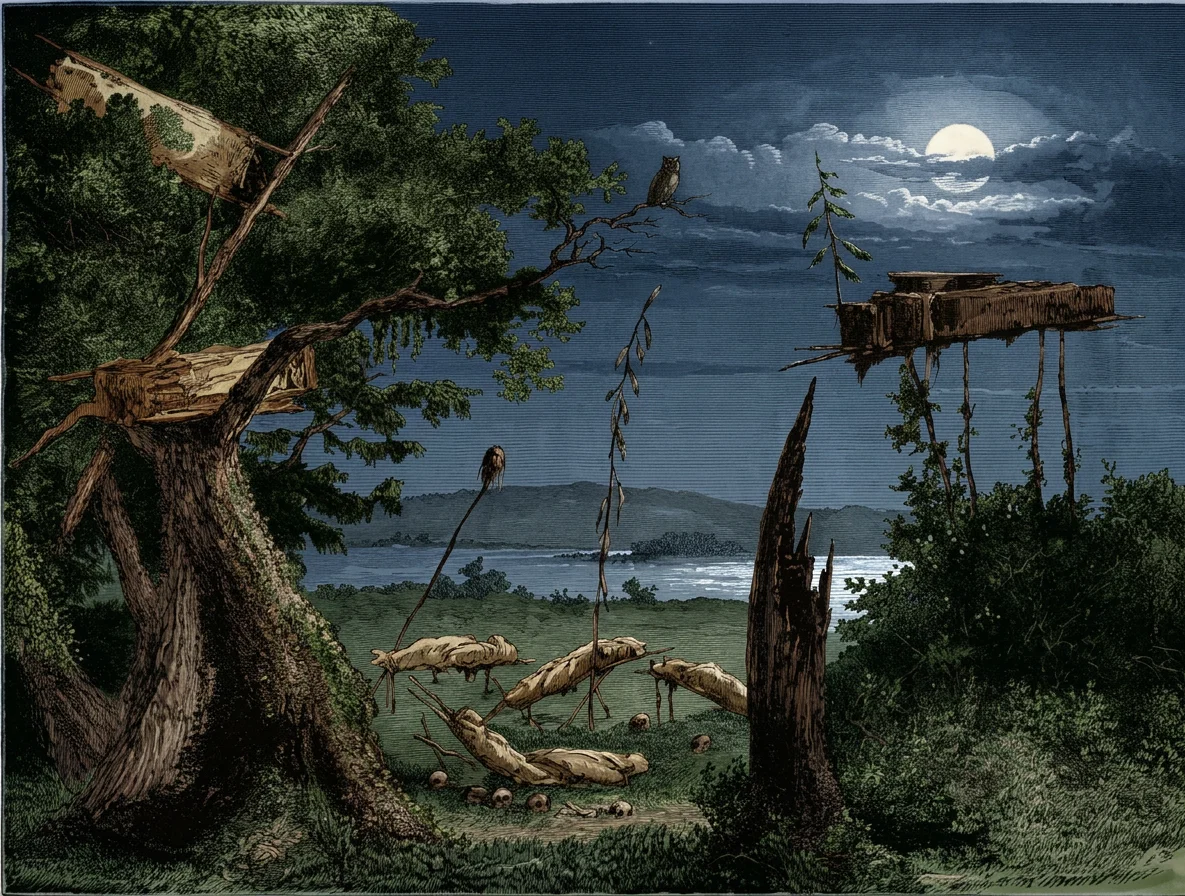
INDIANS vary greatly in their treatment of the dead, and it makes much difference whether a death occurs in winter, when the Indians are in permanent camp, or when on the march. A death in camp is an event of great importance, and is really hailed with joy, since it breaks the monotony of camp life. The warrior is then buried with all the pomp peculiar to the tribe. If the same person should die on the march, instead of in camp, the body would be tumbled without ceremony into the first convenient crevice in the rocks.
Formerly, the Indians of the plains deposited their dead in the tops of trees, making rude caskets of poles, and covering them securely with buffalo hides; but now most all Indians bury their dead. Among the Utes, great secrecy is observed, and no one knows what becomes of the body except those who have charge of it; while after the funeral everything left by the dead chief, and not specially willed to individuals, is utterly destroyed.
Restored with AI
The “teepe” is the habitation of the Indian when at home. It is tent-shaped, like a cone at the bottom, making a circle from twelve to eighteen feet in diameter, and is about twelve feet high. It is supported by peeled poles. A squaw ties three together near the top, and thrusting them inside the buffalo skins or cotton cloth of which the teepe is made, raises it up, and spreads the lower ends out. Other poles are then carried in and thrust through the opening at the top, the lower ends extended in a circle, stretching the covering tightly. Two active squaws will pitch, or take down and pack up, a teepe inside of five minutes. A teepe is rarely overturned by the wind or storms, and can be kept comfortably warm even in very cold weather. An Indian is very susceptible to cold; hence he contrives this for a winter home.
In camp, the oldest squaw, or the one least in favor, does the cooking. Meat is put to boil in a kettle over the fire, and when done, or whenever the chief or some other member of the family feels hungry, the kettle is placed in the middle of the lodge, and each one helps himself. On the war-path, where squaws do not accompany the party, each warrior cooks for himself, broiling the meat on the coals, or roasting it on a stick before the fire.
The buffalo was formerly the sole dependence of the Indian. Sixty years ago the buffalo roamed from Texas to the British Possessions, and from the Missouri and Upper Mississippi rivers to the eastern slope of the Rocky Mountains, in countless herds, going north in the spring and south in the fall. Now scarcely a buffalo can be met with, so ruthless and criminal has been their slaughter. With the disappearance of the buffalo went the freedom of the Indian, the animal being his daily food, and furnishing him with clothing, a home, fuel, and most of the articles needed by him. Losing the buffalo, the Indian of the plains lost his chief means of subsistence, and was compelled to submit to the white man’s terms.
In the spring, the buffaloes were thin, and wandered north in large droves, dividing, as they advanced, into smaller and smaller herds. In October, when the animals were fat, and in prime condition, the hunting began. Runners scoured the country to learn the location of the buffalo, and then selected a convenient camp near them. When everything was in readiness to secure and preserve the carcasses, a herd was selected that from its position would not alarm others in being slaughtered; and being surrounded, the animals, with a yell and a rush, were suddenly dispatched. Then the squaws skinned and dressed the animals, drying the flesh. In this way, herd after herd was surrounded, until the winter’s supply of meat was obtained. In places not favorable to surrounding the herds, the Indians, mounted on ponies, dashed in upon them, killing what they could. The Sioux used to kill immense numbers by stampeding them over a precipice, the buffalo being a very stupid animal, and easily frightened and stampeded.
W. S. C.