TROPICAL VEGETATION

6%

S. D. A. Publishing Association · Battle Creek, Mich. · Oct 9, 1889

FromThe Youth’s Instructor, Vol. 37, No. 41.

Read the full edition

TROPICAL VEGETATION.

It is but a small portion of the land surface of the earth that is wholly destitute of vegetation. Except in extreme altitudes, or in those places where there is insufficient moisture to sustain plant life, vegetation appears in some form. Dr. Kane, the celebrated Arctic explorer, made the statement that “as far as man has reached to the north, vegetation, when fostered by a sheltered situation and the refraction of solar heat from the rocks, has everywhere been found to rise to a considerable altitude above the level of the sea; and should there be land at the North Pole, there is every reason to believe there would be animal and plant life.”
Vegetation, scanty and feeble in the cold regions of the north, is of short duration. It gradually improves as the temperate zones are approached, where the rays of the sun, falling more directly upon the surface of the earth, produce a great number and variety of plants.
But it is the perpendicular rays of an equatorial sun falling upon the moist grounds of the tropics, that clothes Nature in her richest dress. Humboldt says that “tropical trees are endowed with richer juices, ornamented with a fresher green, and decked with larger and more lustrous leaves than those of the more northerly regions. Trees nearly twice as large as our oaks, there glow with blossoms large and magnificent as our lilies.”
Restored with AI
He mentions a flower that grows upon the Magdalena River, in South America, that measures four feet in circumference, which the children sometimes wear as a helmet in their play; and another flower, in the Indian Archipelago, that measures four feet in diameter, and weighs fourteen pounds.
It is estimated that of the 200,000 known plants, the greater part of the species belong to the torrid zone. And no one can guess how many times this might be multiplied could the vast, unexplored tropical fields be searched. It is within the tropics that the wonderful baobab tree is found; also the beautiful and stately banyan tree, each one of which forms a grove by itself. The Bo-tree, too, is here, and is probably the oldest tree in the world. It is said to have been planted two hundred and eighty-eight years before Christ.
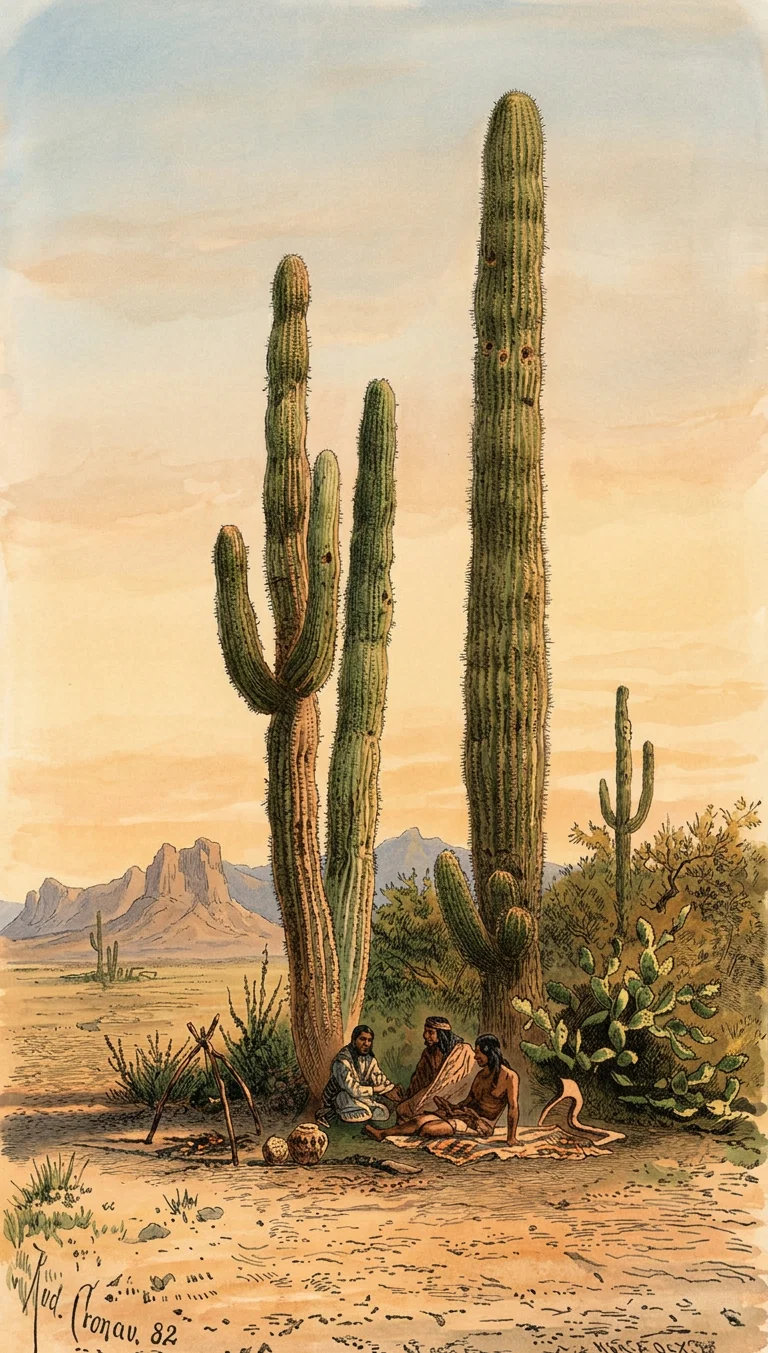
I might mention many other interesting specimens of tropical vegetation; but there is one family of plants that differs from most others, in this particular,—that it grows only in hot, stony, or rocky places. Our picture represents some species of this plant. Linnaeus gave it the name of cactus, from the fact that the ancient Greeks gave this name to some prickly plant. But modern botanists have redivided and renamed the family, so to speak, according to differences in the flower tube,—those with long-tube flowers forming one division, and those with short-tube flowers the other. These are again divided and subdivided according to certain characteristics peculiar to each species, thus forming a great variety of species.
The cacti are plants having the central part woody, around which are overlaid thick masses of cellular tissue; that is, made up of very small cells that connect with each other. The outside skin is tough and leathery, which enables the plant to retain its juice and to thrive on the rocks and barren places of tropical countries.
The cacti grow in various forms, and of different sizes, and are generally covered with bunches of hair and thorns instead of leaves. The tufts of hair show where the flowering buds originate, although but few of these develop.
This family belongs almost entirely to the New World, and thriving, as it does, where scarcely anything else will grow, it seems as if it were a provision of nature for the support of men and animals who inhabit this region of country; for the fruit, as a general thing, is not only good for food, but is agreeable to the taste. Some of the Opuntia cactuses have become very generally distributed over some portions of Europe, particularly upon the shores of the Mediterranean and among the volcanoes of Italy.
In the accompanying engraving may be seen interesting members of the cacti family. One species is the Torch cactus, which sometimes grows to the hight of fifty or sixty feet, having a diameter of from one to two feet. It is generally branchless; but sometimes stems shoot out at the sides at right angles with the plant, from whence they curve and grow upward, parallel with the main stem. It is said they have the appearance of telegraph poles. The stems of the Torch cactus have from ten to twenty ribs, as may be seen in the picture. The natives preserve the fruit, which, when ripe, makes an excellent article of food. To gather it, they make use of a forked stick fastened to a long pole. This family of cactuses, Cereus, is common in hot-houses, where, of course, the plants do not attain to such hight as in their original soil.
Opuntia, the Indian Fig-tree, or Prickly Pear cactus, may also be seen in the engraving. It comprises some 150 species, which differ very much from any other of the groups. These are thick, fleshy shrubs. The farmer makes use of them largely in fencing his gardens. It is upon one species of this shrub that the cochineal insect is raised. Plantations are established for the purpose, and they often contain as many as 500,000 plants. Mexico is the native country of this insect, but our greatest supply is brought from New Grenada, S. A., and the Canary Islands. Some of the opuntias are esteemed very highly for their fruit.
The Hedgehog cactus is also a native of Mexico and South America. It comprises some 200 species, one of which produces plants that sometimes weigh a ton, and measure nine feet in height and three feet in diameter. Upward of 50,000 buds and spines sometimes appear among the ridges of one plant. These spines are used by the Mexicans as tooth-picks.
One nearly related to the Torch cactus is the Old Man cactus. It forms a small group of tallish stems, on which, with the tufts of spines, grow hair-like bodies. These hairs, though coarse, somewhat resemble an old man's beard.
The cacti prefer the driest situation, fully exposed to the burning rays of a tropical sun. Here they thrive, and the several groups form a very interesting subject to investigate. M. J. C.