“Is it true, auntie, that girls sometimes have the care of sheep? There is a hint of this in what I have just been reading,” said Jennie Myers, as she laid down the book she was perusing.
“Why, Jennie,” said her aunt, Mrs. Brainard, “have you forgotten that away back in Bible times Rachel kept her father’s sheep, and that other daughters in those days did the same work? In some Eastern countries it is still a common practice to place the care of the flocks in the hands of girls; and they usually make careful, tender shepherds.
“Besides the care of the flock, the modern shepherdess improves every opportunity when the sheep are quiet, to knit and sew for the family at home, or to add a few pence to the scanty home-purse.”
“I don’t see how they can do that,” said Jennie, “if the duties of a shepherd require such constant watchfulness as is represented in the Scriptures. I would like you to tell me some particulars of Oriental shepherd life; for I know very little of the Scriptures save what I have learned during the few months I have been staying with you.”
Said Mrs. Brainard, “How closely the flocks need watching, depends upon the extent of territory allowed them for pasturage, and upon certain other circumstances that I shall notice as I try to portray in a little word-picture some of the characteristics of shepherd life.”
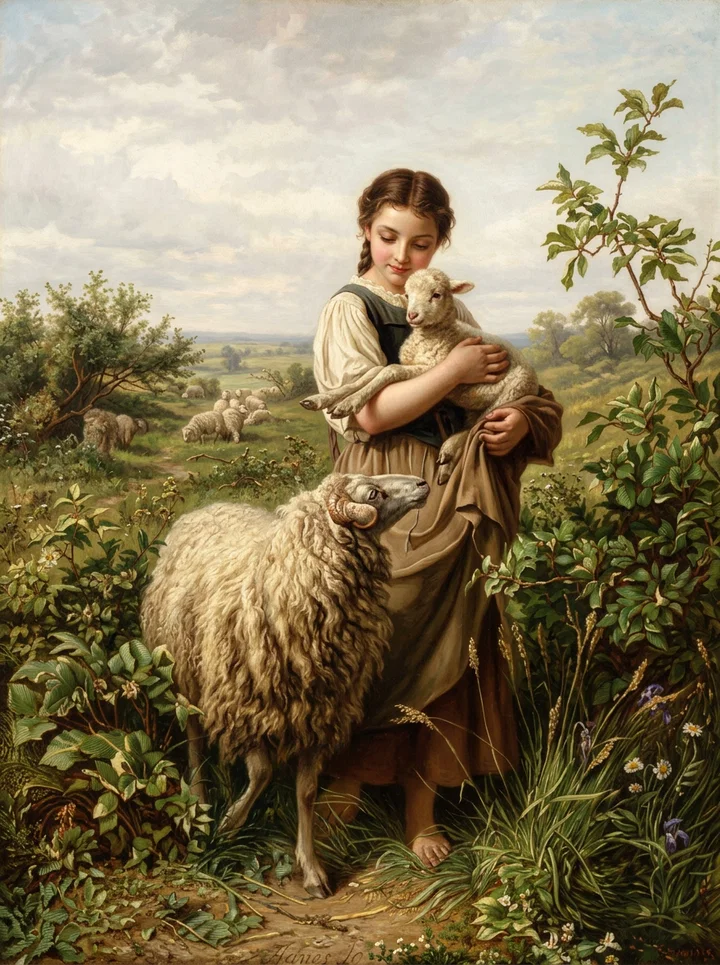
“In Bible times the wealth of the people consisted largely in flocks of sheep and goats, which were allowed to roam over the deserts and uncultivated parts of Palestine. For these flocks shepherds were employed, because the animals were continually exposed to dangers of some sort. In the forests were wild beasts, to which they were a prey, as well as to the robbers which infested the country. Further than this, they were liable to suffer from thirst or want of feed, if, perchance, they should wander far into the desert. In the mountainous districts they were in danger of falling from some high cliff or rocky ledge. There is probably no other animal so dependent upon the care of man for its well-being as is the sheep.
“The shepherd girls of to-day do not have the evils to contend with that those did anciently. They are given smaller pasture lands, over which wild beasts do not roam, and their surroundings are made favorable.”
“The faithful Oriental shepherd remained with his fold through the night, either in buildings prepared to protect them from the cold; or, during the warm season in some sort of inclosure made of thorns, etc. Then as now he made use of a long rod, with a crook at the end, which he placed around the shoulders of the sheep and guided them as he pleased. In the morning he led them forth from the fold by going before them and calling them by name.
“Oriental shepherds have names for the principal ones of their flocks, the same as men do for their horses and dogs. These the sheep learned, and when called by their own shepherd, would at once approach him. But they would flee from the voice of the stranger.
“Porter describes as follows a scene he witnessedp. 102 among the hills of Bashan, to show the readiness with which the sheep of a large flock will recognize the shepherd’s voice:— ‘The shepherds led their flocks forth from the gates of the city. They were in full view, and we watched them and listened to them with no little interest. Thousands of sheep and goats were there, grouped in dense, confused masses. The shepherds stood together until all came out. Then they separated, each shepherd taking a different path, and uttering, as he advanced, a shrill, peculiar call. The sheep heard them. At first the masses swayed and moved as if shaken by some internal convulsion; then points struck out in the direction taken by the shepherds; these became longer and longer, until the confused masses were resolved into long, living streams, flowing after their leaders.’”
“Have you noticed, Jennie, that the Scriptures contain many beautiful figures, in which reference is made to some scene in shepherd-life? For instance, those in possession of large flocks of sheep employed various grades of shepherds, the highest being styled rulers, or chief shepherds. So in the church of Christ,—those who are given the charge of the church upon earth are entitled under shepherds, while Christ himself is the Chief Shepherd.
“The Saviour is the good Shepherd, who ‘calleth his own sheep by name, and leadeth them out. And when he putteth forth his own sheep, he goeth before them, and the sheep follow him; for they know his voice. And a stranger will they not follow, but will flee from him,’ etc.
“Sheep are inclined to wander from the fold, giving their shepherds great anxiety until they are secured. The faithful shepherd will sometimes lose his own life in his attempts to rescue the wanderers. So the good Shepherd seeketh to recover his sheep who wander into the by-paths of sin. For his sheep he sacrificed his life. ‘And when he shall appear,’ his own sheep will ‘appear with him in glory.’ May you, dear Jennie, help to number the one fold, under the one Shepherd.” M. J. C.