A STUDY of the habits and customs of any race of people is interesting, not only because it gratifies our love of the curious, but because it reveals the workings of those motives and passions that proclaim the common brotherhood of man. When the United States government paid to the Russian government in 1867, $7,200,000 for a portion of territory bordering on Behring’s Strait, with nine times as many square miles as are embraced in the New England States, it came into possession of a country of which little was then known, but which has since proved rich in fisheries and fur-bearing animals, and which in coast scenery is not surpassed by the grandeur of the Old World.
The interior of Alaska has never been thoroughly explored. Since it is away from the modifying influence of the Pacific gulf stream, and near to the Arctic Ocean, its vast fields remain frozen for the greater part of the year, and hold out no inducements to the mere adventurer. But along the coast, the warm waters of the gulf stream and the long days of summer have so far softened the atmosphere that in the vicinity of Sitka the temperature at midwinter falls but little below that at Washington, D. C. The summers are cool and temperate. Rain is abundant in this region, and while it causes all vegetable life to grow in rank profusion, it also keeps the atmosphere so moist that hay cannot be cured, and grain will not ripen. It is therefore mainly on its fisheries that Alaska depends for its wealth.
But any description of the geography of the country must be reserved for another time, while at present we take a peep at the houses of the original inhabitants. With the advent of the white man, the Indian has begun to take on some of the ways of civilization, and thus is gradually losing the distinctive features of his race.
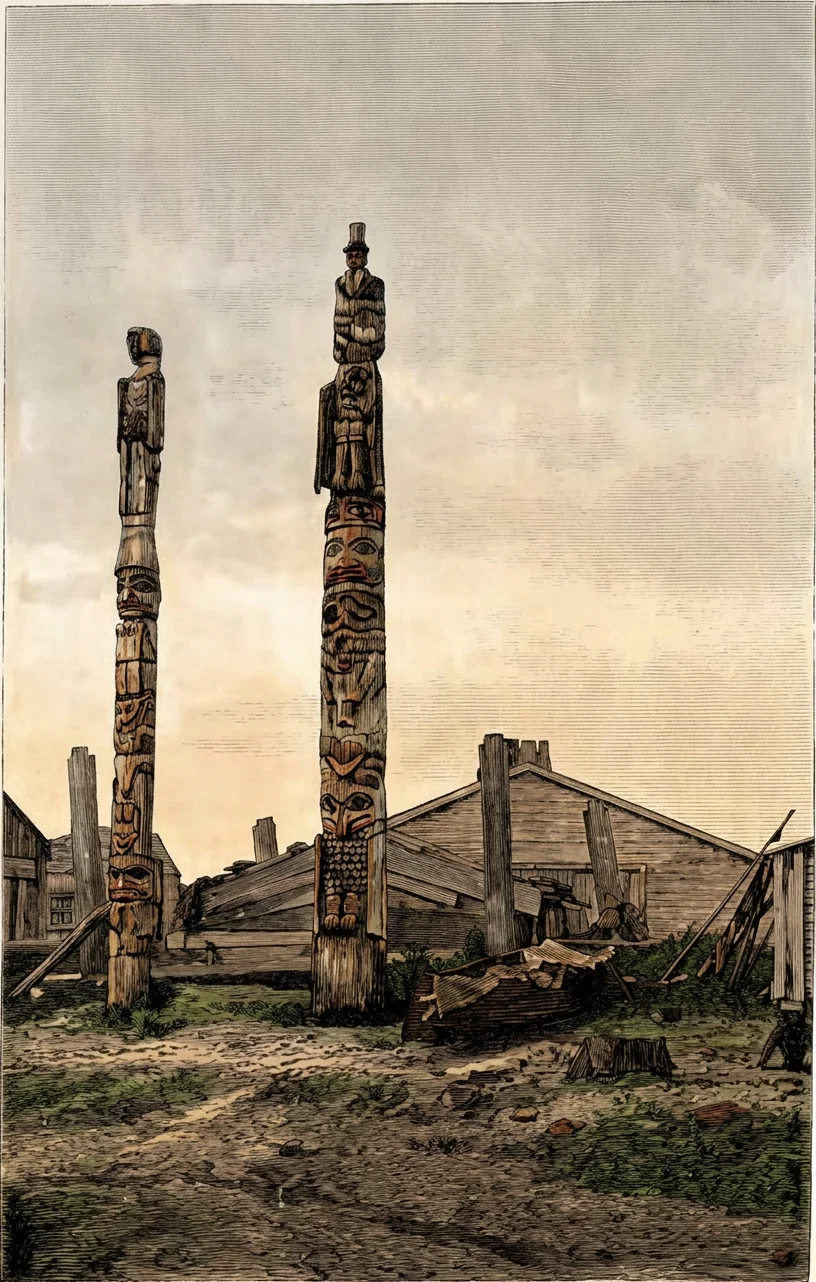
In a recently published book, “Journeys in Alaska,” the writer gives an interesting description of the houses of the Thlinket Indians about Fort Wrangell, and this, together with the accompanying picture of an Indian hut with its totem poles, may give you some idea of life in this part of the world. She says:—
Restored with AI
“The houses of the Indian village string along the beach in a disconnected way, all of them low and square, built of rough-hewn cedar and pine planks, and roofed over with large planks resting on heavy log beams. One door gives entrance to an interior, often twenty and forty feet square, and several families live in one of these houses, sharing the same fireplace in the center, and keeping peacefully to their own sides and corners of the common habitation. Heraldic devices in outline sometimes ornament the gable front of the house, but no paint is wasted on the interior, where smoke darkens everything, the drying salmon drip grease from the frames overhead, and dogs and children tumble carelessly around the fire and over the pots and saucepans. The entrances sometimes have civilized doors on hinges, but the aborigine fashion is a portière of sealskin or walrus hide, or of woven grass mats.
“Before many of the houses are tall cedar posts and poles, carved with the faces of men and beasts, representing events in their genealogy and mythology.” “The truth about these totems will never be quite known until the innate humor of these Indians is civilized out of them;” for “there is nothing the Siwash himself enjoys so much as misleading and fooling the curious white man in these matters.” “These totems are for the most part picture writings that tell a plain story to every Siwash, and record the great events in the history of the man who erects them. They are erected only by the wealthy and powerful members of the tribe, and the cost of carving a cedar log fifty feet long, and the attendant feasts and ceremonies of the raising, bring their value, according to Indian estimates, up to one thousand and two thousand dollars.
“The subdivisions of each tribe into distinct families that take for their crest the crow, the bear, the eagle, the whale, the wolf, and the fox, give to each of these sculptured devices its great meaning. The totems show by their successive carvings the descent and alliances of the great families and the great facts and incidents of their history. . . . Descent is counted on the female side, and the first emblem at the top of the totem is that of the builder, and next that of the great family from which he is descended through his mother. In some cases two totem poles are erected before a house, one to show the descent on the female side, and one to give the generations on the male side.”
“In their mythology, the crow or raven stands supreme as the creator and the first of all created things. He made everything, and all life comes from him. . . . The Indians have a tradition of the deluge, in which the chosen pair were given the shape of crows until the water had subsided, when they again returned to the earth, and peopled it with their descendants. No alliances are ever made within the great families, and a crow never marries a crow, but rather a member of the whale, bear, or wolf families. The man takes the totem of his wife’s family, and fights with them when the great family feuds arise in the tribe.”
“These Thlinket Indians of the coast have broad, heavy faces, small eyes, and anything but quickness or intelligence in their expression. They are slow and deliberate in speech, . . . and any theories as to fish diet’s promoting the activity of the brain are dispersed after watching these salmon-fed natives for a few weeks. Many of their customs are such a burlesque on our civilized ways as to show that the same principles and motives underlie all human action. When a totem pole is raised, the event is celebrated by the whole tribe. A common Indian can raise himself to distinction and nobility by giving many feasts and setting up a pole to commemorate them. After he owns a totem pole, he can aspire to greater eminence. That man is considered richest who gives most away, and at the great feasts, or potlatches, that accompany a house warming or pole raising, they nearly beggar themselves. All the delicacies of the Alaska market are provided by the canoe-full. . . . Blankets, calico, and money are distributed as souvenirs. . . . His rank and riches increase in exact ratio as he tears up and gives away his blankets and belongings; and the Thlinket has satisfied pride to console himself with, while he struggles through the hard times that follow a potlatch.”},{