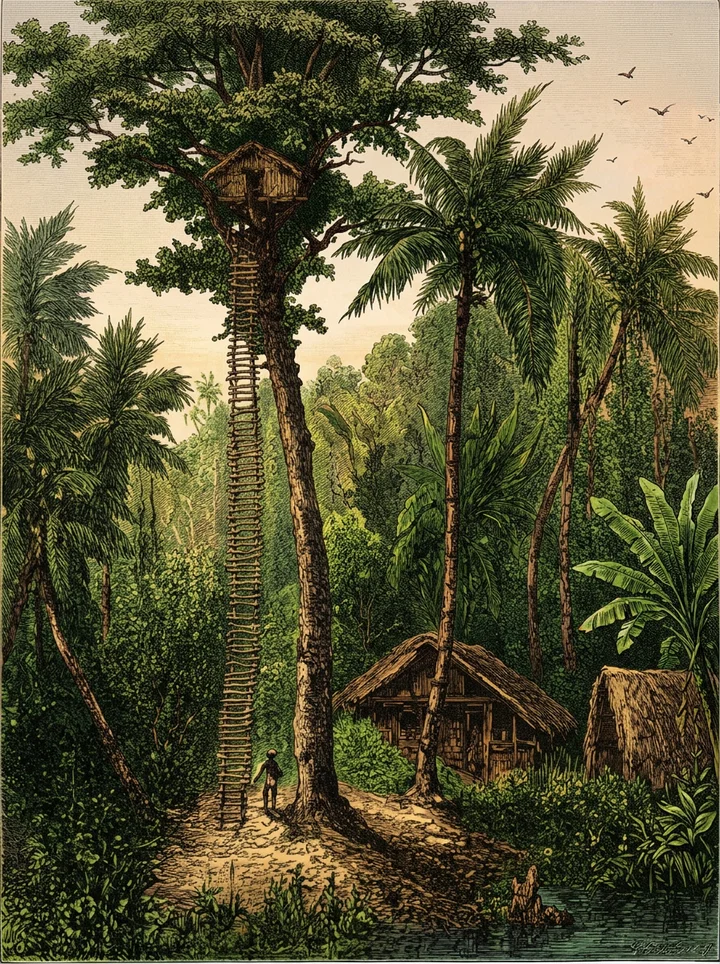
The children in Mr. Miller’s family were delighted. Uncle Ralph, who had been traveling through Western Africa, had returned, and every day he had something new to tell them.
“What do you suppose I found in certain trees of that country?” he asked one evening, as they gathered about him.
“Birds,” said little Nellie, climbing up on his lap.
“Monkeys,” said Fred and Will at the same time.
“Yes, I saw many birds and monkeys up in the trees, but I also found the huts of the natives fastened among the great branches of the Baobab trees.”
“How do the people reach them?” asked Fred.
“By means of rude ladders which at night they draw up after them,” replied his uncle. “In the thinly populated parts of the country, where lions, tigers, and leopards abound, the people feel safe in these home nests, though the lions roar under the trees until the light of day drives them to their lairs. As many as twenty families sometimes live in one tree.”
“The trees must be very large,” said Will.
“Yes, they are much larger than the great trees of California, we hear so much about. The Baobab trees do not grow so very high, seldom over one hundred feet, but their branches, growing out of a trunk thirty feet thick, are often sixty or seventy feet long.
“The leaves are large and of a dark green color. The flowers are white and very large, hanging to peduncles of a yard in length. The fruit is often called monkey-bread. It is inclosed in long green pods, and the pulp between the stones tastes like cream of tartar. It is used by the natives to flavor their food; while the juice, pressed from the leaves, is relished as a drink, and is considered a very good remedy for fevers and other diseases.”
“I wish we had such a tree growing in our yard,” said Will. “It must be as useful as the palm-tree.”
“Yes,” said Uncle Ralph, “it is a very valuable tree. The bark is stripped off regularly, and made into ropes, fishing nets, and clothing for the natives. The tree has wonderful vitality; one-half the trunk may be cut or burned away, or even the tree cut down, if, while lying on the ground, it has any connection with its roots, it will grow and yield fruit. The Baobab tree is said to attain to a greater age than any other tree. Some say it will live for thousands of years.”
“Then I’m sure it will live until I’m a man, and can go to Africa to see the curious old tree,” said Fred.
“I think you need not fear on that account,” his uncle replied. “And you may learn how the natives sometimes use the tree, when hollow, for a burial-place; and other things of interest about the Baobab trees of Africa.” —Sabbath Visitor.