Two little girls, Allie and Nettie, went once to see some Indian houses. Their uncle took them, and they had to drive a long, long way over the prairie. The Indians were not wild like those who live in the far West. They lived on a Reservation, and had frame houses.
In each house was only one room, and in front a large porch, almost as large as the house. But there was no floor in the porch except the ground. Near each house was also a wigwam, made of bark, and the Indians liked better to stay in the wigwam or the porch than in the house. On this page is a true picture of the houses built by these Indians. They had hammocks hung up in the porch, and wide platforms along the sides, where they could sleep.
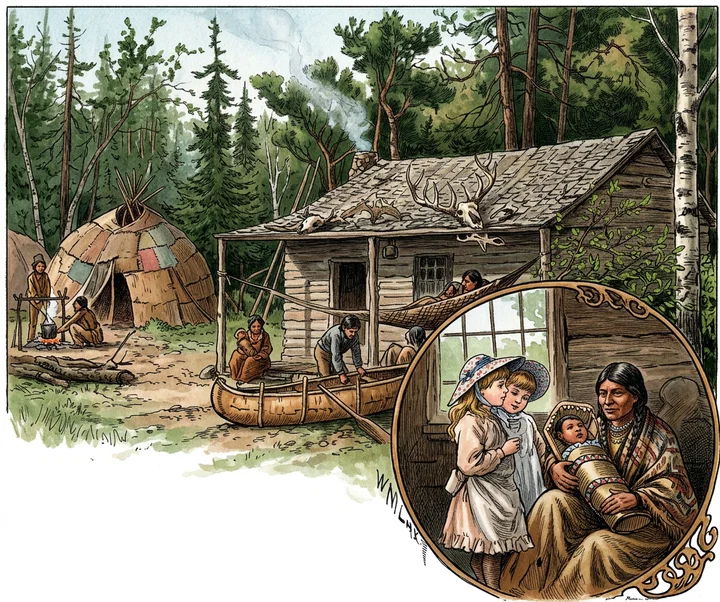
The little girls were almost afraid to talk to the Indians at first, but they soon found courage to look into the houses and wigwams.
At the second house they visited, they found a little pappoose. That is the Indian name for baby. It was asleep in a hammock on the porch. It was about two years old, and as brown as a berry.
Then the squaw took them into the room, and showed them another baby. It was a little bit of a thing, and was strapped on to a board. There was a piece of hoop that came in front of its head. The hoop had tiny bells hung on it, and when the pappoose was moved, the bells would jingle.
The little girls wanted to take the baby home with them, but the squaw thought too much of her baby to let it go. She laughed when they asked for it.
A squaw mamma once did let her baby go. She saw some beautiful earrings in a lady's ears that she thought she would rather have than her own pappoose, so the owner of the earrings traded with her. It was not long, however, before the squaw went in great haste to the woman, threw down the ornaments, snatched the pappoose, and ran home with it. She loved her baby best of all.
Nettie and Allie each bought a bead necklace to remember their visit to the Indians.
A little boy, named Hal, once went with his papa and some soldiers to visit an Indian encampment. Here the houses were all wigwams, set up near the edge of a grove on the river-bank. There were four close together, under a large cotton-wood tree. And what do you think Hal saw there?
On one of the branches hung three Indian babies! The babies' mammas had hung them there out of the way. They were not hung up by their necks though. Each baby was strapped on to a flat board, which was hung to a limb by a piece of leather.
Hal had never seen a pappoose before, and he took great pleasure in looking at them. The squaws were much pleased to see him so interested in their babies, so one squaw came and took down her pappoose, so that he could see it better. She let him hold it in his arms too. It must have seemed odd to hold such a stiff baby, as the board would not bend a bit. He did not care to hold it long. Although it was a pretty baby, he thought it was almost too brown.
This pappoose had on a red blanket under the bandages which bound it to the board. Hal said it looked like a great red bird hanging there. The other babies were asleep, and had brown blankets around them.
As they rode home, Hal asked one of the officers, who knew a great deal about Indians, if the babies liked to be tied to a board that way. He said they seemed to, and would cry if left off from the board. Then if they were put back again, they would be quiet.
—Adapted.