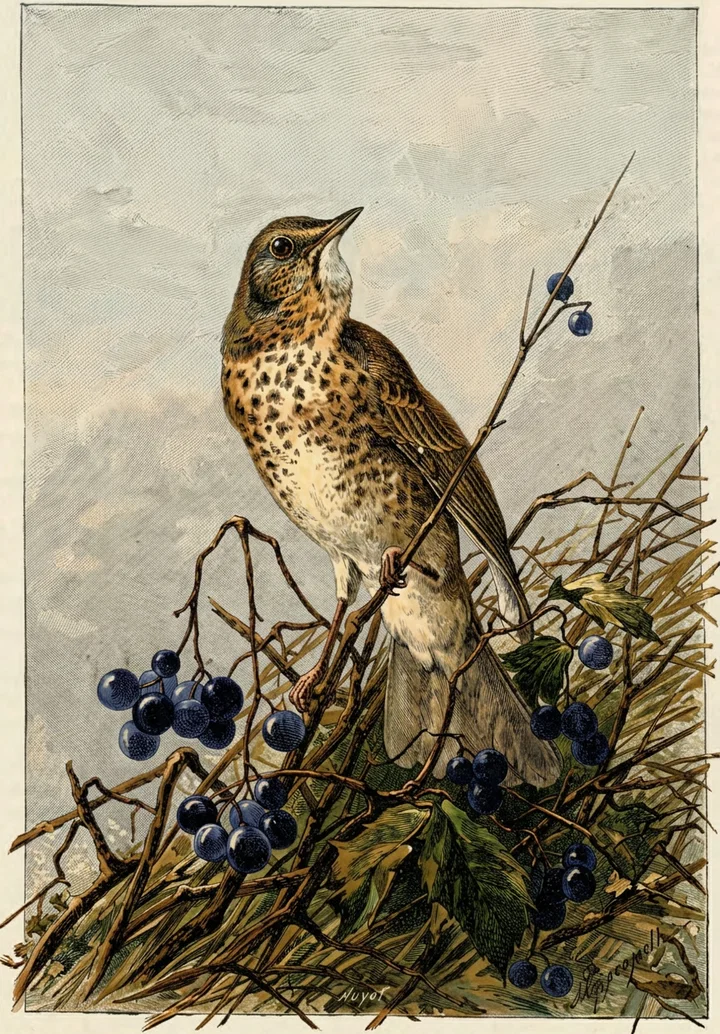
THE sky-lark, as shown in the accompanying picture, is a bird of European origin, never appearing on American soil. Its early arrival in spring and its marvelous song have made it a favorite with all. Says one naturalist: “The bird rises on quivering wing, almost perpendicularly, singing as he flies, and even after gaining an extraordinary elevation, so powerful is his voice that his wild, joyous notes may be heard distinctly when the pained eyes can trace his course no longer; but an ear well tuned to his song can yet determine by the notes whether he is still ascending, stationary, or on the descent; for the strain is continued on his downward course till he approaches the ground, when it stops abruptly, and with a headlong dart the bird alights.”
In regard to its domestic life, another observer says: “The mother-bird builds her nest between two clods of soil, and lines it inside with dry grasses. She lays four or five spotted eggs, brown or gray, which she hatches hastily. As soon as the young ones are feathered, they leave their nest, and roam about the fields under the lead of the mother, and their promptness often misleads those who are hunting for bird’s nests.”
“Whilst these are tripping over the stubble fields, the mother keeps flying about them with constant care and solicitude. She feeds them with worms, caterpillars, ants’ eggs, and grasshoppers. This, however, is only the food of their infancy; for as soon as they are grown, they live upon vegetable food. In summer, the season of song and bold soaring upwards, larks are very lean; but they make up for lost time towards autumn, when they live more on the ground; eating at all hours, they then grow plump and fat.”
But prosperity brings with it dangers to sky-larks as well as to human kind. The corpulent little body tempts the hunter with the promise of a dainty dish, and larks are accordingly hunted down with net and mirrors, and every known device. Competent authorities state that during the last century over five million larks were received in Leipzig annually, and “in 1854 there were brought to the London markets about four hundred thousand, and the official returns state that in 1867–68 more than a million and a quarter were taken into the town of Dieppe, France.” It seems a pity that such sweet songsters should meet so ignominious a doom as to satiate the appetite of the epicure. W. E. L.