THE MANUFACTURE OF IRON.
By J. O. C.
Iron is one of the most valuable metals known, because of its adaptability to so many uses. Gold and silver are valuable, but we could manage to live without them. It would be almost impossible, however, to get along without iron and steel. Just think, for a moment, what the world would do without iron, with which to make plows; or shoes for the horses’ feet; or saws, hammers, and chisels for the carpenter; or nails, with which to build houses; or needles, with which to make and mend our clothing. Iron is now used for almost everything. When the writer was in Pittsburg not long ago, he went into one of the many rolling mills of that city, where at one point he saw iron worked into flat plates covering a large surface, while at other places it was being drawn out into large bars and wires of every size. Iron in some form is found almost everywhere. It is hidden in the earth under our feet, in the water we drink, and it enters into the composition of all plants and creatures.
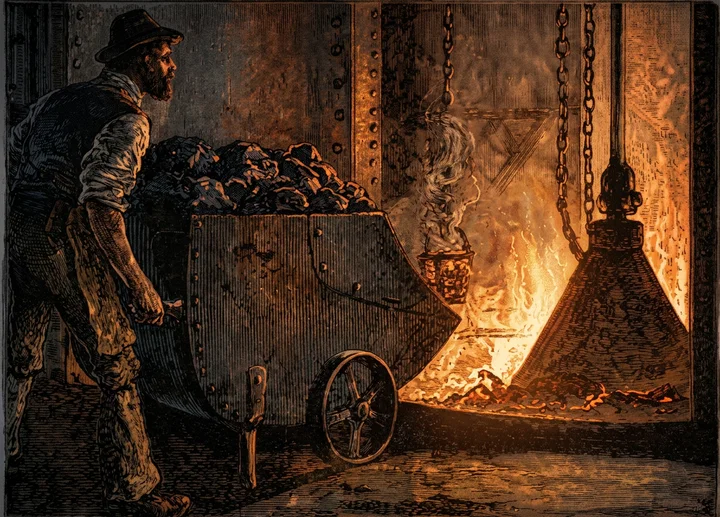
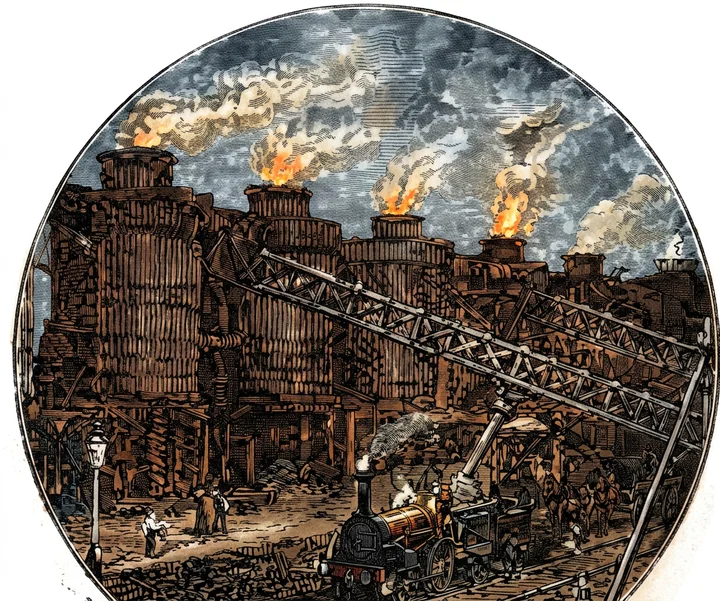
When iron is first taken from the mine, its particles are so mixed with the earth in which it is found that it looks just like pieces of reddish brown dirt. In this condition it is taken to the smelters, or blast furnaces, six of which are shown in the upper part of the picture on this page. In these a hot fire is kept constantly burning, fed by a plentiful supply of coal thrown in at the top, where the fire is seen issuing forth. In the middle of the picture, the top only of a furnace is seen, and the man with the wheelbarrow is represented as just dumping into the fire a load of coal. When the fire is in the proper condition, the iron ore is brought up and tumbled in at the same place. As the iron melts, it separates from the limestone, earth, and other matter with which it is mixed, and runs through the mass to the bottom of the furnace.
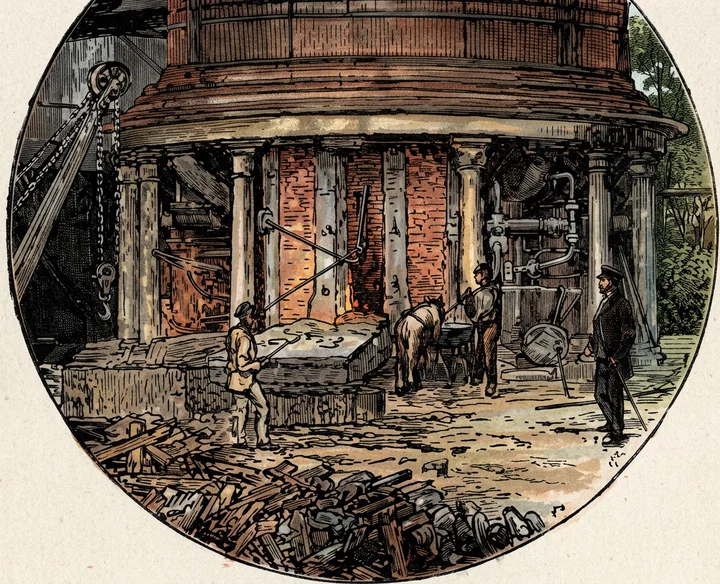
When a charge of ore has stewed in this “fiery furnace” for about twelve hours, it is taken out at the bottom of the furnace, which is shown in the lower part of the picture. At this place an opening was left when the furnace was made, which was stopped up during the melting process by a mixture of clay and coal-dust. This must be drilled open, by driving through it a long iron bar. But before this is done, the ground near the furnace must be prepared for the reception of the liquid iron; for there are no pots or pans which could well hold such fiery liquid. The furnace itself is provided with a method by which a current of cold air is constantly circulated round the blast pipes inside, lest they should be melted in the fiery mass.
The preparation required is made by first smoothing over the great layer of damp sand which lies about, and then a small gutter is plowed through it, leading down to numerous little nicely-molded places in the sand, which are connected with one another by small ducts. As the melted iron runs down this first gutter, it finds its way into all these small molds, where it remains until it is cold, when it is taken out in the shape of the pieces seen piled up in the foreground of the lower part of the picture. In this shape it is called “pig-iron.” It is given this name because the group of molds in which it was cast are called “pigs,” while the long duct leading from the furnace to feed them is called the “sow.”
When one row of these pigs is full of the metal, sand is thrown into the duct leading to them, and the liquid is turned toward another row until that is full, and so on till all are filled. When the flowing metal does not move fast enough, it is helped along in its course by drawing before it a long pole, which leaves a slight track behind, drawing the iron after it, much as a little stream of sluggish water can be made to follow one’s finger when it is a little moist. All this must be done quickly; for as soon as the metal commences to flow, it also begins to cool and grow thick. The writer saw this work done once in the northern part of Michigan, and it was to him a grand sight to watch the men at their work, and notice how each one did the right thing just in time, without any one to prompt him.
When the pigs are all full, the hole in the furnace is again quickly plugged up, wet sand is thrown over the glowing iron lying about, and a stream of cold water is turned on, to cool it. This fills the place for a little while with steam, which is soon gone, and then the men with heavy sledges go about and break the pigs of iron apart while the metal is yet soft, when it is ready for the market. Two sets of men are required to attend to these smelting furnaces, because they are in operation day and night. Each set of men, therefore, works twelve hours. It costs so much to start one of these furnaces up, that the fire is never allowed to cease, from one year’s end to another, except for repairs. The men, therefore, who work there must attend to business seven days in the week, without any Sabbath. This seems very hard to us who enjoy our weekly rest, yet there are many thousands in our country and in others also, who, because of the insatiable greed of their employers, are obliged to work every day in the week. J. O. C.