HUDSON RIVER

8%

S. D. A. Publishing Association · Battle Creek, Mich. · Apr 16, 1890

FromThe Youth’s Instructor, Vol. 38, No. 16.

Read the full edition

HUDSON RIVER.

ONE of the great rivers of the United States is the Hudson, the American Rhine. It is more closely associated with the history of our country than any other large river. Many of the most important events of the Revolution took place in its vicinity.
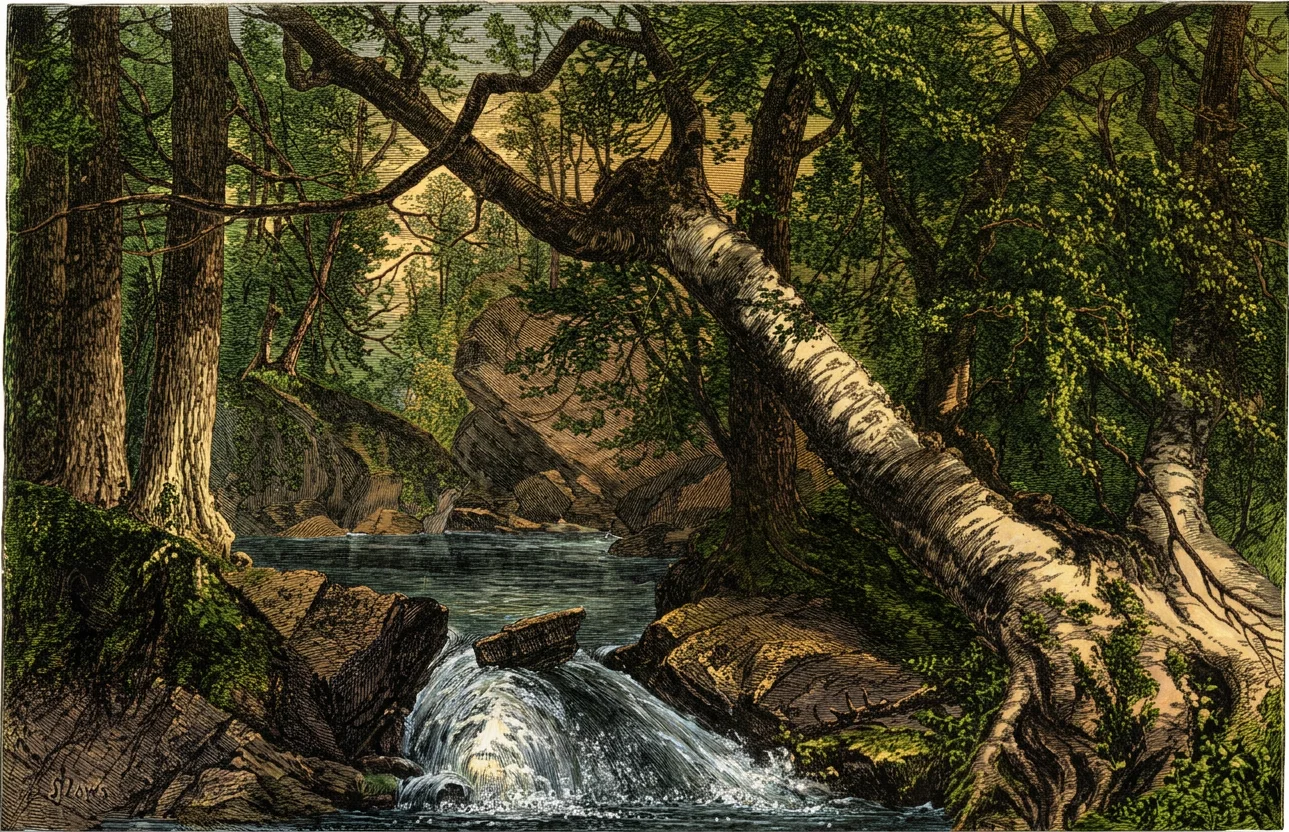
HEAD WATERS OF THE HUDSON.Restored with AI
HEAD WATERS OF THE HUDSON.
It rises in the Adirondack Mountains, and flows south, through the eastern part of New York State, to New York Bay. Around its head waters the scenery is very fine, but as we follow it southward, the graceful landscape gives place to the bold and imposing characteristics that mark its lower portion.
Many large and flourishing cities are scattered along its entire length. Going up from New York City, we pass Yonkers, where many wealthy men from the metropolis have located; Dobb's Ferry, an important point during the Revolution; Haverstraw, where Arnold and Andre met; Tarrytown, near which is the famous “Sleepy Hollow;” Sing Sing, where the State prison is situated; Stony Point, where a light-house, a keeper's lodge, and a fog-bell only are left to tell where the old fort was; West Point, the seat of the national military school; Poughkeepsie, a thriving city; Albany, the State capital; Troy, a large manufacturing city; and many others, which we have not space to notice.
There are natural and historic scenes of peculiar interest all along the route. The river itself, about four miles wide, is grand in its calmness. Scarcely a ripple breaks its glassy floor, except where the steamers, plying up and down its surface, send their gentle waves out to meet the distant shores.
The one feature of the Hudson, which is probably the most famous, is the “Palisades.” They extend along the western shore for about thirty-five miles. They rise directly from the water in a perpendicular wall, from three hundred to six hundred feet high. The highest point is opposite Sing Sing, 666 feet above tide-water. The face of the palisades is rude, columnar, and almost unbroken; but now and then a rift in the rock reveals glimpses of the beautiful landscape beyond. The top of this rocky wall is quite narrow, and covered with a thin growth of trees.
On its western bank, in full sight of its wide waters, lived Washington Irving, one of America's greatest authors. “Sunnyside” has become a household word; and in my childhood a picture of the vine-covered cottage and shaded lawns was my particular delight. A few years ago, as the train wound by the river-bank, I caught a glimpse of the reality of my dream—the same cottage, almost hidden by ivy, and stately trees flecking the slope of the grassy bank. From Mr. Lossing we quote the following description of the place:— “I visited Sunnyside, and strolled along the brook at the mouth of the glen, where it comes down in cascades before entering the once beautiful little bay, now cut off from free union with the river by the railway. The channel was full of crystal water. The delicate foliage was casting delicate shadows where, at this time, there is half twilight under the umbrageous branches, and the trees are full of warblers. It is a charming spot, and is consecrated by many memories of Irving and his friends, who frequented this romantic little dell when the sun was at its meridian. After awhile, I climbed its banks, crossed the lane, and wandered along a shaded path to a hollow in the hills, filled with water. This pond, which Mr. Irving called the ‘Mediterranean Sea,’ was made by damming the stream, and thus a pretty cascade at its outlet was formed. It is in the shape of a ‘palm-leaf’ that comes from the loom. On one side a wooded hill stretches down to it abruptly, leaving only space enough for a path, and on others it washes the feet of gently grassy slopes. This is one of the many charming pictures to be found at Sunnyside.”
The Croton Aqueduct, a huge artificial water-way, by which New York City is supplied with pure water, follows the Hudson River throughout its entire length, and about half a mile from it. Work was begun on this aqueduct in 1837, and finished in 1842. Its cost was $12,000,000. Its source is in an artificial lake, 166 feet above mean tide-water at New York, and capable of holding 500,000,000 gallons of water. From forty to fifty million gallons pass through this aqueduct every twenty-four hours.
“Its course is marked by culverts and arches of solid masonry, and its line may be observed at a distance by white stone towers, about fifteen feet high, placed at intervals of a mile. These are ventilators of the aqueduct; some of them are quite ornamental, while others are simple mud towers, and every third one has a square base, with a door, by which a person may enter the aqueduct.”
The Highlands of the Hudson are in the vicinity of Newburgh, a place situated in the midst of the grandest scenery along the river. On the lofty peaks of the Fishkill Mountains, signal-fires were lighted during the Revolution.
Catskill Mountains, on our route, are very beautiful. At every turn in the road leading up the mountains, the traveler discovers some new scene of loveliness. A coy stream dances along beside us, now peeping out like a shy maiden, then hiding its sunny face in the tangled wilds of the forest. The road is very tortuous, and in its ascent up the glen is almost inclosed by rocks and trees. Part way up this magnificent gorge is a little nook, in which nestles the cabin where Rip Van Winkle is said to have taken his twenty years' nap. This legend of Irving's, and his descriptions of the surrounding country, have made the Catskills famous.
MARY STEWARD.