Some years ago, Elisha Kent Kane, the Arctic traveler, wrote much about the children of the regions which he visited. Since then, other explorers have added to Dr. Kane’s account, until we know a good deal about the boys and girls of the snow. The igloo, which is the funny name of the ice-house of the Eskimo, is the narrow play-ground of the children when the snow is deep, and the weather is bitter cold.
“The girls amuse themselves with queer-looking dolls, whose heads may have been carved out of walrus ivory; for there is no wood where the long, cold nights are. They dress the dolls in soft deer-skins, and take the ears of the Arctic fox for doll hoods. Sometimes these little ladies of the cold will go visiting, just as the little misses of our country do; and when they go, they always take the doll along. Dolly rides in a sled, which the girls, wrapped in their garments of bear-skin, pull over the snow in high glee. These visits are often made at night, and for hours a group of Eskimo girls will make an igloo resound with childish talk and laughter. They don’t know anything about the great world that lies warm and pleasant beyond the boundaries of their ice-locked homes—nothing about the May parties, the forest festivals, and the merry nuttings. They have no knowledge of the handsome dolls that fill the windows of our stores. An Eskimo girl would hold her breath if she could be set down in one of our toy stores, stocked with grand things for the holidays. They know nothing about them.
“When they learn to sew, it is with a sharp piece of ivory for a needle, and a sinew for a thread. It is slow work over the poor fire, which is never allowed to go out on the hearth of the igloo, and the stitches are not very even; but the little seamstress works patiently, and the hours pass away. When she has dismissed her callers, she may think she can improve the looks of her doll. One of her visitors may have shown an improvement in doll fashions, and forthwith the Arctic girl adds something to the costume of her own pet. And thus it goes. The Eskimo girls do not know the wilder sports indulged in by the boys; but for all this, they have very merry times, for God meant children to be happy, wherever he has placed them.
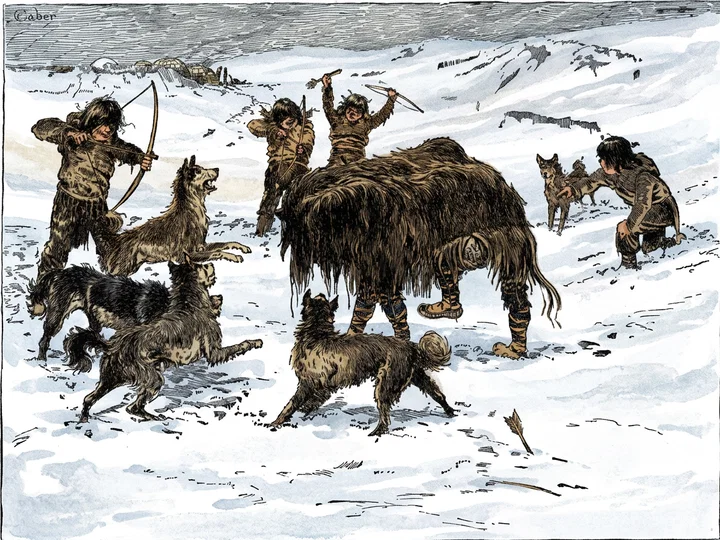
“The minds of the boys of the polar world run to sports that suit their natures. They are generally found in the open air, no matter how cold it is. At night, when the moon is full, and when the snow looks like a vast field of burnished silver, a company of Eskimo boys will engage in a game of ball. The ball is sometimes as large as a boy’s head, and is covered with a piece of hide sewed with sinews. Each boy carries a crooked stick, which is the rib-bone of some Arctic animal, and the whole company will play ball among the drifts till tired.
“They learn early to drive dog teams over the snow, and often, under the moon, they will race back and forth in this manner. The Eskimo boy is always a good driver, and he is not very old when he watches near the seal-holes with a harpoon. The seal, you know, furnishes the Arctic people with food, clothing, and light, and is, perhaps, the most important animal of the country. The boy who manages to spear a seal is a hero, and night after night he recounts the story of his exploit to his companions by the igloo fire. His playthings, from the time when he first forms a taste for such, are rudely fashioned sledges, harpoons, boats, and lances, and when alone, he will pass many happy hours amusing himself with them.
“The far northland is one without picture-books; but the Eskimo boy will draw rude pictures on the skins that hang on the walls of the igloo. He draws no beds of flowers, because he sees none. His pictures represent the animals of the snow, and dog-trains, and ball-playing. The children of the snow have merry times, just like other little people. They never complain of their isolation, nor of their lot. They are patient and thankful for what they have, as we all should be; for the care of the Father is over them, even in their land of endless winter.—The Sunday-School Times.