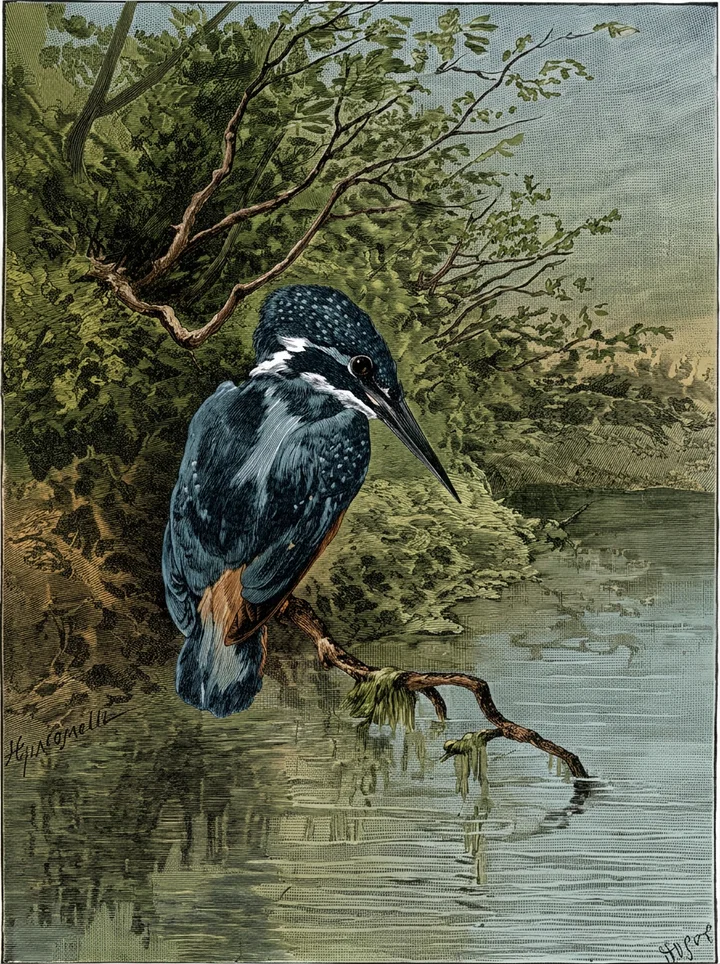
Our cut shows one of a very interesting group of the feathered creation, known as the kingfisher. It is now estimated that there are about a hundred and fifty species of this bird, which are distributed over all the habitable portions of the earth, although much more profusely in some localities than in others. Their chief place of residence is upon some of the East India Islands; and here it is that they are the most attractive in appearance, being dressed in colors that vie with those of other tropical birds.
The distinctive features of the kingfisher are a crested head, a long, pointed bill, which is thickly set upon the head, a short, well-built body, and short, strong legs. In these respects the several species are very similar, although in coloring and in some minor points quite dissimilar.
Notwithstanding the species are so multiplied, except upon the seashore and some of the streams in California there is only one species in the United States, the belted kingfisher. It is thought that formerly there were none in America, but that this species found its way into North America, and from thence southward even to South America.
This bird is a burrower, yet to save labor he will appropriate a rabbit burrow or the abandoned hole of a water rat for his nest. However, he makes thorough repairs, and to avoid damage by water, shapes the hole so that it will have an upward ascent toward the farther end.
He constructs his nest of the fish bones and skins that he ejects from his mouth. Several layers of these are placed one above the other, upon which the eggs are deposited, making a good nest but for the odor arising from the stale fish bones. It is claimed by some authorities that the stench is so great that it clings tenaciously to the bird ever after. If the bird is unmolested in removing the eggs from its nest, it will continue laying throughout the season, after the manner of domestic fowls.
The kingfisher is one of the most gluttonous of birds, often attempting to swallow morsels larger than its body can hold. In several instances one of these birds has been seen with the tail or head of a large fish protruding from its mouth, which it could neither swallow nor eject, and so was a prey to its own greediness.
Some of the species confine themselves less closely to a fish diet than do others, partaking of insects, grubs, caterpillars, and sometimes even snakes and water rats. Chief among this class is the Australian or Giant Kingfisher; named also the “Laughing Jackass,” from its peculiar cry, which is sometimes a perfect imitation of a braying donkey. Of the latter popular species you will read with interest the following quotation from the pen of one who has heard and seen for himself their peculiarities. He says:—
“About an hour before sunrise the bushman is awakened by the most discordant sounds, as if a troop of fiends were shouting, whooping, and laughing around him in one wild chorus. This is the morning song of the ‘laughing jackass,’ warning his feathered mates that daybreak is at hand. At noon the same wild laugh is heard, and, as the sun sinks into the west, it again rings through the forest.”
The regularity of these sounds, at morning, noon, and night, has given this bird the title of bushman’s clock. He further says:—
“I shall never forget the first night I slept in the open bush in this country. It was in the Black Forest. I awoke about daybreak, after a confused sleep, and for some minutes I could not remember where I was, such were the extraordinary sounds that greeted my ears:—the fiendish laugh of the ‘jackass,’ the clear, flute-like note of the magpie, the hoarse cacks of the wattle-birds, the jargon of flocks of leather-heads, and the screaming of thousands of parrots as they dashed through the forest, all joining chorus, formed one of the most extraordinary concerts I have ever heard, and seemed at the moment gotten up for the purpose of welcoming the stranger to this land of wonders on that eventful morning. I have heard it hundreds of times since, but never with the same feelings I listened to it then. . . .
“The ‘laughing jackass’ being of a companionable nature, a constant attendant about the bush-tent, and a destroyer of snakes, is regarded, like the robin at home, as a sacred bird in the Australian forests. It is an uncouth looking bird. It is common in all the forests throughout the year.”
This species seeks the hollow trunk of a tree in which to build its nest.
The true kingfishers, to which the American species belong, “are remarkable for their fish-eating habits. The Old World members of this family are noted for their gorgeous coloration. It is especially the silky azure and bluish-green tints which cause the admiration of all observers, and the common European species forms no exception to the rule.” The North American belted kingfisher is less gorgeously arrayed, but is a stronger, more powerful bird. It adds to its bill of fare, besides fishes and insects, now and then a mouse.
Of the general habits of the fish-eating kingfishers, a celebrated writer remarks:—
“Like most birds of brilliant plumage, the kingfisher prefers a quiet and secluded haunt. It loves the little trout streams, with wooded and precipitous banks, the still ponds and small lakes, ornamental waters in parks, where it is not molested, and the sides of sluggish rivers, drains, and mill-ponds. Here, in such a haunt, the bird often flits past like an indistinct gleam of bluish light. Fortune may sometimes favor the observer, and the bird may alight on some twig over the stream, its weight causing it to swing gently to and fro. It eagerly scans the shoal of young trout sporting in the pool below, when suddenly it will drop down into the water, and almost before the spectator is aware of the fact, is back again to its perch with a struggling fish in its beak. A few blows on the branch, and its prey is ready for the dexterous movement of the bill, which places it in a position for swallowing. Sometimes the captured fish is jerked adroitly into the air, and caught as it falls.”
The superstitious connected many fables with the kingfisher, in the past; but most of them are forgotten.
M. J. C.