THE TOWER OF LONDON

6%

S. D. A. Publishing Association · Battle Creek, Mich. · Sep 18, 1889

FromThe Youth’s Instructor, Vol. 37, No. 38.

Read the full edition

THE TOWER OF LONDON.

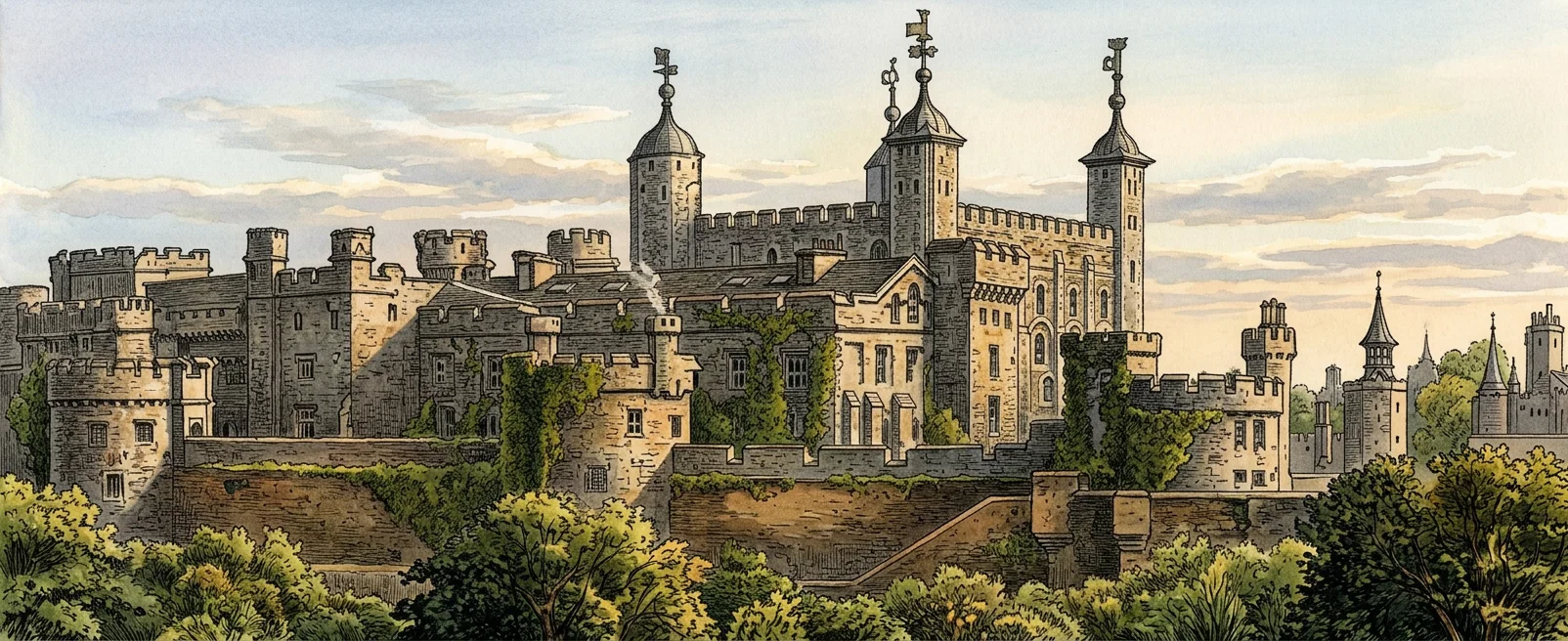
THIS tower is situated on the northern bank of the Thames, in the very heart of London. It was built by William the Conqueror about the year 1079. The tower proper, now called the White Tower, is a grim, square building of gray stone. At each angle is a small watch-tower, or turret; on the top of each is a curious conical roof, with a still more curious flag weather-cock on the top of that, just as you see in the picture. At a distance of about 150 yards all round this central tower, runs an embattled wall, and at a few yards' distance another, and outside of all these is an immense moat. In the first wall, at regular intervals, are twelve other towers, giving the whole the appearance of a confused mass of hoary walls, turrets, and gates. As you enter, and glance around at these towers, you cannot but feel awed to think how many an illustrious captive, how many servants of God, have sighed out a lifetime in those chill and lone lodgings, or had their blood poured out in the courtyard below. The ghoulishness of the whole makes you think of secret passages, torture rooms, and reeking dungeons.
Restored with AI
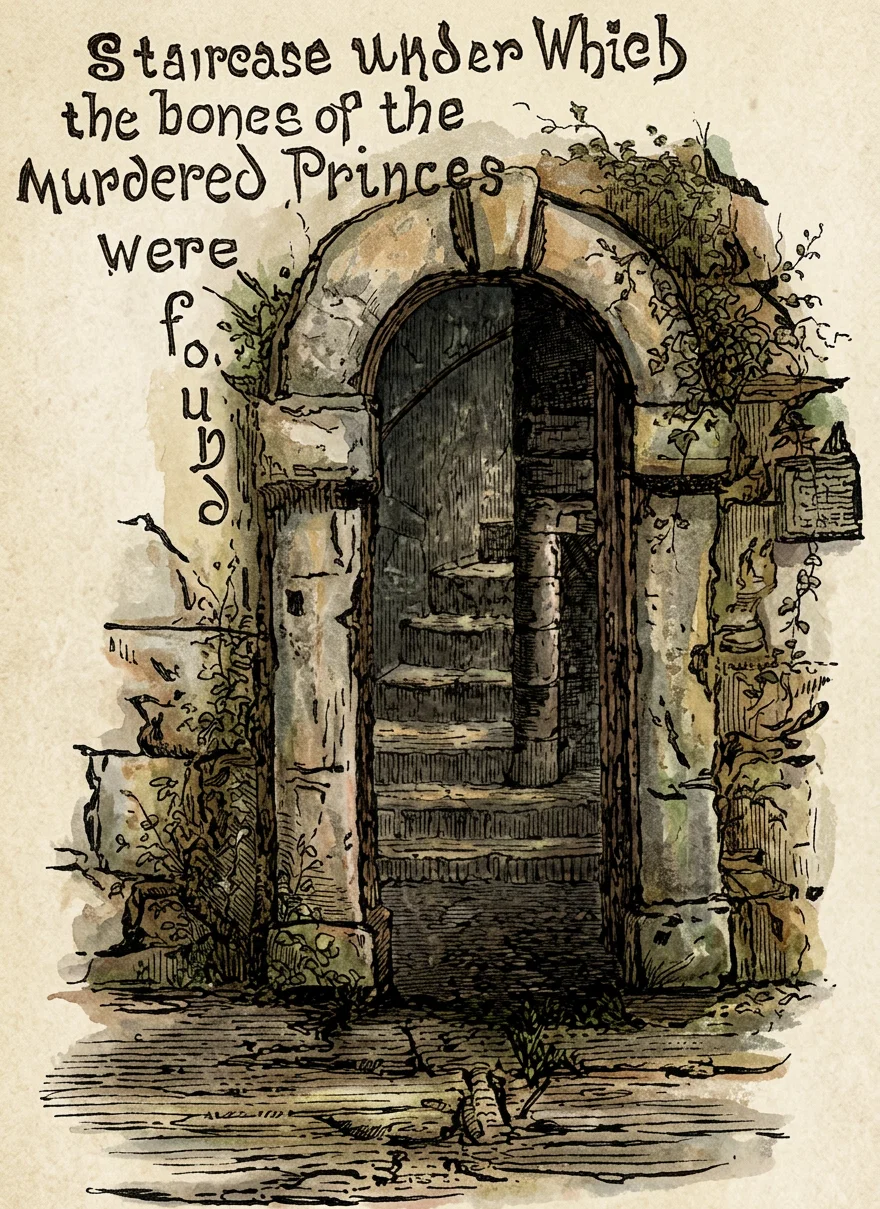
The White Tower demands the first attention. It is about 92 feet high, and has walls of solid stone, 15 feet thick. You see it was built to stand. It has three lofty stories. To get above, one has to climb an ancient spiral staircase of stone in one of the corner towers. The staircase consists of a central column, or newel, and the steps wind around it. It is very narrow and dark. The bottom of the second flight is shown in the illustration.
Restored with AI
It was here where the bones of the princes were discovered. Their father was Edward V., of England. He, dying, left his little boys alone in the world, the eldest, of course, being king by right. But their uncle, the duke of Gloucester, also wanted to be king. So he shut them up in the tower, and had them smothered as they lay asleep; then he ascended the throne as Richard III. Their bones were not discovered till many years afterward. Poor little boys! it would have been much better for them if they had been the sons of some poor farmer, and not a king's children. However, it is said they were very good little Christians; so they may have a happy time yet in the new earth.
The tower was used as a royal palace by all the kings up to the reign of Charles II., and the ancient chronicles have many accounts of the gorgeous magnificence of the scenes which occasionally gilded those gloomy walls. One old writer says about an event: “It is vain to attempt to describe the ceremony; so far from being utterable, it was almost inconceivable.”
Happily, it is no longer needful for Britain's sovereigns to live within the walls of a fortress; so now the tower is used as a barrack and also as an armory of curious weapons. The walls and ceilings of the different rooms are now covered with every description of arms, arranged in different patterns. Among others is a rising sun of bayonets; another is a bird catching a butterfly among the corn, made of sword blades. Here are also different instruments of torture,—the thumbscrew, the rack, the scavenger's daughter, etc. Also the headman's block and ax, on which several have been beheaded. The torture room is in the basement.
The most interesting of the smaller towers is the Beauchamp Tower, built about 1200 A. D. This tower has always been used as a prison, and has several rooms and dungeons. The walls are covered with inscriptions and names written by the poor chained inmates, some of whom never left their cells till death released them; others were allowed to take a little air in a small courtyard below. Many of the prisoners were here simply on the caprice of some tyrant; others, for their faith. Among the inscriptions are many interesting ones. Here is one in Latin: “The more suffering for Christ in this world, the more glory with Christ in the next world. Arundell, June 22, 1587.” Another reads thus: “That which is sown by God in tears is reaped in joy. E. Poole. Æ 21. 1562.” In the yard just opposite this tower is the scaffold site, where so many noble persons, including two queens, lost their heads.
The Wakefield is another interesting tower, as it contains the crown jewels. They have been kept here since 1260. The most important is the royal crown, made of purple velvet, surrounded with hoops of silver, and surmounted with a ball and cross, all of which is resplendent with diamonds and the largest of sapphires and other gems. This tower contains also other baubles of royalty, such as the queen's diadem, a thing like a saucepan stuffed with velvet.
The royal scepter, an affair something like a golden kitchen poker, with a bird on the top. Another interesting arrangement is St. Edmund's staff, a long pole which is carried before monarchs at their coronation. To make it of more effect, it is said that the ball on the top contains a piece of the true cross, which of course is not so.
The traitor's gate is of interest. It is a gloomy archway leading into the river, through which prisoners of state were brought. As you look into its horrid maw, you wonder how often nobility, and even royalty, have passed beneath its frowning portal, to exchange the dream of honor and glory for the stern realities of the dungeon, the torture room, and the fatal ax.
To us, the most interesting captives are those who came here under the charge of heresy. At times, Rome kept the cells full. The Protestant queen, Elizabeth, was kept a close prisoner here during her girlhood. During the beginning of the Reformation, the tower was full of learned divines. In 1546, Anne Askew, “a lady of cultivated mind and good family,” was confined and tortured here, and afterward burnt nearby. Cranmer, Ridley, and Latimer were all imprisoned here before martyrdom. How glad we ought to be that we can obey God without imprisonment.
Restored with AI
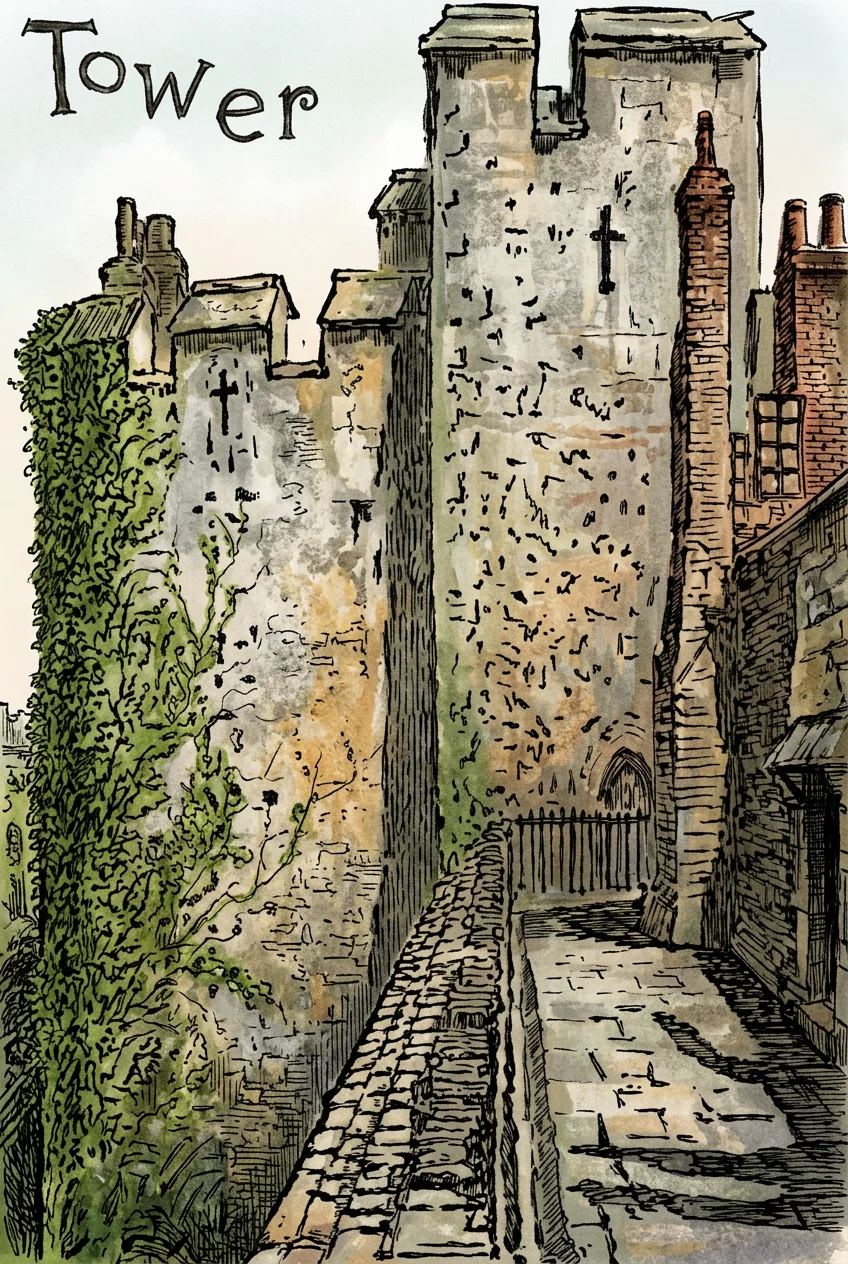
Prisoners' Walk from the Beauchamp TowerRestored with AI
Prisoners' Walk from the Beauchamp Tower
But should the time ever come when my young readers will need to choose between forsaking the right and adhering to it, as these old martyrs did, in the face of suffering and even death, I hope they may have the courage to choose always the side of right; for that is God's side. FRANK HOPE.