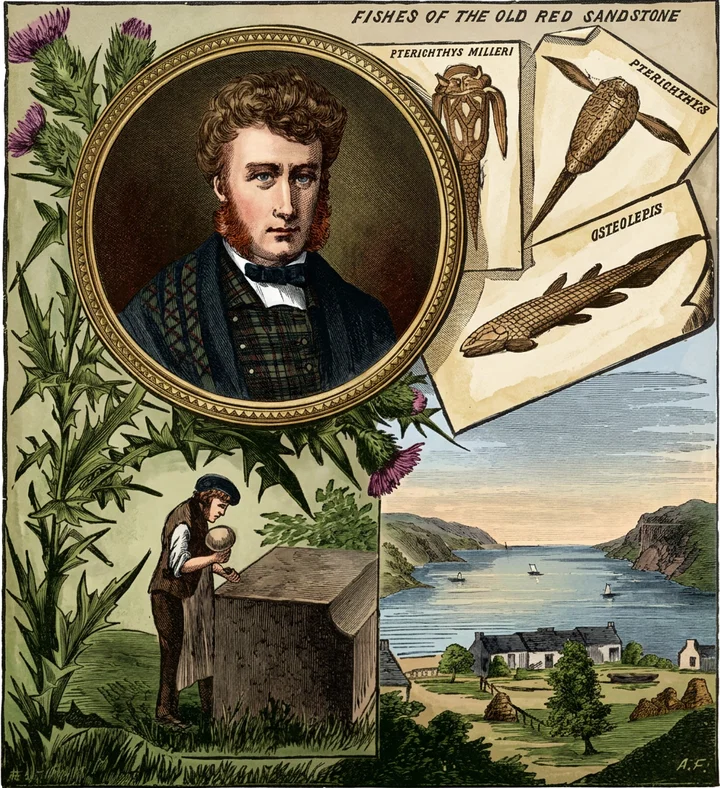
HUGH MILLER.
By Julia Coleman
Hugh Miller was a Scotchman and a stone-mason. He learned his trade early in life, and worked hard. Some boys would have thought, after they had done so big a day’s work, they ought to have the rest of the time for play. But Hugh Miller wanted it for reading. He loved books, and though he had but little school education, he became a learned man, a writer, an editor, and a geologist. It would be well worth while for any boy or girl who feels disposed to complain of lack of schooling, to read the life of Hugh Miller, and see how he employed every spare moment in reading and studying. For he was not content with story books. The wonderful things in nature, in the flowers, and even among the stones, excited his curiosity, and he liked to read the books that told about them. And as he worked in stone, he learned by observation, and in time he became a great geologist. True, he had to work hard and wait patiently for his wisdom and his fame, but the real secret of it was that he made good use of his spare minutes when a boy. This gave shape to all his after life. Instead of taking all his exercise in play, he took it in the fields and among the rocks. And then he was eager to get all the time he could for his loved books. He was always contriving to have a few minutes here and there, so that he could read. Bacon’s “Essays” was one of his favorite books, and they are deep reading for most men.
Another good thing for him was that he kept his head clear. In those days everybody drank a little; for he was eighteen in 1820, and people had not learned so much about temperance then as they have now. They thought a little drink was good. This is what Miller tells us about it:—
“I learned to regard the ardent spirits of the dram-shops as high luxuries; they gave [or seemed to give] brightness and energy to both body and mind, and changed dullness and gloom into exhilaration and enjoyment. Whisky was simply happiness doled out by the glass and sold by the gill. The drinking usages of the business in which I labored were many at this time. When a foundation [of a house] was laid, the workmen were treated to drink. They were treated to drink when the walls were leveled for laying the joists. They were treated to drink when the building was finished. They were treated to drink when an apprentice joined the squad, when his ‘apron was washed,’ when his time was out. Occasionally, they treated one another to drink. “In laying the foundation-stone of one of the houses built this year by Uncle David and his partner, the workmen had a ‘royal founding pint,’ and two whole glasses of whisky came to my share. A full-grown man would not have deemed a gill of whisky an overdose, but it was too much for me. When the party broke up, and I got home to my books, I found, as I opened the pages of my favorite author, the letters dancing before my eyes, and that I could no longer master the sense. I have the volume at present before me, a small edition of the ‘Essays’ of Bacon; for of Bacon I never tired.”
“I felt that the condition into which I had brought myself was one of degradation. I had sunk for the time, by my own act, to a lower level of intelligence than that on which it was my privilege to be placed; and though the state could have been no very favorable one for forming a resolution, I in that hour determined that I would never again sacrifice my capacity for intellectual enjoyment to a drinking usage; and with God’s help, I have been able to hold my determination.”
Here is a point we should particularly notice. Drink hurts the brain and nerves. It hinders or perverts the action of the mind, even when taken in small quantities. And the mind is what makes the man. We do not think enough about this. We talk about what it does to the stomach, and blood, and heart, and liver; but the worst mischief of it is that which is done to the brain. Hugh Miller recognized that, and saved his brain to serve his God and his fellow-men, and left a name that will last for ages.—Julia Coleman.