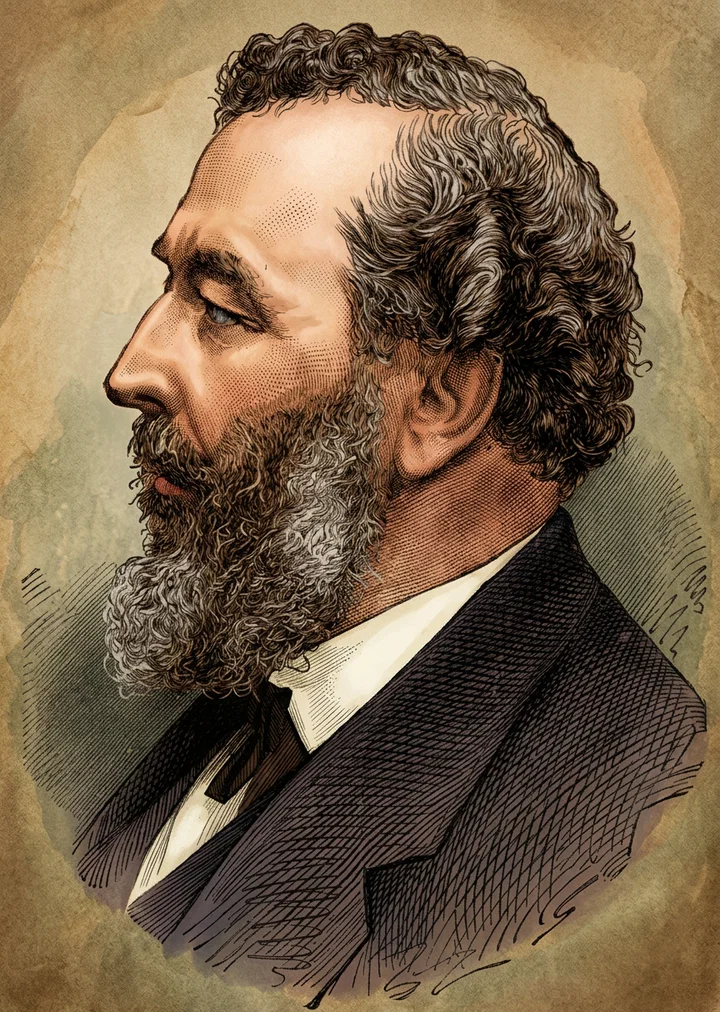
It is pleasant to study the boyhood and early life of a man who has made a name and a place for himself in the world; for useful lessons may be learned from the way in which he has met and overcome those difficulties sure to beset the path of all who would do earnest work. And, too, we like to see whether his boyhood gave any indication of the greatness that was his in after years. The life of the poet and traveler, Bayard Taylor, whose portrait is given on this page, shows how patience, courage, and perseverance may accomplish large results.
Mr. Taylor was brought up in a quiet Quaker community in Pennsylvania. His father was a farmer, and a poor man, and in his humble home the luxuries of life were unknown. But Mr. Taylor seems to have had a fund of enjoyment in himself that no adverse outward circumstances could take away. Very early in life two ruling passions began to manifest themselves. One was an intense love for poetry, and the other a propensity for exploration and adventure.
Writing at one time of those early days, he says: “Almost my first recollection is of a swamp, into which I went, bare-legged, at morning, and out of which I came only when driven by hunger or approaching darkness, with long stockings of black mud, and a mask of the same. If the child was missed from the house, the first thing suggested was for some one to climb upon a mound which overlooked the swamp. Somewhere among the tufts of the rushes and the bladed leaves of the calamus, a little brown ball was sure to be seen moving, now dipping out of sight, now rising again, like a bit of drift on the rippling green. It was my head. The treasures I there collected were black terrapins with orange spots, baby frogs the size of a chestnut, thrushes’ eggs, and purple phlox.”
“In looking back to my childhood, I can recall the intensest desire to climb upward, so that without shifting the circle of my horizon, I could yet extend it, and take in a wider sweep of vision. I envied every bird that sat swinging upon the topmost bough of the century-old cherry-tree; . . . to rise from the earth in a balloon was a bliss which I would almost have given my life to enjoy . . . I remember as distinctly as if it were but yesterday the first time this passion was gratified. Looking out of the garret window one bright May morning, I noticed a row of slats which had been nailed over the shingles for the convenience of the carpenters in roofing the house. Here was, at last, a chance to reach the comb of the steep roof, and take my first look abroad into the world! . . . Unknown forests, new fields and houses, appeared to my triumphant view. The prospect, though it did not extend for more than four miles in any direction, was to me boundless. Away in the northwest, glimmering through the trees, was a white object, probably the front of a distant barn; but I shouted to the astonished servant girl, who had just discovered me from the garden below, ‘I see the falls of Niagara!’”
Books of travel were his special delight; and as he pored over the fascinating pages, he indulged in many bright dreams of visiting those countries for himself sometime. He says: “When a boy of ten years, I read Willis’s ‘Pencillings by the Way,’ as they appeared from week to week in the country newspaper, and those charming pictures of scenery and society filled me with a thousand aspirations. I wandered along the shores of the Mediterranean while hoeing corn or tending my father’s cattle; the geography of Europe and the East was at my tongue’s end, and the confidence with which I spoke of going to London, Paris, and Rome, often subjected me to the ridicule of my school-fellows.” His classmates used to say, “Bayard knows all about his geography without even reading his lesson over.” He was a great favorite, and at school a crowd of boys constantly dogged his heels, soliciting the help in their lessons which he good-naturedly gave them.
But better than he liked books of travel, he liked books of poetry. He read Wordsworth, Milton, Scott, and all the books of the English and American poets that he could get hold of; and at night, after he had gone to bed, his mother would often hear him repeating to his little brother the poems he had read and unconsciously learned. He began at the age of twelve to write poems, and stories, and historical sketches, which, of course, never saw light through the medium of printer’s ink. But it gave relief to the pent-up feelings within him, and helped him to express his thoughts clearly.
Young Bayard did not like to be a farmer. He wanted to live in the world of books; and so, when he was seventeen, he went to learn the printer’s trade.
It did not take him long to master that. He soon grew tired of the drudgery, and longed to be free to see the world. This desire grew so strong that at the end of two years he left the office, determined to see the old world if he had to travel afoot. He had no money; but he had unbounded faith that somehow money would come. He had a cousin Frank, who wanted to go to Europe, too; and together they trudged to Washington afoot to get their passports, even before Bayard knew where the means was coming from for him to go with. He visited office after office in the hope that some paper would want to make an engagement for letters of foreign travel, and would be willing to advance him the money to go. At last he found two men, who, liking the youth’s courage, earnestness, and pleasing address, and perhaps remembering their own early struggles to rise, advanced him some money, and gave him excellent advice. Bayard was grateful for both, and with high hopes set out for Europe with $150 dollars in his pocket. Fancy crossing the ocean, and going into a strange country, among people whose language, even, he did not know, with no possibility of returning to his friends should sickness overtake him, and with only this paltry sum between him and starvation! Yet he seems never to have thought of these things; as the old saying goes, “The ignorance of youth is its courage.” With light hearts, Bayard, his cousin, and another young man took steerage passage in a sailing vessel. O, the utter misery of those seasick days and nights in the crowded emigrant quarters! But it did not discourage them. Together they tramped through English towns and over Scottish hills, through France, among the Alps, in sunny Italy; burnt by fierce suns, or nipped with cold, drenched often to the skin, eating coarse food, sleeping on hard beds, sometimes going for days without regular meals, and with starvation staring them in the face. Yet somehow when all hope seemed lost, relief always came.
Bayard read, studied, thought, imbibing the beauty of every scene, and drinking deeply of the classic art of the old world. He came back, no longer an inexperienced country boy, but a man, ready to do his work in the world. And work was waiting for him. All the while he was gone, he had been writing back letters to the newspapers, for which he had received some pay, just enough to meet his meager expenses. They were such interesting letters, so different from the others that had been written on foreign travel, that people were eager now to read anything he wrote, and editors willing to pay for it. The door to fame, which had been so difficult to open, now swung back to let him enter.
Then followed years of such busy work, writing, traveling—into California, then a newly-opened country, filled with gold-seeking adventurers; through Mexico; again into Europe, Northern Africa, Palestine, China, Japan, the Scandinavian countries; doing editorial work on a popular paper when at home, lecturing, making books. So great confidence did our Government have in his ability, that they sent him once as secretary of the American legation top. 158 Russia, and afterwards as the American minister to the German Empire. These offices he filled well, and won many friends among these people.
But there is not space to tell you of all the changes of this eventful life. Some of them you may learn from his books of travel, which will form very entertaining and instructive reading for long winter evenings.
Mr. Taylor did not wish to be remembered as a traveler; he wanted to be thought of as a poet. Poems he had written all his life long; and in his later years he turned his attention toward producing something that would live after he was dead. This ambition was strong in him, even when a boy. When he was only eighteen, he wrote to a friend: “With all the sincerity I possess, I declare that my highest ambition is to do good, to raise the hopes of the desponding, to soothe the sorrows of the afflicted. I believe that poetry owns as its true sphere the happiness of mankind. Its use, as Channing says, ‘is to lift the mind out of the beaten, dusty, weary walks of life, to raise it into a purer element, and to breathe into it a more profound and generous emotion.’ . . . Hence it has thus far been and always shall be my greatest care to write no line that could have an evil influence, but to endeavor as much as possible to exalt and ennoble the soul.” And through all his industrious life, he very well fulfilled his boyish ambition.
But death comes to the busiest, happiest, and most useful lives, and stops their labor. It came to Mr. Taylor when he was in his beloved Germany, working and planning for greater things than he had yet accomplished, and bade him lay down his pen. He was sitting in his library among his beloved books when the end came, and his last words were, “I want, O you know what I mean. I want that stuff of life!”
But a good and industrious life does not end when the body is interred in the churchyard. The influence of example lives, and the work left behind lives, to help and bless those that live afterward.
W. E. L.