It was the time of the wheat harvest. The broad fields of bending grain invited the reaper’s hand. Every fruitful hill and valley seemed responsive to the goodness of the Creator. From man’s heart alone no thankfulness welled up. Grief, shame, and rebellion against the dealings of God, held sway; for this was in the time when judges ruled in Israel, and the people had departed from God. And so far had they turned away from the right, and so stubbornly had they persisted in their rebellion, that the Lord had allowed their enemies to prevail against them.
A little more than half a year had gone by since the fateful day when Israel, without inquiring of the Lord, went in their own strength to conquer the Philistines, and in the first battle were defeated and four thousand of them slain. Angry at the just rebuke of God, they hardened their hearts still more, and most presumptuously carried the ark from the tabernacle at Shiloh to the battle-field. Then the Lord allowed it to be taken by their enemies, and thus the visible evidence of his presence departed from Israel.
The Philistines rejoiced greatly when the ark came among them, thinking, no doubt, that the power of the Israelite’s God would go with it, and make them victorious over all their foes. But in this they judged wrongfully. The God of Israel was not as the gods of wood and stone. His name was to be feared. Wherever the ark went among the Philistines, sickness and death followed, until at the end of seven months they were anxious to send it home.
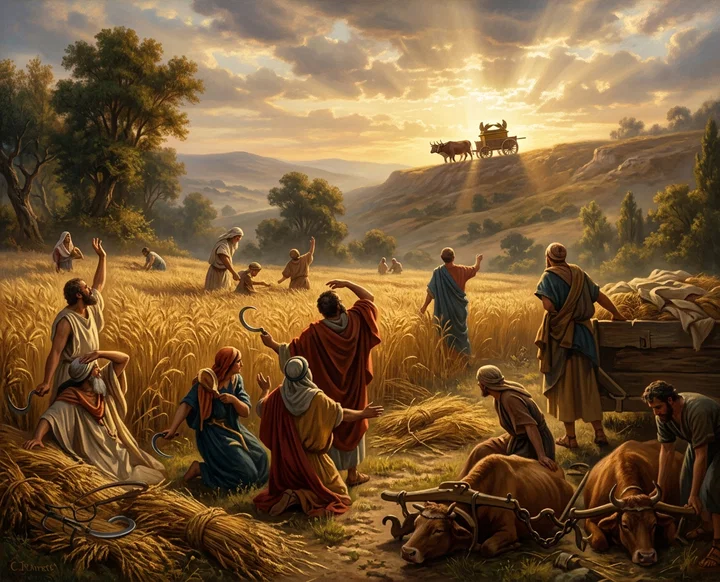
One day a Beth-shemite named Joshua went with his men into the fields to reap the grain. Undoubtedly it was with heavy hearts they thrust in their sickles, while they spoke to one another of the departed glory of Israel. While they were talking, they looked up, and saw a strange sight; for approaching the field where they were reaping, came two lowing kine, drawing a new cart, and in the cart was the ark of God. Unguided by human hands, the kine came “into the field of Joshua, a Beth-shemite, and stood there, where there was a great stone; and the men of Beth-shemesh offered burnt-offerings, and sacrificed sacrifices the same day unto the Lord.” And they rejoiced that God had not wholly turned away his face from Israel.
But it is safe to infer that their prayers were not of the right sort, and contained no heart-felt repentance for the sins that had divorced them from God’s favor; for while the ark was in the field, curiosity so far took possession of them that they forgot, or at least disregarded, the careful instructions they had had concerning the sacredness of the ark,—that ark so sacred that even the priests dared not remove its coverings, but only the high-priest beheld it when he went into the most holy place once a year; they forgot all this, blinded their eyes to the fearful judgments that had already been visited upon them for disobeying, and, removing the coverings, they looked in upon the tables of the law. And God “smote the men of Beth-shemesh, because they had looked into the ark of the Lord, even his servants of the people fifty thousand and three-score and ten men; and the people lamented, because the Lord had smitten the people with a great slaughter.” And they cried, “Who is able to stand before this holy Lord God?” Then they sent for the men of Kirjath-jearim, and they took the ark to the house of Abinadab, a Levite, where it remained for twenty years.
Now these things that happened were examples unto us, and were written out for our instruction. What a lesson this brief experience of the Israelites contains! How careful we should be to render prompt obedience from the heart to all God requires, and to treat with reverence the things he has made holy. God says he does not change; and if he was so careful then to teach people reverence for his law and place of worship, do you think he now lightly regards irreverence in his house, and unfaithfulness in his service?
W. E. L.