One day Jennie went with her papa to see how dishes were made. She was very much delighted with the visit, and when she came home, she wrote out a story about what she had learned. This is what she wrote:—
Papa took me to a pottery, where they make all kinds of dishes. First the man took us through the dressing-room. There I saw piles of dishes, and men and women hammering at them. But we did not stop there; we went out into the yard. I looked into one part of the building where it was all dark, with three great chimneys, broad on the ground and narrow high up.
There wasn’t anything to see in the yard but horses and carts hauling clay, and great heaps of it on the ground. Papa said it was kaolin, not exactly dirt, but clay. He spelled it for me.
There was another of those chimneys in the yard. That is where they dry the clay. Then the man led us to a little door in the side of the house, and we went in. That brought us into a little room where they were getting the clay ready.
The clay was first sieved through a sand-screen. Then it was weighed and put into bins. It looked like fine, dark flour.
A little way from the bins was a big, deep box. They were mixing clay and water in it, and making a paste.
At the end of the box they had a pump working, and it was pumping the paste into what is called a press. I couldn’t half understand it. It looks something like a baby crib, only it has slats across the top, and they’re close together. They have a lot of bags in between the slats, and the clay gets into the bags and gets pressed flat, so that most of the water is squeezed out. When they take it out of the bags, it looks something like a sheet of short-cake before it’s cut or baked. A lot of them are rolled together, and that’s what dishes are made of. They call it biscuit.
After the little room comes one big room, where they don’t make much of anything. It is like a large shed, for it is dark and has no floor. We went through it, and over to one side, and up the stairs to the second floor.
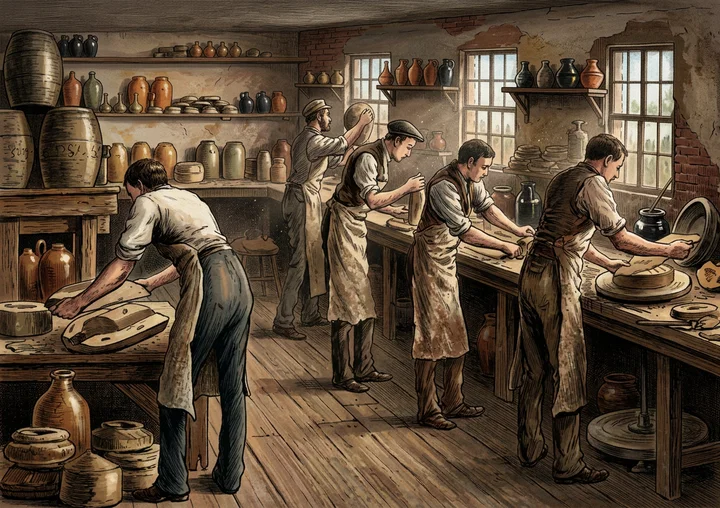
This is in one large room, with ever so many windows. All around the sides, and down the middle, and crossways, and out in the wings are shelves piled full of new dishes. All along the walls are tables on which they make them.
I saw two boys throwing up a great lump of clay and catching it, then cutting it with a string and putting the pieces together again, then throwing it up again, until it made me dizzy to look at them. I asked the man what they were doing, and he said, “Wedging the clay.” That means taking the air out. They keep on doing that until there are no air-bubbles in it.
We stopped and talked to a man who was making a sugar-bowl, and he told us how he did it. All the men have on the table in front of them a lump of clay, a wheel, some molds, a sharp knife, a bucket of water with a sponge in it, and something like a round slab of plaster of Paris to work on.
Do you know what the potter’s wheel is? It looks as if it was made of hard, smooth, baked white clay, and is something like a grindstone, only not half as thick. The grindstone stands up, but this lies flat, with its round side turned up, like the head of a barrel, and is set on a pivot.
The molds are of plaster of Paris. They are round on the outside, and have the shape of what the man wants to make on the inside, and are in two pieces. Little things like cups are made in one mold, but large things like pitchers are made in two or three pieces, in two or three molds, and then put together. Handles and spouts and such things are made separately in little molds, and put on afterward.
This is the way it is done. First the man cuts off a piece of the biscuit, and kneads it on the plaster of Paris slab. Then he takes one piece of the mold, fixes the clay in nicely, shaves off what he don’t want, then puts on the other piece of the mold, and sets it on the wheel. He gives it a shove and sets it spinning. It stops itself after awhile; then he opens the mold, and there is the dish. The clay keeps the same thickness all through, and fills both pieces of the mold.
Then the man takes it out and sponges it. If it isn’t just the right shape, all he has to do is to wet it, and it will come right. Then he puts on the handle, or puts the pieces together, fixing them just so with his fingers and knife. Then they’re ready to be burnt the first time.
We walked all around, and saw here one man making cups, another tureens, another bird-baths, and everything you could think of. Then we went downstairs, through the dark rooms, into where the tall chimneys are. Then I found out they call them kilns. They have at the bottom a large furnace, and over that a huge oven, where they put the dishes in to bake.
But they don’t put them in just as they are. On the high shelves all around are a lot of things called saggers. They look something like bandboxes made of fire-brick. The soft dishes are put into them, the lids are put on, and they are piled up in the oven. Then the men build a big fire in the furnace, and let it burn for several days. When it goes out, they let several more days go by for the kiln to cool, and then take out the saggers. When the dishes are taken out, they are hard and rough and of a yellowish white. The fire is built up after the dishes are put in, and the kiln is allowed to cool off before the dishes are taken out, because the men have to go in and out of the big ovens.
Wouldn’t you think a pile of soft plates and saucers would burn all together and stick fast to each other? But they don’t. There are little things made of hard clay with three bars and three feet, and they put them in between dishes, so that one plate has one in it, and the next sets on top of that, so that they can’t stick together. Did you ever see three little dark spots on the bottom of a saucer? This is what makes them.
We next went into the room back of the kilns. It had shelves all around, too, and there were piles of dishes after the first burning. A lot of women sat on stools on the floor, and they were brushing the fire-cracks with some stuff out of little bottles. This was to fill them up so that the glazing wouldn’t run in.
In another room at one side of the first, they did the glazing. They called it dipping. There was a large tank in the middle of the room, with a deep red liquid in it. The men dipped the dishes in, and they came out a beautiful pink. Then they stood them up on the shelves around the room, and by and by they turned white, just like the ones we have on the table every day.
There is nothing more done to them except dressing. We had now gone all around, and were at the dressing-room, where we started. Dressing is nothing but knocking off any rough lumps with a chisel. Every time I look at dishes, I think there are ever so many things we use every day that we don’t know anything about. —Adapted from Wonder Stories of Science.