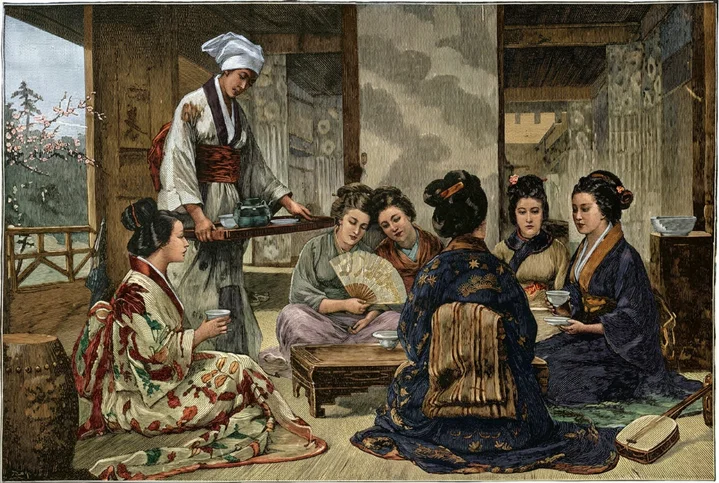
A DINNER IN JAPAN.
By W. S. C.
In the exterior a Japanese house is a dreary, barn-like looking structure; inside it is a paper-doll house on a large scale. The hall, in a private dwelling, is simply a raised platform about two feet from the ground. Here the visitor removes the covering of his feet,—boots, shoes, or sandals, as the case may be;—and enters the interior through a sliding door. That he has been in the house before is no sign that he can recognize the rooms on another visit, because the partition walls, which are all made of paper, and are simply movable panels, are changed repeatedly, as occasion and necessity require. The visitor may, therefore, pass directly to the parlor, the dining-room, the study, or the nursery, as the convenience of the family may have arranged the screens during his absence. There is no privacy in a Japanese house. Conversation can be heard with ease in any part, and the eavesdropper has simply to wet his finger, and touch the paper, in order to obtain a convenient “key-hole” through which to ascertain what is taking place within.
The floors are of a peculiar kind of matting made of stuffed wicker, and are an inch thick, let into the floor. They are kept scrupulously clean. There are no tables or chairs. The Japanese sit down on their heels, wherever they may choose, and their meals are brought to them. At first a stranger takes little pleasure in eating, because of the painful attitude he is forced to assume, in order to follow the custom of the country.
At any time, when tired, the visitor is not obliged to go to bed. All that is necessary is to throw one’s self down on the matting wherever suited, and take one’s ease. At night, all that is required to obtain a bed-room is simply to draw the walls around the selected spot, and rest comfortably and peacefully in company with hundreds of rats, which, never molested, are harmless and very friendly. In the morning it is customary to take a bath; and if an honored guest, the host and hostess with their family will approach the bath while the visitor is thus engaged, and congratulate him upon his good health. On returning to the place of the bed-room of the night before, all will have disappeared, and the entire house, perhaps, have been rearranged. Sometimes a bed is improvised by laying a few of the paper walls first upon the matting, or a futon, or thick quilt, is first laid down, and a rug or blanket furnished to roll the body in.
The bath differs from our American idea of such a contrivance. It is an oval tub, holding about fifty gallons of water. Through the center runs a funnel, or pipe. This is filled with charcoal coals, and soon heats the water nearly to the boiling point. Into this the Japanese boldly enters, sits down, and perspires freely. It requires some courage for foreigners to imitate him, while the members of the entire household stand around, amused at the grimaces of pain and the antics of their guest. It is not intended to wash in these baths, but simply to open the pores of the skin. In proper time attendants present themselves, and, if a stranger, soap the bather, or if a member of the family, administer a rubbing, after which comes a cold douche.
The Japanese are outwardly the most polite people in the world, and at dinner this characteristic is fully exhibited. A party congregate at some chosen spot, and sit down on the floor for a formal repast, ordinary family meals being consumed at such points as individuals elect. As soon as congregated, various objects of interest are handed to the guests, withp. 10 which they may amuse themselves during the waiting period. It is proper to affect the greatest interest in all these, no matter how familiar the object, any lack of interest being considered a grave breach of etiquette.
The first course of soup and fish is then served on a lacquer tray. After drinking the soup from the bowl, the fish is eaten with chop-sticks, a much easier feat than is commonly supposed, a very little practice, with the force of example, making one tolerably expert. Next comes, generally, a beautiful little dish with four kinds of food upon it,—a preparation of chestnuts, a portion of a nicely-cooked small bird or wild fowl, and two little tempting piles of boiled lily root and stewed sea-weed. One is required to eat these, a portion from each alternating, with the chop-sticks. Then comes the native wine, sake. It resembles sherry, and is served hot. The guests do not help themselves. Servants, usually girls, sit on their heels in an outer circle, before the diners, and place a bowl of water and a tiny cup before each. It is their duty to see that the cups are kept constantly filled. If a Japanese desires to drink a glass of wine with a guest or another diner, no words are spoken. He dips his cup in the bowl of water, and moving in front of the selected party, touches the cup to his forehead, and then placing it upright on the palm of his hand, offers it to the one he desires to toast. It is received with profuse demonstrations of appreciation, and then immediately filled by the servant. A few minutes afterward the toast is returned.
The toasting ended, the servants present very small wire gridirons, upon which are laid tiny pieces of horrible-tasting raw fish, with a palatable sauce, and delicious salads. After this course come the inevitable cakes in endless variety, and tea. The tobacco bon, a receptacle for a small brazier, or coal box, pipe, and a place used as a spittoon and depository for ashes, is now brought in, or even previous to the toasts, as the diners wish. When one wishes to retire, it is customary to call for rice, which closes the repast.
During the entire dinner the geisha, or girl musicians, dance to the samisen, the biwa, and the ni-gen-king. They are generally small, beautiful girls, most exquisitely dressed, with marvelously framed headdresses and coiffures. The dinner ends the day in Japan, and the guests depart with as much ceremony as at their arrival.
W. S. C.