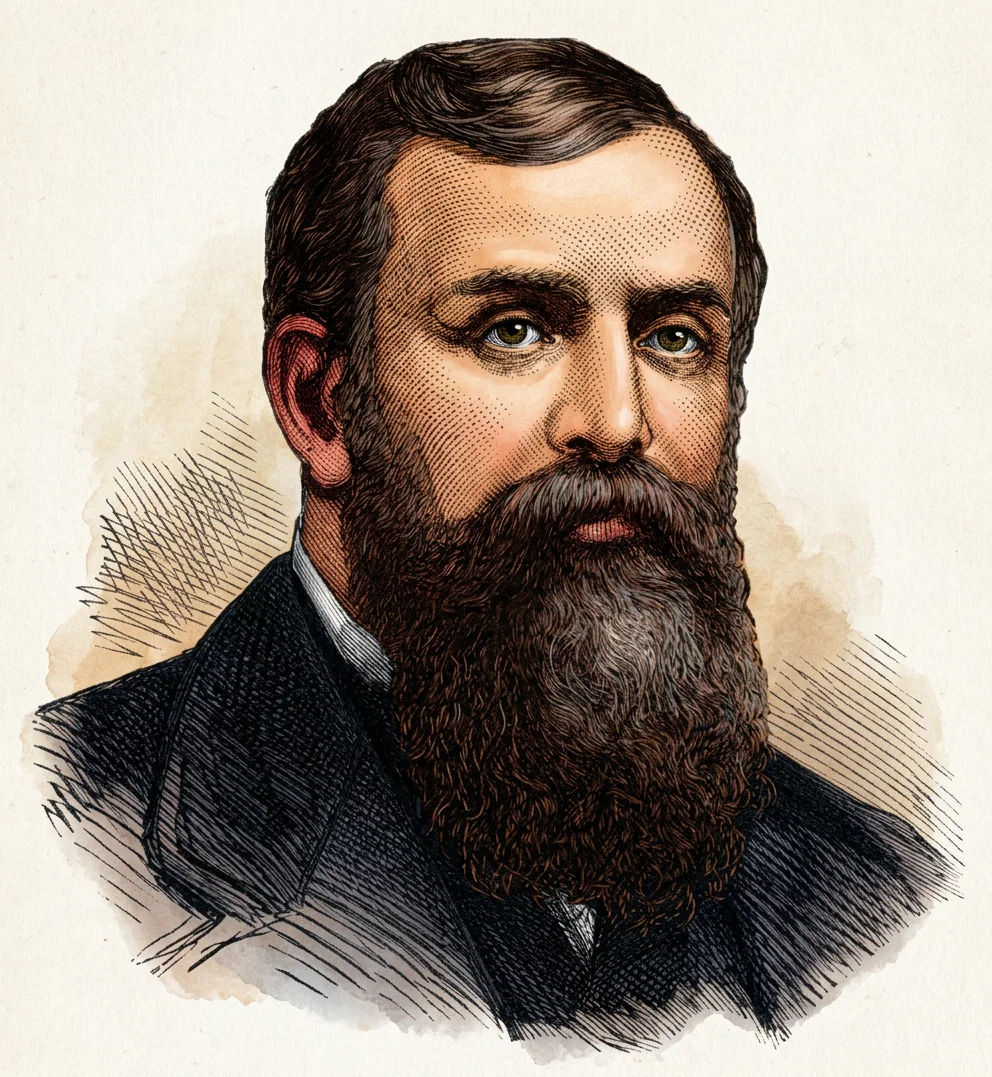
A FAMOUS PREACHER

7%

S. D. A. Publishing Association · Battle Creek, Mich. · Apr 24, 1889

FromThe Youth’s Instructor, Vol. 37, No. 17.

Read the full edition

A FAMOUS PREACHER.

One day, when two boys were going down the streets of a town a few miles from their home, they saw an old man approaching them. Said the elder boy, who had been in the town before, “There is a man that will give you a cent. He gives a cent to every new boy who comes into this town.” The older, not wishing his young brother to lose the cent, told the old man that the boy with him was a stranger in the town. The old man gave him the cent, and, with a kindly smile, placed his trembling hand on the lad’s head, and told him that he had a Father in heaven. The lad was Dwight L. Moody. He never forgot the old man’s kindness.
Dwight’s father died when the little lad was only four years old. He left his widow with a large family of little ones to provide for, and with no means of support. Mrs. Moody refused, when her neighbors suggested it, to give her children away, and, with remarkable energy and courage, by tilling the garden and doing odd jobs for the neighbors kept her family together.
There was not much schooling to be had where there were so many little people to be cared for, and only one woman’s hands to supply the needs. Dwight did not like to go to school. The teacher was a quick-tempered man; and to this little boy no learning at all seemed preferable to the rattan that was laid about the boys’ backs for every misdemeanor. When speaking once of those early days, he told how a change took place in the school. “After a while there was somebody who began to get up a movement in favor of controlling the school by love. I remember how we thought of the good time we should have that winter, when the rattan would be out of school. We thought we should then have all the fun we wanted. I remember who the teacher was—a lady—and she opened the school with prayer. We hadn’t seen it done before, and we were impressed, especially when she prayed that she might have grace and strength to rule the school with love. The school went on several weeks, and we saw no rattan; but at last the rules were broken, and I think I was the first boy to break them. She told me to wait till after school, and then she would see me. I thought the rattan was coming out sure, and stretched myself up in warlike attitude. After school, however, she sat down by me, and told me how she loved me, and how she had prayed to be able to rule that school by love. and concluded by saying, ‘I want to ask you one favor; that is, if you love me, try to be a good boy;’ and I never gave her trouble again.”
Restored with AI
Farming was too dull work for such an energetic boy as Dwight; so he gained his mother’s consent to go to Boston, where he finally obtained a place in his uncle’s shoe store. He attended the Mount Vernon church and Sunday-school, in accordance with his uncle’s advice. The preaching was beyond his understanding; but his Sunday-school teacher had great tact with boys, and persuaded him to be a Christian. Little did he dream what far-reaching results would attend his faithful efforts for this one boy. Young Moody was so awkward in expressing his thoughts that it was not until a year after his public confession of Christ that he was taken into church membership. Even then they thought him “unlikely ever to become a Christian of clear and decided views of gospel-truth; still less to fill any extended sphere of public usefulness.”
But the good people seemed to have forgotten that when a man is in Christ, he becomes a new creature; they forgot the humble fishermen whom God made mighty instruments to do his work. Young Moody did not forget. He believed, as did the apostle Paul, “I can do all things through Christ which strengtheneth me.” The love of God toward sinners seemed so precious that he knew of no reason why he should not tell it, and of many reasons why he should. It was like fire shut up within him. It impelled him to speak even when the more cultured in his church told him that his silence would be more effective for good than anything he could say!
He came to Chicago, where he hoped to find a wider field for usefulness than he could get in conservative Boston. He rented four pews in Plymouth church, for the young men he hoped to bring in. He offered his services to a mission school, and astonished those in charge by bringing eighteen rugged urchins to the school the next Sunday. He distributed tracts among the sailors at the wharves, and went boldly into saloons to work for the inmates. Wherever he saw a soul in wretchedness, there he went to hold up Christ, the joy-bringer.
“Finally,” says his biographer, “he wanted a larger field still, and opened an old saloon, which had been vacated, as a Sunday-school room. It was in the neighborhood of two hundred saloons and gambling-dens! His heart was full of love for the poor and the outcasts, and they did not mind about his grammar. A friend came to see him in these dingy quarters, and found him holding a colored child, while he read, by the dim light of some tallow candles, the story of the prodigal son to his little congregation. ‘I have got only one talent,’ said the unassuming Moody. ‘I have no education, but I love the Lord Jesus Christ, and I want to do something for him. I want you to pray for me.’”
“Thirteen years later, when all Great Britain was aflame with the sermons of this same man, he wrote his friend, ‘Pray for me every day; pray now that the Lord will keep me humble.’”
It is hardly necessary to tell you how his work has grown from these humble beginnings, until now thousands flock nightly to hear him in his commodious tabernacle. He has made two visits to Great Britain. “For the past ten years his work has been a marvel to the world, and, doubtless, to himself. His sermons have been scattered broadcast by the hundreds of thousands. He receives no salary, never allowing a contribution to be taken for himself; but his wants have been supplied. A pleasant home at his birth-place, Northfield, has been given him by his friends, made doubly dear by the presence of his mother, now over eighty years old. He has established two schools here, one for boys and another for girls, with three hundred pupils, trained in all that ennobles life.
“The results from Mr. Moody’s work are beyond computing. In his first visit to London a noted man of wealth was converted. He at once sold his hunting dogs, and made his country house a center of missionary effort. During Mr. Moody’s second visit the two sons at Cambridge University professed Christianity. One goes to China, having induced some other students to accompany him as missionaries; the other, just married to a lord’s daughter, has begun mission work among the slums in the East End of London.”
This is only one instance among the thousands that might be pointed out. One poor, unlearned lad, because he loved the Lord, let the light he had, shine out. He believed the Bible true when it says Christ died for all, and that whosoever believed on him might be saved. He was willing to sacrifice his own comfort to help others. He was dead in earnest. He used his one talent. Mighty results followed. What are you doing with the light God has given you? Have you told others of the merciful Father, who is not willing that any should perish? Do you say it is so little you can do? Suppose Mr. Moody had stopped when he was told that his silence would serve God better than active service! God gives to “every man his work,” and to every child his work, and you may be sure he has some for you to do. He wants you to work for him because you love him, and to leave the results to him.
W. E. L.