If all the lands made beautiful by mountains and valleys, lakes and waterfalls, Norway is the most picturesque, surpassing even the land of the Alps. The whole country is broken and rugged, and every mile has its changing scenes of verdure and rock and bewitching cascades. Lakes lie high up on the table-lands, and their waters find vent only in narrow crevices of the mountains, through which they tumble uproariously down, striking the projecting shelves of rock and scattering in cloudy spray, then gathering up their fragments and rushing on, leaping, whirling, thundering down to the sea. Huge glaciers, too, are formed on these highlands, and are slowly but constantly pushing their way down to the valleys.
In such a land as this we might expect to find a people sturdy and independent, healthy and honest, with a wealth of love for home and country; and so they are. From valley to mountain-crest their dwellings are scattered, sometimes in such precarious places that it seems a miracle they are not blown off by the fierce winds that sweep around the craggy summits. But there they nestle, held close in the rocky niches, the contented farmers sowing and reaping their year's harvest in the short summer, and making merry by the bright fireside during the long, dark winter.
A Norwegian home usually consists of several separate buildings surrounding a little yard, and all painted red. There is the living-room, with its open fire-place or porcelain stove, a long bench or two to sit on, perhaps some chairs made by sawing off a tree trunk and leaving part of the bark for a back, and a bed or two. Then there are barns, hay-sheds, houses for sleighs, wagons, carts, blacksmithing, etc., sometimes as many as twenty different structures all belonging to the same farm.
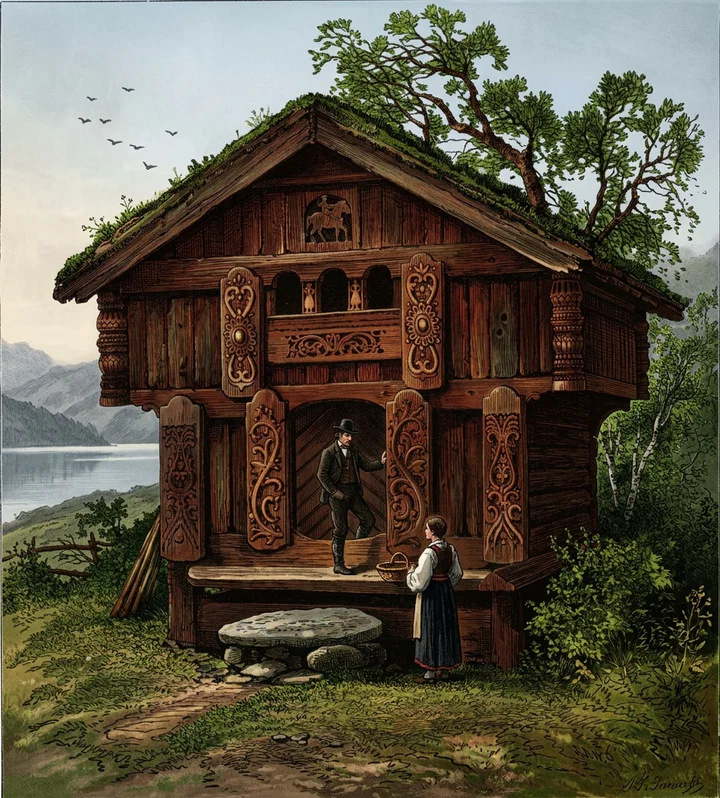
The most curious of these is perhaps the one shown in the engraving, called a stabbur. It is the family store-house, and has an almost sacred character to these mountain farmers. In the olden days, this was a room where all kinds of provisions and clothing were kept. After a time a second story was added, and the clothing was brought up here and hung high, so that it might be kept free from the dampness rising from the ground. There were windows in the ends, so the air could circulate freely. In those times, personal property was mostly in clothing, either in wearing apparel or for beds. So it was very important that it should be well taken care of. Originally built for a store-room, the upper story soon came to be used also, as it is to this day, as a sleeping-room for guests. Especially were noted guests taken here to rest on the softest of feather beds and pillows, and in the whitest and cleanest of linen sheets.
Great care was used in the construction of these buildings, provision always being made for a draught of air under the floors. Elaborate carvings often adorned the doors and windows. To prevent the entrance of rats and mice, the stabbur was sometimes built on posts, and this was what gave such buildings their name. The peculiar shape of these houses, especially those in Southern Norway, attracts the attention of strangers at once, and their dark, weather-beaten walls tell of their antiquity.
MARY STEWARD.