ECLIPSES

5%

S. D. A. Publishing Association · Battle Creek, Mich. · Mar 12, 1890

FromThe Youth’s Instructor, Vol. 38, No. 11.

Read the full edition

ECLIPSES

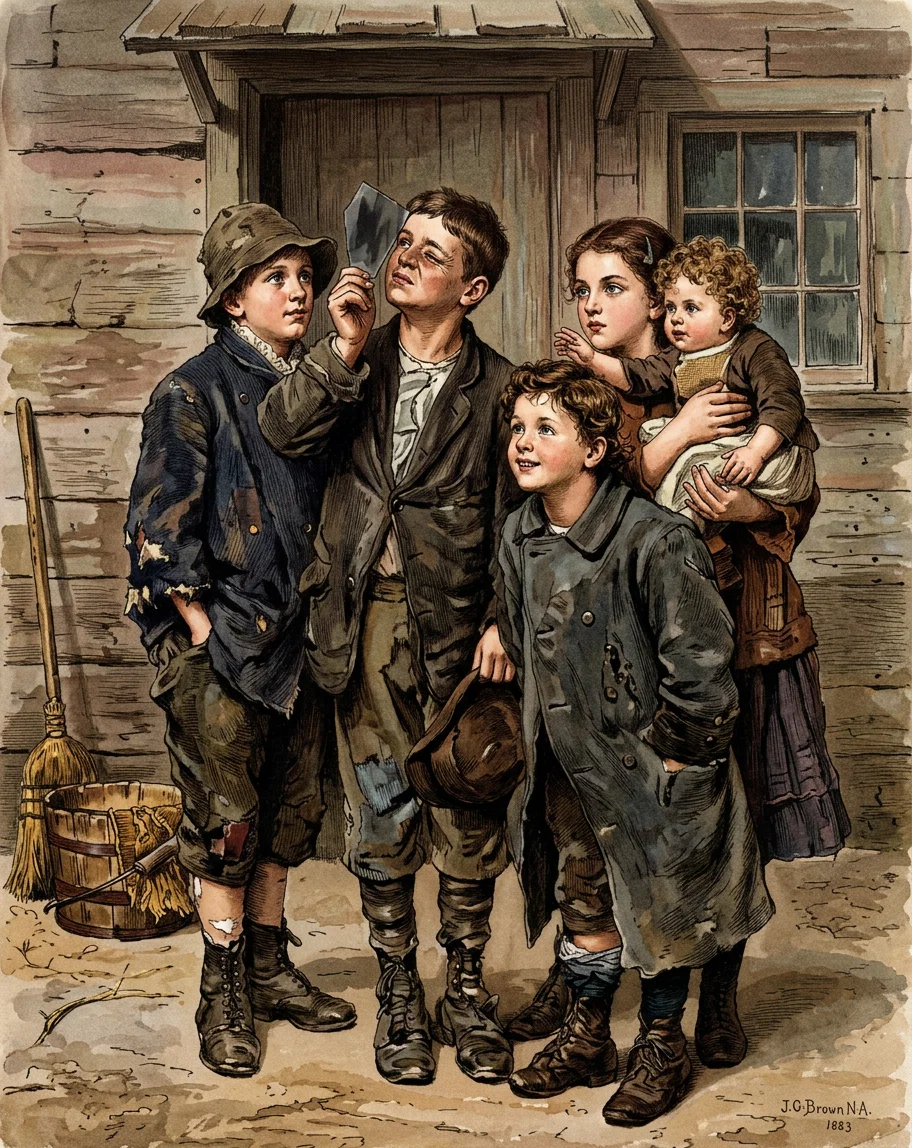
The little Bentleys all stood outdoors, looking up into the sky. There was something going on there that interested them. It was an eclipse of the sun. Jack and Harry had heard it talked about in the streets, and they had told it to the others at home. There had never been an eclipse since they could remember, and the thought that anything but a cloud could dim the bright sunshine, sent a little chill of terror over them.
With some trouble and a few burns of his fingers, Jack had succeeded in smoking a piece of window-glass; for the sun, even under an eclipse, was too bright to be looked at steadily.
“I smoked the glass,” said Jack, “and it’s my place to look first.”
“But Nettie’s the oldest, and she’s a girl,” said Elmer, who always wanted to see his sister treated kindly.
“Don’t care if she is,” Jack replied gruffly, “I’ve got the glass,” and he proceeded to look at the eclipse, holding the glass a great deal longer than he really cared to, because he was angry at Elmer.
Restored with AI
“Nothing about an eclipse to make such a fuss over, after all,” said Jack, turning to hand the glass to Nettie.
But Nettie had had to go in. Master Teddie, who was Nettie’s especial care while mother was away to work all day, had set up his claims for attention, and before he could be quieted, the eclipse was all over; for the sun, way off in the heavens, couldn’t wait for a little girl to quiet a restless baby before he took the shadow off his face.
Jack felt mean when he saw Nettie’s disappointed face, but he did not say he was sorry. He only spoke crossly to Sam, who wanted him to come and see how funny everything looked through the blackened glass, and he hit his foot against the block house Elmer was making for the baby. The baby set up a wail, and Elmer said some angry words himself.
Then there were two eclipses in one afternoon; one was in the great sky of nature, and the other was in the household sky, and it shut out the sunshine of love. Jack blamed everybody but himself because things didn’t go smoothly; for he was looking through the smoked glass of selfishness. He was the oldest boy, and of course he had a right to the first use of things, he reasoned.
The next day, when Nettie had swept the room and put it to rights, and had got the fretful baby asleep in the cradle, she said to herself, “Now I can have time to finish my new apron,” and she went into the other room for her thimble and thread.
While she was gone, Jack came across the clean floor, with his shoes all covered with mud, and left great clumps of dirt behind him at every step. He had a branch of willow in one hand, and in one end he had made a whistle. The shrill shrieks he forced out of it waked up the baby, and brought Nettie in a hurry from the other room.
“O Jack!” she cried in dismay, as she went to take the baby up, and saw the muddy tracks on the floor, “Why can’t you remember to clean your boots? Now you’ve waked the baby up, and I can’t do anything more this forenoon but tend him!” Nettie looked as though she thought it was hard to be the only girl in a family of boys.
“That’s what girls are for,” Jack replied unkindly, “and I guess I can whistle if I want to.” And he gave another loud blast that was almost deafening.
Then Nettie cried. “I think you are the hatefulest boy I ever knew,” she said.
“And I think you are the silliest girl I ever knew,” he answered; “can’t look at you without your crying.”
And so the bright sunshine and home happiness were shut out another day by Jack’s selfishness.
I wonder how many of my little readers have eclipses at their houses. How many let selfishness and discontent shut out the happiness that might be theirs, and make other people unhappy also?
W. E. L.