In one of the most beautiful places in England, on the banks of the Thames, stands Eton College. It was founded over four hundred years ago by King Henry the Sixth. Near the college, on the banks of the same river, is Windsor Castle, from whose windows the unhappy king no doubt often looked upon the stone masons and the carpenters, as they reared the buildings under his directions. King Henry loved nothing so much as quiet and books; so he founded two colleges in his lifetime,—this one at Eton, and another, King’s College, at Cambridge. But though he loved quiet and study, he could get very little of it himself; for all his life he was embroiled in those bitter quarrels that resulted in the wars of the Red and the White Roses,—quarrels so bitter, and troubles so annoying to him, that at last he went crazy.
Whenever the king met any of those first Eton boys in his beautiful grounds around the castle, he generally gave them a little present of money and this wholesome advice: “Be good boys, meek and docile, and servants of the Lord.” He did not much like to have them come; for he knew, better than they, that kings were not happy.
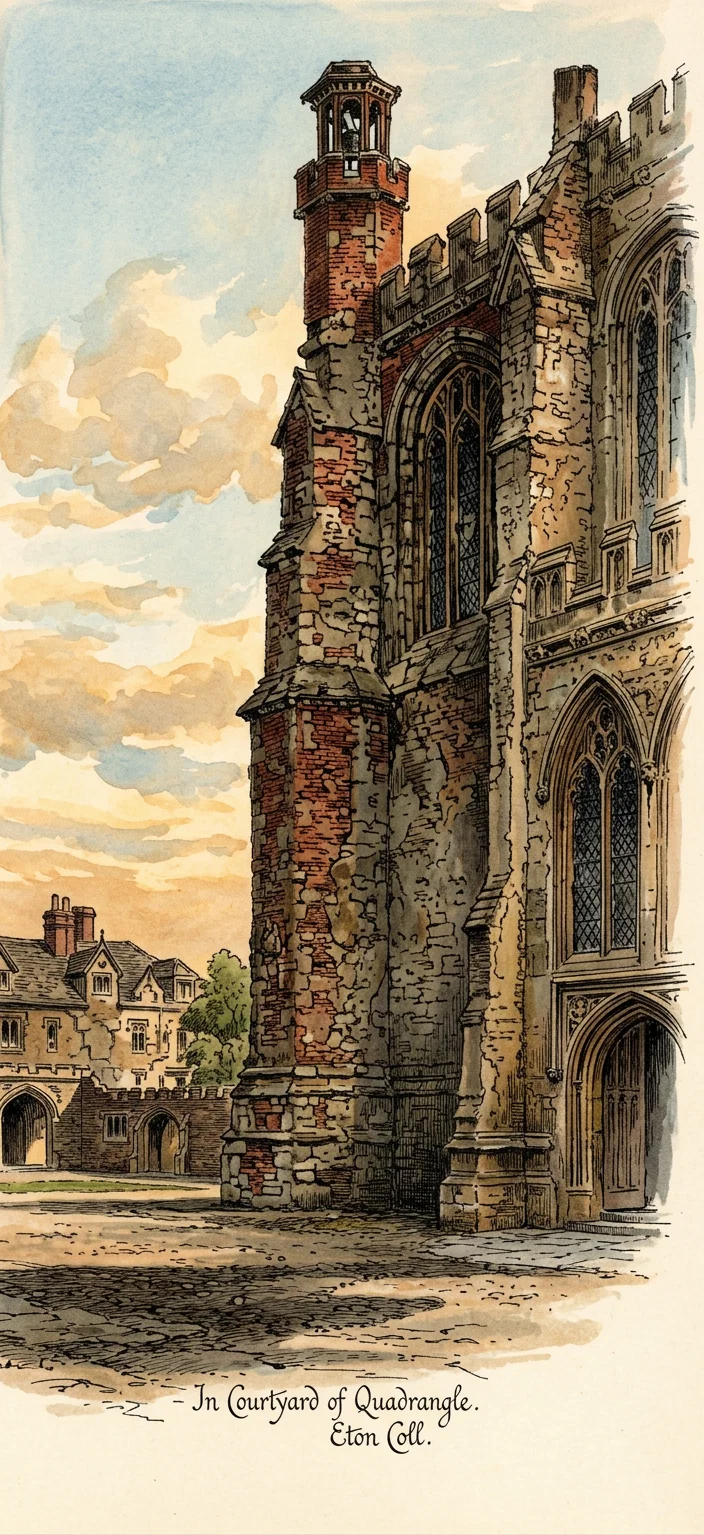
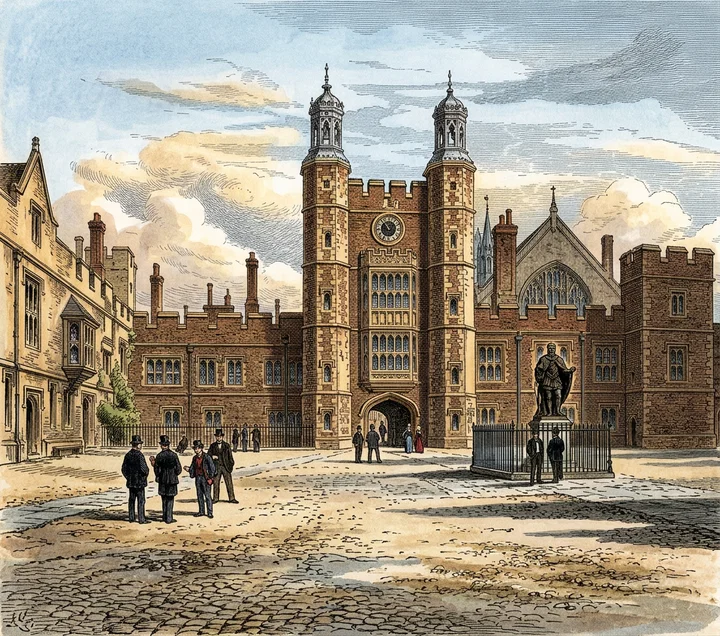
The buildings of Eton are located, as was the fashion to build churches and schools then, around an open space, thus making an inclosed yard, or court, called the quadrangle. In this quadrangle stands a statue of the king, with a scepter in his hand. King Henry is held in great veneration by the boys.
When the college was first opened, the king appointed “a provost, a head master, a lower master, who was called the usher, ten fellows, ten chaplains, ten clerks, sixteen choristers, seventy scholars, and thirteen almsmen; for in those old times they used to have a place set apart for the poor in almost all institutions.” But this is much changed now. The almshouse was banished before King Henry died, and the ten fellows, who were priests allowed to spend their whole lives in study at the college, are also gone.
But the seventy scholars are there. These are poor boys who are allowed to go to school free of charge. At first they were appointed by the heads of Eton and Cambridge; but now they are admitted on competitive examination. The examination is a severe one, and it is considered a high honor among the boys to receive an appointment. There were few good schools in England when Eton was founded, and so pupils were sent here from all parts of the kingdom, to obtain an education. These boys were not permitted to live in the college building, but boarded out in the town at their own expense; hence they were called “oppidans,” which means “town-boys.” The “collegers” still board in college hall, while the “oppidans” room in the different masters’ houses around the town. “Every master has charge of thirty or forty boys, and every boy has a little room of his own. And very snug rooms they are, too, with the tables covered with books, and pretty things from home on the mantle-shelf, and the walls decorated with photographs and the pictures of hounds and horses. And the School Almanac is sure to be there, and the rules of the boat-clubs, and all sorts of hats and caps, and cricket-bats, and pewter cups won in the races.”
There is one custom prevalent among English schools which is not seen in America. The older boys have fags, that is, boys whom they select from the younger members of the school to do menial service for them. “Fagging,” says one, “is not easy work at Eton. Fags not only have to wait on their fag-masters at almost all hours, to bring them water, and to look out for their rooms, but they even have to cook for them. All the boys of a house take their dinner together; but excepting in two or three houses where a new rule has been made, every one has his breakfast and tea in his own room. And for these meals the poor fags are cooks and waiters. There is even a kitchen provided for their especial use, where they boil water, brew tea, and toast bread. Many heartaches have there been in those little kitchens! Fancy a youngster just out of the home nursery, you might say, being set to making toast, when he knows as little about it as he does about making Latin verses! And yet, if it is not all right, his fastidious master will take him to task with all the indignation of disappointed hunger, and then send him off to do his work over again.”
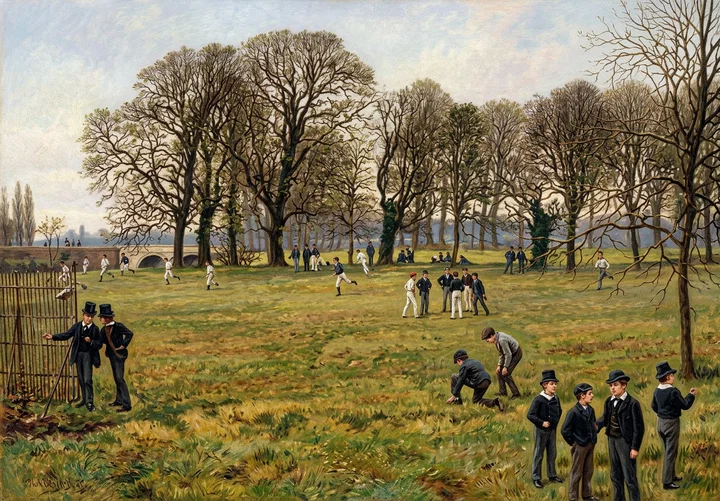
After school hours in the afternoon, the boys toss aside the tall silk hats and black coats and trousers, which custom obliges every Etonian to wear, exchanging them for caps and flannels, and hie away to the playground, which is soon alive with boys. Eton playgrounds are very beautiful. The shady elms of Poet’s Walk invite to delightful rambles, the green fields hold out inducements to the cricketers, and the Thames River, flowing close by, is specially tempting to all lovers of aquatic sports. “English boys are as serious at play as at study, and they will not spoil their chances of becoming either a really good cricketer or good oarsman, by trying to be both. It is considered an important moment when an Etonian decides whether he will be a ‘dry bob’ or a ‘wet bob.’”
No boy is allowed to join the boating-clubs who has not first learned to swim well. Every year boat and cricket matches are held between Eton and rival schools, and these seasons are very exciting to the boys.
And now I shall give you a description of the school from two travelers who have been there, and wrote out what they saw for the young readers of the St. Nicholas: “Across the yard, in front of us, beyond King Henry’s statue, is the Provost’s Lodge, filling that whole side of the square, and with the great clock-tower in the middle.
“On the right, as you stand in the gateway, is the great chapel, one of the most magnificent churches in all England, though not so magnificent as Henry meant it to be; and beyond that is the hall where the seventy collegers dine, with its fine stained-glass windows and big stone fire-places and portraits of famous Etonians. On the left is the Lower School, with the collegers’ rooms above it, where Long Chamber used to be; and over our heads, as we stand in the gateway, is the Upper School. The Upper School is a very long room. It is full of stools for the boys, and there are five desks for the masters, and great curtains which can be drawn to divide the long room up into small rooms. There are busts of kings and queens and statesmen all around; and the oaken panels of the walls are all cut up with the names of old Eton boys. In one very small space you can see the names of Chatham, Howe, Wellington, Canning, Gray, and Fox. At the end of the Upper School is the head-master’s room, a very handsome room, full of pictures of Athens and Rome. Here the sixth form is taught.
“But I think the old Lower School, with its rows of rough, worn-out desks and benches, is even more interesting than the Upper School. Here, too, the windows and the posts are all cut up with the names of those who, in the old days, obtained scholarships, and went up to King’s College at Cambridge.”
“The classes at Eton are much the same as at other English schools. The sixth is the highest form, and then follow the other forms and divisions. So long as they are in the Lower School, the boys do almost all their work in the pupil-room. At stated hours they study with their tutors, who then helpp. 74 them to prepare their verses, so that when they go to their masters, their work is really done.
“The day begins with ‘morning school,’ at seven in the summer and half-past seven in the winter, and this hour is the most miserable of the twenty-four. Then comes breakfast, plenty of time being allowed for the fags, after they have waited on their masters, and perhaps run for them to the ‘tuck’ shops for extra delicacies, to wait on themselves. Next comes a twenty minutes’ service in the chapel, to which all Etonians must go. At the end, they march out in regular order, first the collegers, in white surplices, then the oppidan sixth form, and finally the oppidans of the lower forms.
“After this, work begins in earnest with ten o’clock school, which lasts from quarter of to half-past ten, and is quickly followed by eleven o’clock school. For two hours there is a great quiet in Eton. When they are over, comes the ‘after twelve.’ Until two o’clock the elder boys do whatever they like; but the unfortunate little fellows in the Lower School must go on constructing and grinding out Latin verses in pupil-room. At two, however, when the dinner-bell rings, they are also at rest. They can at least eat their midday meal in peace; for they know that if the mutton is underdone, they will not have to roast it the second time, that if a glass of water is called for, they will not have to fetch it.
“The ‘after two’ is very short, afternoon school beginning again at three. The ‘after four,’ from a quarter to four to a quarter past during the winter term, is quite a favorite time for a walk on the High street. If you happen to be out just then, you will see boys in every shop in deep consultation with tailors and boot-makers, making appointments with photographers, looking over books, or more often in the confectioners’, eating pies and sweets. The fags, too, are on duty again, and are marketing for their fag-masters. As ‘lock-up’ in winter is at five o’clock, the boys have a long evening in the house. This they spend sometimes in studying, but, as a rule, in doing whatever best suits them. But you must not think on this account, these are always idle hours. There are many prizes outside the regular course, for which the boys compete; and then—another great reason for study—all who distinguish themselves in their school work are, like the great cricketers and oarsmen, looked up to as the ‘swells’ of the college. There are, besides, the house debating societies, and the great school debating society called ‘Pop,’—to which so many famous Englishmen belonged in their Eton days,—and literary societies and magazines; and altogether any Eton boy who chooses will find more to do than he has time for.” W. E. L.