A THREE-MULE COACH

10%

S. D. A. Publishing Association · Battle Creek, Mich. · May 8, 1889

FromThe Youth’s Instructor, Vol. 37, No. 19.

Read the full edition
Restored with AI

A THREE-MULE COACH.

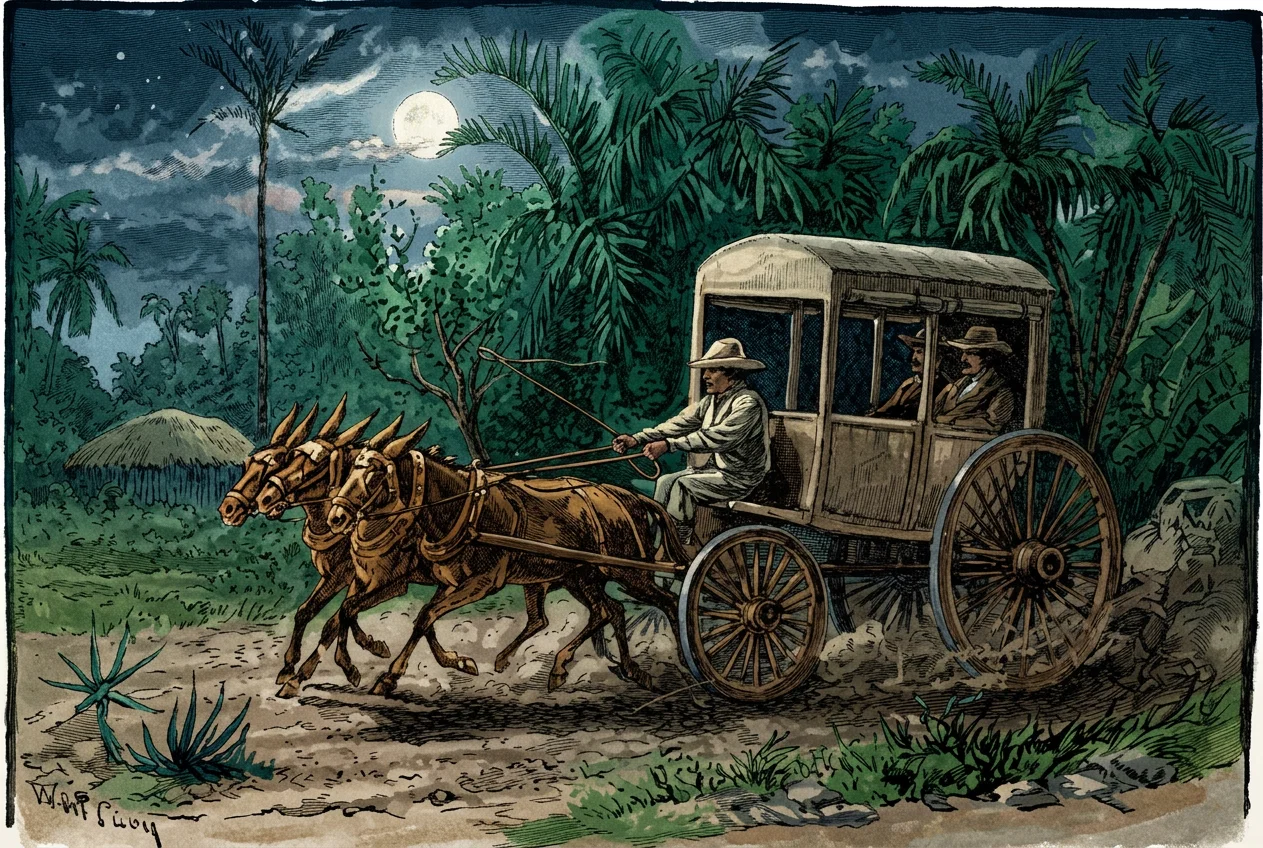
THREE mules harnessed abreast to a coach! Where do they do it? In some countries of Europe they drive horses and mules in this way. The people of Mexico would laugh to see horses driven in pairs, or one ahead of another, because it is not their custom.
It was in a country called Yucatan that I traveled in this manner. Yucatan is far south of the United States, and is a portion of Mexico. The land is low and flat, like a great broad table of coral rock. It is very hot there.
Being so hot by day, people travel by night, when it is cool. The roads are dusty, but you don't mind the dust so much at night. I hired a driver and this coach with three mules to take me forty miles from the city I was living in, to a hacienda. This is a Spanish word meaning an estate, or farm.
As you may know already, a large part of America was once owned by Indians. The first people who visited them were the Spaniards. They were not willing the Indians should have so much good land, so they took it away from them. Then the Indians had nothing to do, and the Spaniards set them to work. They worked so hard that nearly all of them died.
Why did the Indians allow them to make slaves of them? Because the white men were stronger than they, and had guns, powder, armor, swords, and cannon. The poor Indians had nothing better than bows and arrows. Little by little the white men from Spain took the best part of America. But they have lost nearly all again; for they are not so strong as they were. They own only two islands now, in America. These are Cuba and Puerto Rico. But in the countries they once conquered, the people speak Spanish. Even the Indians, most of them, have forgotten their own language, and speak Spanish. This is the reason why we find large estates in Yucatan and Mexico called haciendas, and small farms called ranchos.
The estate I visited was very large. Its owner had forty square miles of land. This was planted with only one kind of plant. For miles and miles you could see nothing else. A great sea of green was spread out on every side.
What do you suppose was so profitable in Yucatan that they planted nothing else? It was not wheat, or barley, or oats, or even corn, though corn will grow there. It was the hemp plant. The soil is so poor that but few other things will grow there. But the hemp plant is at home here.
From hemp is taken a fiber from which twine and ropes can be made. This fiber is cleaned, and packed in bales, and sent by steamer to New York. There it is bought by the merchants, and sold by them to the rope-makers. Perhaps this very fiber, after having been twisted into ropes, may visit the land of its birth again. Thus the world is kept moving. We buy of other people what we need, and send them our products in payment.—Fred A. Ober.