HOW STEEL IS MADE.
By J. O. C.
If we were to look in the dictionary for an explanation of what steel is, all we would be able to learn would be that it is a combination of iron and carbon. But this is just what cast-iron, and even wrought-iron, is. The principal difference between any of these seems to be in the proportion of the ingredients in each, or in the manner of their combination.
As to what carbon is, we are told that it is a substance different from metal, which is found in all vegetable and mineral bodies, and is also the principal element which forms the several kinds of mineral coal. The diamond is said to be pure carbon in a crystallized form. The graphite, or black lead in our lead pencils, is carbon in which is a trace of iron.
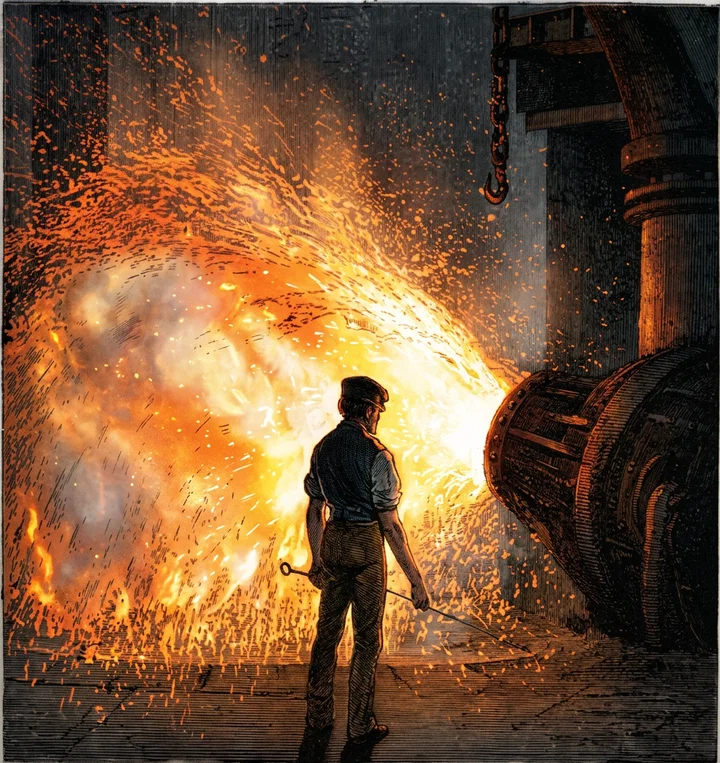
Steel has more carbon in it than wrought-iron, but much less than cast-iron. It is made from bar-iron, by a process which was first known in England about the middle of the last century. The bars to be converted into steel are put into a large conical furnace, or “converter,” like that in the picture, which is so arranged inside that the fire may burn all around the outside of the iron, and keep it at a high and regular heat.
At the bottom of the converter a layer of powdered charcoal is scattered, and on this is placed a row of the iron bars. On the top of these another layer of charcoal is scattered, and another row of iron bars, until the converter is full. Over the whole of this is laid a heavy coat of cement, to prevent the charcoal from burning away. The fire is then lighted, and kept fiercely burning by means of large bellows blown by machinery, which keeps up a constant roaring, and throws out fire and sparks.
When these bars are taken out, they are covered with blisters, like wood when freshly painted and exposed to the sun. They are then known as “blister steel,” and are fit for nothing but the coarsest kind of work. They must therefore go through further preparations, in order to make them into fine steel, fit to use in the manufacture of the best cutlery. So these bars of “blister steel” are put into large melting pots composed of indestructible materials. These are placed in a furnace, and subjected to the most intense heat, when, at a given time, the man who is tending the process, adds a mixture of carbon and manganese to refine the steel.
When certain signs appear in the condition of the metal, the pot is quickly removed, and its contents poured into large cast-iron molds, which were made ready while the steel was in the furnace. The molds are made in halves, to fit exactly together, and are coated on the inside with some kind of composition. Placed on end with the top open, the mold is ready to receive the liquid steel, which is poured straight down into it, with the care and nerve which only long practice can give. When the casting is cool enough to be taken out, the two halves of the mold are separated, and the contents are turned out ready to go to the large steam hammer.
Manganese, so much used in refining steel, is a grayish-white metal, having the appearance of hard cast-iron, brittle, and very difficult to melt, yet when oxidated, as it will become in the air, it drops down as a black powder. It is used to give the black color to certain pieces of china, and is employed in clearing flint-glass of impurities, and to give it a purple tint. It is largely found in France, Spain, and Portugal, where it lies scattered near the surface of the ground. It has also been found in great Britain.
When steel is highly refined, it has wonderful properties. If a thin strip of it is bent double, it easily returns to its former shape when the pressure is removed. In this condition it is made into steel pens, or springs for watches and clocks, and other delicate purposes. Much of the machinery now in use is made of steel, and all the rails used on our railroads are of the same material, because it is so much harder than common iron, and will last a great deal longer.
J. O. C.