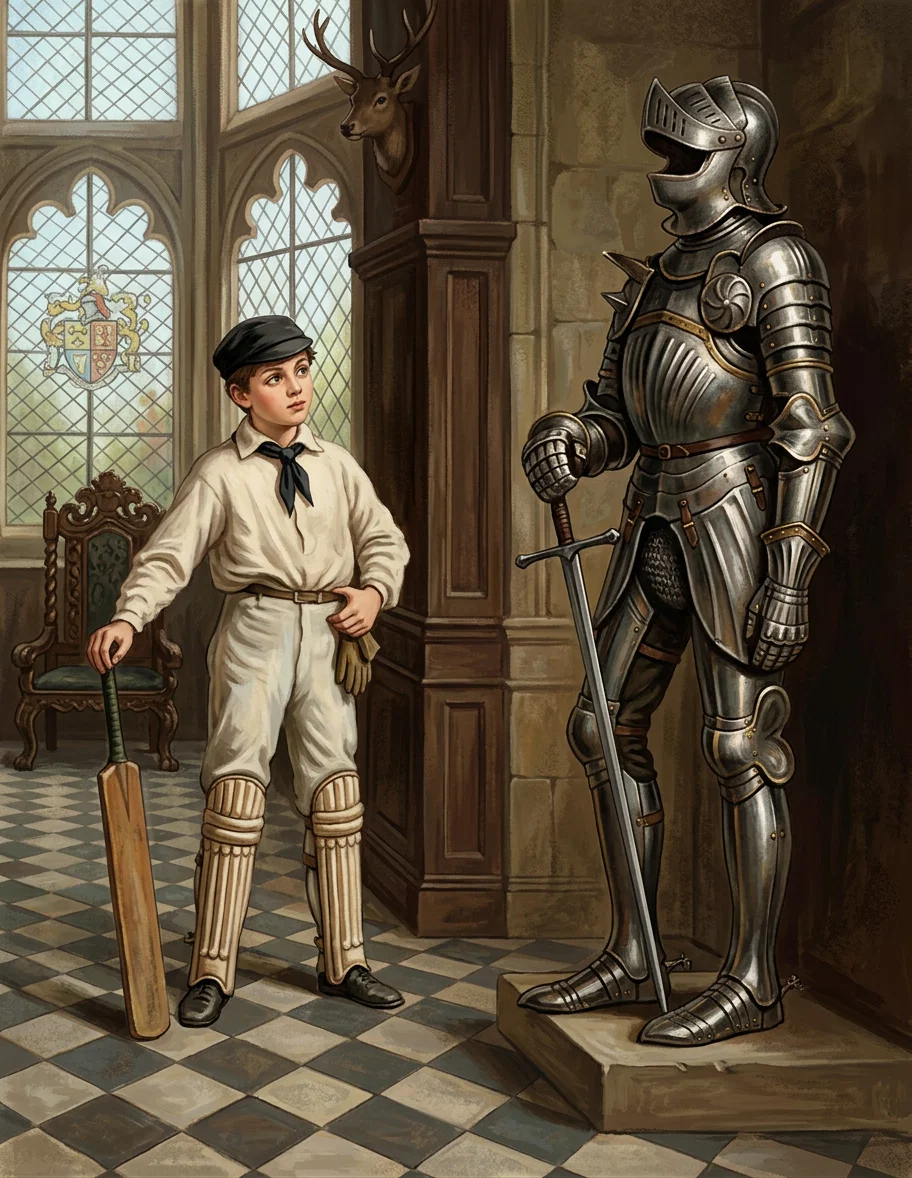
As long as war has been one of the conditions of life of the human family, so long have various methods and means of personal protection been used. The ancient methods of warfare, and the arms used in war, were very different from those used at the present day. Then it was a hand-to-hand conflict, with swords and spears and arrows; but the invention of gunpowder has entirely changed all these. And while these various contrivances for protection might have been of much service in those days, with the methods and instruments of war then used, at the present time they would be worse than useless, by their cumbersome weight and their impediment to the free movements of the wearer, and their inability to shield the wearer against the terrible missiles that are hurled from the mouths of rifles and cannons by the force of exploded powder.
Restored with AI
The history of the many kinds of armor that have been used in war by the various nations is very interesting. It is asserted by some writers that the skins of wild beasts formed the first means of defense of the body. But it is certain that bronze, or brass, was very early used as the material of these helmets and body armor; for we learn from sacred history that away back in the days of David's youth, when he went forth with the armies of King Saul to fight the Philistines, in the valley of Elah, that a haughty giant Philistine, who came out and bade them defiance, “had an helmet of brass upon his head, and he was armed with a coat of mail, and the weight of the coat was 5,000 shekels of brass; and he had greaves of brass upon his legs, and a target of brass upon his shoulders,” etc., and when David told King Saul that he would go and fight the haughty Philistine alone, Saul, thinking to protect him from the weapons of his adversary, “armed him with his armor, and put an helmet of brass upon his head; also he armed him with a coat of mail.” But as David did not like these, he finally put them off, and went forth armed only with a simple sling and five smooth pebbles from the brook.
The accompanying engraving presents a very good illustration of a complete suit of armor as worn by the ancients. With different nations its construction and form were changed. While some adopted a style which covered the entire body, with the exception of a portion of the face, others wore an armor which left many parts of the body exposed. We also learn that the ancients possessed a secret by which they accomplished that which modern science has failed to do,—the tempering of copper, or bronze, so that it would carry a cutting edge, and would repel a sword-blow or a spear-thrust, without bending.
From that of a rude piece of workmanship, these armors became very ornamental, and the splendor of their construction became a matter of much attention. Froissart records the case of Raymond, a nephew of Pope Clement, “who was taken prisoner, but afterward put to death for his beautiful armor.” Miniature wings were attached to the back and shoulders, the caps were adorned with plumes and feathers, and much effort was made to make them exceedingly showy.
Thus as the methods of warfare changed, these things changed also, until, instead of being worn only as a means of protection in battle, they were worn solely at tournaments and on festive occasions.
In the Tower of London there is preserved an unbroken series of specimens of the armor of every reign from the time of Henry VI. to that of James II., with whose time the use of the complete armor is said to have ceased. So perfect and complete had this armor become, that historians tell us that in Italy, where the best armor was made, two armies fought from nine o'clock in the morning until four in the afternoon, and not only was no person killed, but no one was wounded.
This armor is frequently spoken of, not only by the writers of the Old Testament, but also by those of the New. The Apostle Paul, in his writings to the churches, uses it to enforce upon the minds of his brethren the truths he was endeavoring to teach them, exhorting them to, “Put on the whole armor of God, that ye may be able to withstand the wiles [or attacks] of the Devil.” And that Paul was familiar with that of which he was speaking is shown by his enumeration of the various articles of armor deemed necessary for complete protection against the weapons of the enemy. He says: “Stand, therefore, having your loins girt about with truth, and having on the breastplate of righteousness; and your feet shod with the preparation of the gospel of peace: above all, taking the shield of faith, wherewith ye shall be able to quench all the fiery darts of the wicked. And take the helmet of salvation and the sword of the Spirit,” etc. Eph. 6:14-17.
If it was necessary for the ancient warrior to so thoroughly equip himself with the armor provided for him, it is equally as important that the Christian, fighting the spiritual warfare, be thoroughly clad in the armor provided for him. The foe he has to meet is a strong and wily one, by long experience, and he readily sees the weak and unprotected points in the Christian's character. While such complete provision has been made for our protection in this warfare, let us be diligent to heed the apostle's injunction to “put on the whole armor, that we may be able to stand.”