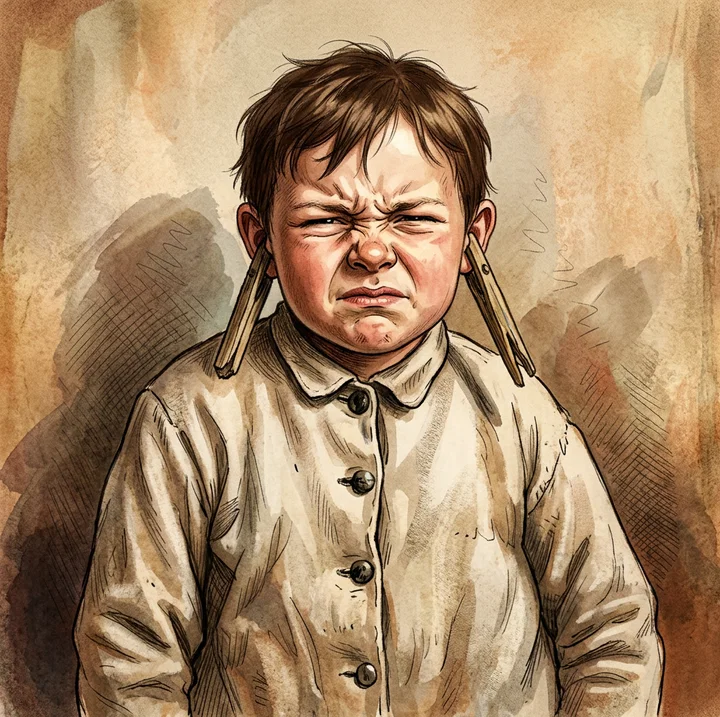
“O MAMMA, what does ail the little boy? See his funny ears; and how he squints his eyes?”
“Why, don’t you see the little fellow’s ears are being pinched? This is why he scowls so. If you would like to know how his ears feel, you can cut a slit in a stick and crowd it on to the tip of your own ear. Then, too, if you should look into the glass before you took it off, I think you would see another squint-eyed boy.”
“Does he put the sticks on to his ears in play, mamma?”
“He might do that for ‘just a little minute,’ as you say; but boys and girls don’t like to feel pain well enough to play that way very often. The sticks were put upon this little boy’s ears at school, to punish him for being naughty.”
“My teacher never punishes that way.”
“I don’t think teachers do so very often now-a-days; but ever and ever so long ago, as many as forty or fifty years, and more, they had a great many queer ways to correct naughty children. They seemed to think the most curious way was the best.”
“Don’t you know some of them to tell me, mamma?”
“May be I can tell you some things that happened at school when I was a little girl. One thing in particular I remember. In the teacher’s desk in those old-time school days there was always a ferule. This, as I think you have been told before, was a flat piece of wood two or three inches wide and some twenty or more inches long. With it and the whips the boys brought from the fields at the master’s bidding, disobedient children were sometimes pretty severely punished.”
“But the ferule was the stand-by, and was used in a great many ways besides in giving blows upon the open hand. The transgressor was often made to balance it upon his head for an hour or more while walking about the room. At another time he had to hold it upon the tips of his fingers with his arm stretched to its full length.”
“Some teachers would oblige the boys to bend over and place the fore finger of one hand upon a crack of the floor. Permission was given to change from one hand to the other once in awhile, but in some cases, to make the punishment more severe, the teacher would aim now and then a blow upon the bend of the body.”
“It was the most vexing to the boys to be given a ‘cutter ride,’ as the teacher named it. The pupil would take a position upon his hands and feet like a four-footed beast, and then have given him several rousing blows with the ferule upon the bend of his body.”
“To stand or sit upon the ‘dunce-block’ for breaking the rules of school, did not seem very hard, unless the teacher, to shame the scholar, dressed him in some ridiculous way.”
“One kind of punishment for lying was to place upon the end of the tongue a split stick like those upon the boy’s ears. Another punishment for this and other sins of the tongue was to place in the wide-open mouth a stick called a gag, to be held there as long as the teacher chose to leave it. Much as little boys like to open their mouths to laugh, talk, whistle, and sing, after being gagged a long time, you may believe they were glad to keep it closed a good long while.”
“I have read of scholars who, for lying, had mustard put upon the end of the tongue; and for some other misconduct had their hands held over hot coals until nearly burned.”
“While some teachers were very, very cruel, causing all the bodily suffering possible, others chose to mortify the feelings, making the scholars appear ridiculous in some way.”
“People laugh about the old-fashioned way of governing children; but in trying to do better, they too often neglect to punish them at all, so that many boys and girls of to-day are no better trained than were those away back there.”
“The Bible says it is necessary to correct faults. ‘The rod and reproof give wisdom; but a child left to himself bringeth his mother to shame.’ ‘Correct thy son, and he shall give thee rest; yea, he shall give delight unto thy soul.’ Prov. 29:15, 17.”
“To punish a child by making him appear ridiculous to a laughing crowd, does no good. It only makes him angry, and destroys his self-respect. Reproof and the rod should be given kindly and in love.”
“There was much good, however, in the old-time schools. Reverence for God, respect for parents, and courtesy to strangers were generally taught, and we thought it very disgraceful to meet or pass a stranger without making a low bow.”
“School was usually dismissed with a sort of benediction, said by teacher and scholars, and we went to our homes with a feeling of dependence upon our Maker.”
“Those days have gone by, and the little boys and girls may be glad for the many improvements in ways of teaching and governing the child. He is, too, the wisest, who improves his time best.” M. J. C.