TRAVELING IN BOGOTA

4%

S. D. A. Publishing Association · Battle Creek, Mich. · Oct 16, 1889

FromThe Youth’s Instructor, Vol. 37, No. 42.

Read the full edition

TRAVELING IN BOGOTA.

EVEN our young readers, I suspect, can tell what a mountain is, although they may never have seen one. It is wonderful how many there are upon the earth, and some of them so very, very high!
If you will look upon a map of the world, you will see pictured out upon the western coast of America (and here I mean both North and South America) a long chain of mountains. It reaches from one end of the continent to the other. There are many other chains of mountains upon the earth, but this is probably the longest one.
This long mountain range is not called by one name. In South America it is named the Andes; in the northern and western parts of America, the Rocky Mountains; in the central part of America and in Mexico, the Cordilleras and the Sierras.
Among these mountains are some peaks that rise thousands and thousands of feet higher than the waters of the sea; so high that no man can climb to their top, which is always covered with snow and ice. There are but few peaks in the world higher than some of these.
Restored with AI
You have learned in your geographies that a valley is the low land between hills and mountains, and that table-land is level land way up on high land. Some mountains rise, peak by peak, away up into the clouds, with hardly a resting-place for the foot of the traveler. Others rise hundreds and thousands of feet, when there will appear a great level tract of land, sometimes many miles long and wide, around which peaks several thousand feet higher lift their lofty heads. May be you have learned the names of some of these high peaks.
Well, that part of America which lies within the tropics (how many of our small boys and girls know where the tropics are?) has some wonderful valleys and table-lands. You will find many of these about Quito and Bogota in South America, and in Mexico.
One, the table-land of Quito, called also the valley of Quito, is thirty miles wide, and two hundred miles long from north to south. It is a level tract of land upon the Andes mountain range, 10,000 feet higher than the sea, so you know why it is called table-land.
But I think I hear you ask how it can be a valley; for the school books say that low land between hills and mountains is a valley.
Quito table-land is surrounded by some twenty great peaks that rise several thousand feet still higher, making this low land when compared with the great mountains on all sides of it. The table-land of Quito is a high valley.
The valley is on the equator, and the climate is said to be more nearly perfect than anywhere else upon the globe. It is neither too hot nor too cold, but is fine spring and autumn weather the year round. The atmosphere is so pure that persons with good habits are hardly ever sick; and it is so clear, too, that the cloaks of the horsemen have been seen when eight miles away.
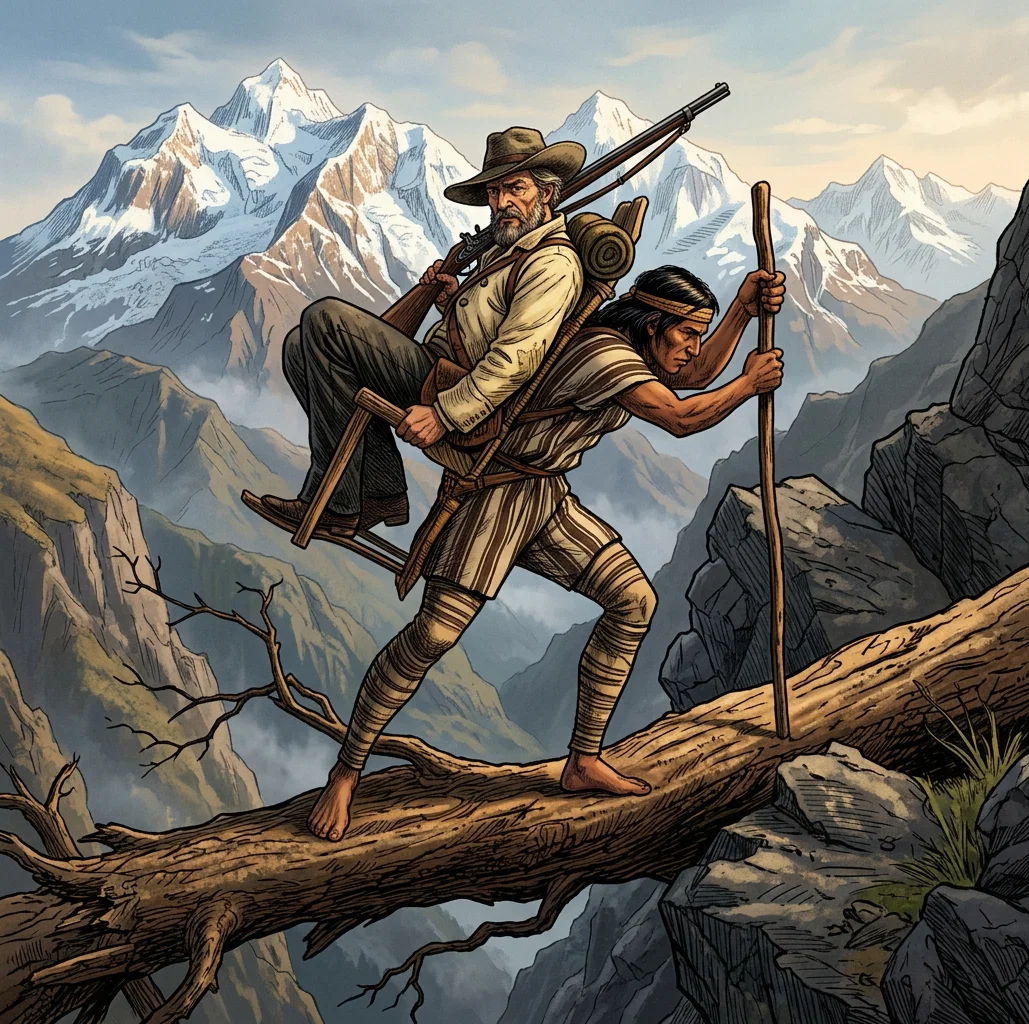
There is much you should know about the Quito valley, and of the hard times the traveler has climbing the mountains before he reaches it; but I must hasten to tell you something of another great table-land two or three hundred miles farther north; for our engraving shows you a traveler making his way towards it—the Bogota table-land.
One writer says if you will pile the Catskill Mountains of New York on the top of Mt. Washington, N. H., and then level off a tract about half as large as Connecticut, you will have the great Bogota table-land, which the people who live there think is the pleasantest place in the world.
But like Quito it is a hard place to reach; for after sailing up the Magdalena River two or three hundred miles, one has to go over two ridges 3,000 feet high before he gets to the foot of the mountain, where it rises up like a great wall. Up this wall a crooked path winds something like a circular staircase.
The plain of Bogota is not far from the equator, and is lower down the mountain side, yet it is much colder than Quito. Wheat, barley, and grass, with a few roots, are the most that will grow there. People who live in the plains away down the mountains supply the Bogota markets.
Men and women climb the mountain with great loads of fish or plantains, and if they happen to sell them while trudging over the plain, they think themselves fortunate. Often before they go back down the mountain, they will climb still higher, up some one of the peaks that lie around Bogota, to buy oranges and other tropical fruits to take home with them.
But you must not get the idea that these grow away up on the mountains above Bogota. No, they are brought from the valleys ever so much lower down than Bogota, on the other side of the mountain.
We would none of us think Bogota a nice place to live in; for it is so cold and rainy there, most all the time; but every one thinks his native land the best. When the inhabitants want a very good time, in a warmer climate, they make a visit to the plains lower down, or at the foot of the mountain. One village where they like to go is a long way down, and to reach it they have first to climb a mountain one thousand feet higher than the table-land where they live, and then go down three thousand feet on the opposite side of it.
There are two ways of traveling,—“mule-back” and “man-back.” When traveling with a mule, they usually load him down with luggage, leaving room for only themselves to ride.
The women generally ride man-back, or by silla; and so do the men quite often. A bamboo chair is strapped to a man’s back, as seen in the picture, and the rider sits there perfectly helpless. I think he must have a good deal of faith in his sillero, as the man is called who carries the passenger.
But a story is told that one time a Spaniard, wearing huge spurs, was riding in this way near Bogota, when he began pricking his sillero as though he were a mule. The sillero gave a sudden jerk, and threw him down a precipice, and then ran away, and was never caught.
M. J. C.