ROUND THE WORLD.—7

9%

S. D. A. Publishing Association · Battle Creek, Mich. · Feb 12, 1890

FromThe Youth’s Instructor, Vol. 38, No. 7.

Read the full edition

ROUND THE WORLD.—7.

South Africa is generally looked upon as being one of the most barren, desert-like countries in the world; but although there are hundreds and hundreds of square miles of its territory that are arid plains, yet there are some spots, the loveliness of which rival lands will find it hard to surpass.
Restored with AI
There are many beautiful trees and flowers in Cape Colony. The cypress is found almost everywhere. It is an evergreen, of which there are many different varieties. The tall and stately blue gum, or eucalyptus, has been largely planted. These trees are not only useful for shade and ornament, but when set out in large quantities, are said to attract moisture; so that in many places where, as we were told, there was a few years before nothing but a parched and barren plain, we now saw eucalyptus trees growing, surrounded by verdant crops of almost every description. Palm trees are not plentiful, but they grow in many of the gardens of the rich, and seem to thrive very well. They have been brought from farther north. The “bottle brush” grows in many parks and domains. It is a medium-sized tree; large and bushy at the top. The flowers are red, arranged in circular form on long peduncles, and the corollas stick out like the bristles of brushes made for cleaning lamp chimneys or narrow-necked bottles. “Silver-leaf” trees cover the sides of the gorges on the mountain. They are very beautiful, and the leaves, when once pressed, never lose their color or satin gloss. In the curio shops one finds many of these, with views of picturesque plains, ships, mottoes, etc., painted on them.
About the only tree or bush that adorns the plains is the “acacia,” or “white thorn,” as it is generally called. These are very different from the “white thorns” we have in America. On all the boughs, about three inches apart, and growing in pairs, are snow-white spines, varying in length from two to four inches. They are hollow, and the walls are about as thick as a quill. So sharp and powerful are they, that even the lion, the king of the forest, dreads them, and has been known to have met his death by becoming entangled in them.
Pomegranate trees form many of the hedge-rows. They grow up with numerous stalks from the ground, have a small dark-green leaf, very glossy, and rather a large red, cup-shaped flower, with yellow anthers. The fruit in appearance resembles, to some extent, an ordinary dark red apple. They have a strong shell and a thick pulp, neither of which are palatable. Within the pulp are a number of seeds, which look like cranberries, and these are the eatable part. This variety is supposed to be exactly the same as the pomegranate so often mentioned in the Bible.
Many of the farmers raise nothing but grapes, the greater part of which is made into wine. The vines are not permitted to twine around trellises, as in the northern States of America, but are cultivated on the Californian plan, being cropped close to the ground every year. The best variety is called the “honey pot.”
It is the month of November now. Next month brings the hottest weather of the season. Strawberries and cream and pine-apples are in bountiful supply. As a rule, the farmers in the western province are descendants of the Dutch boers, and they are not very thrifty. The land has an untidy appearance, and the machinery is even more crude than that used in the United States of America fifty years ago. There seems to be a universal fear of adopting anything that “my father” did not use. A gentleman informed me that a short time ago he was passing through a farm which the year before had borne splendid crops, but now was growing nothing but weeds. He asked the cause of this, supposing that there must be some plague on the land. The farmer replied that the land was all right, and bore such good crops the year before that they thought they would have enough to carry them through that year without doing anything; so they were taking their ease. This shows the sentiment of many.
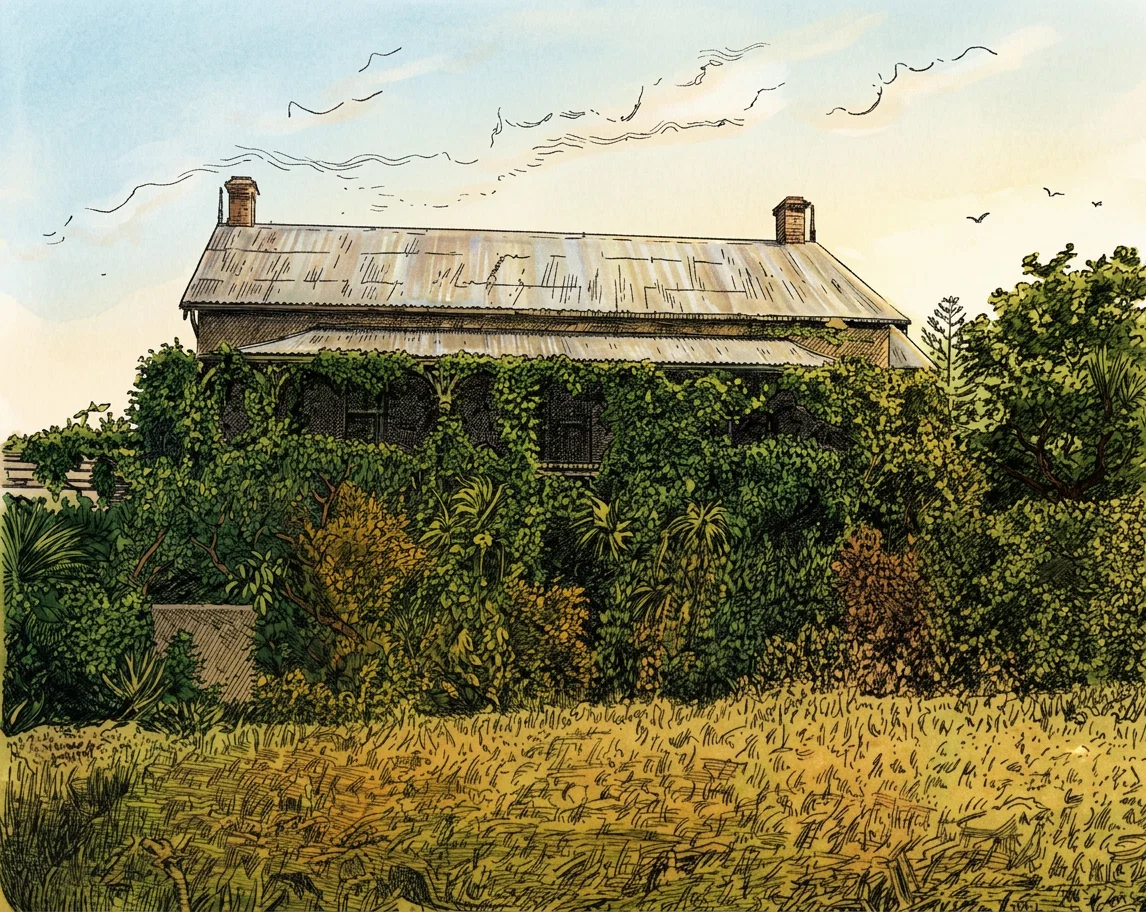
Lovely ferns and wild flowers in almost endless variety cover the mountain sides and the country in the vicinity of the Cape of Good Hope. Calla lilies adorn the meadows, and are so common that they are of no value. They are known by the name of “pig lilies.” Many of the hedges around the gardens are of thornless rose-bushes. Many of the houses are covered with Banksia roses, a small yellow or white variety, very pretty, but unscented. The accompanying cut shows a residence covered with roses. Geraniums cover the slopes of the mountains, and in the woods attain to a height of four or five feet, with a profusion of red blossoms. In some places maiden-hair ferns form a carpet of green over the ground.
Yes, there are in South Africa many spots where the traces of Eden may yet be discerned. Although the curse of God rests on the earth here as elsewhere, our Father has not forgotten, nor will he entirely forget this land.
P. T. M.