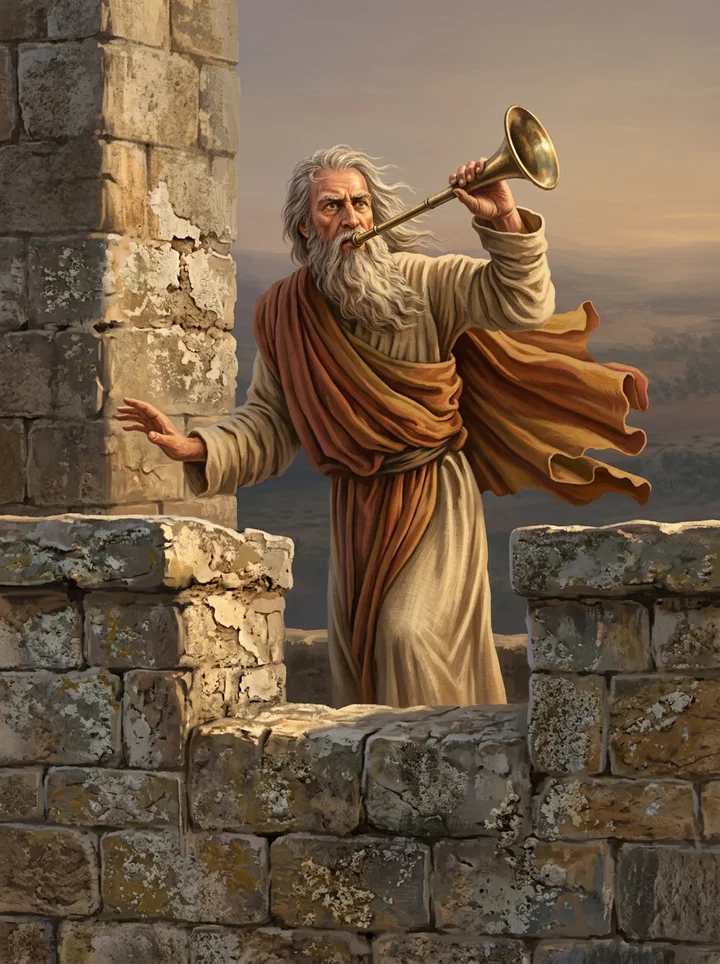
SOUNDING AN ALARM FROM THE WATCH-TOWER.
By M. J. C.
AWAY back when men began to multiply upon the earth, iniquity also began to increase, and man's selfish nature to predominate, making it necessary for the weaker party to protect themselves from the encroachments of the enemy. Hence there originated with the ancients, and has been handed down through the generations to more modern times, the custom of fencing-in, or building walls around, their cities. These fortifications were made strong in proportion as dangers threatened. The walls were not only made very high, but in some instances very thick. The one around Babylon was eighty-seven feet broad, so that six chariots could be driven upon it. The wall of Nineveh would take three chariots abreast. Many of these walls were fifty feet high.
Oftentimes a second, and even a third wall was built some twenty or more feet from the main wall; and to make it more difficult for the enemy to capture the city, outside of all a great moat, or ditch, was dug.
The entrances to the city were closed with strong gates, or doors, which, except upon certain occasions, were kept locked or barred, especially in time of war. Yet the walls and gates alone did not give the feeling of security the people desired, so they built, at regular intervals upon the walls, watch-towers of the same height, or nearly so, as the walls. In these, watchmen were set, especially near the gates, to keep a close lookout over all the surrounding country day and night, unless in times of peace, that at the first approach of impending evil, a cry could be sounded out from the tower that would bring the needed help for the protection of the city.
As a last means of defense, when all others failed, in the interior of some cities a much greater and higher tower than those on the walls was erected. This was called a citadel. Towers were built, too, in the country for the protection of wells, cattle, vineyards, etc. Villages also had their towers, with a watchman set in each to descry danger. Anciently the only distinction between a city and a village was that a city had walls and a village had none. Hence it would seem that in those times a village, unwalled as it was, had need of a tower and a watchman.
The watchman's task was made easy for him, the night being divided into three watches, and in later times even into four. But faithfulness was required of him; for should the enemy get the advantage through the watchman's neglect to sound the alarm, the watchman was responsible for the evil wrought. The Lord, speaking of an unfaithful watchman in Eze. 33:6, alludes to this ancient custom. He says: “If the watchman see the sword come, and blow not the trumpet, and the people be not warned, if the sword come, and take any person from among them, he is taken away in his iniquity, but his blood will I require at the watchman's hand.”
In the same sense the Lord holds us all responsible as watchmen. If we fail to warn those whom our influence can reach, we fail to sound the trumpet; or if by carelessness or indifference on our part any are turned from the narrow way, we have given the trumpet an uncertain sound. In either case we are unfaithful watchmen, with whom God will deal as he has said in the thirty-third chapter of Ezekiel. Please read the whole chapter. Let us one and all be faithful in receiving and giving the warning message that God has for this time, and so be shielded from the plagues that shall fall upon the wicked.
M. J. C.