FORMING the northern boundary of Palestine, is the region of territory known as Lebanon. It was given to the Israelites to possess, but was never completely conquered by them. It consists of the celebrated mountain ranges of Lebanon and Anti-Lebanon, the former extending along the coast of the Mediterranean Sea from the Litany River (anciently called Leontes), on the south, to the Nahr el-Kebir on the north. Running parallel with this chain, a few miles farther to the east, is the Anti-Lebanon range, meaning the range opposite Lebanon proper.
In Scripture, the eastern range as well as the western is sometimes called by the general name, Lebanon, and once is called “Lebanon toward the sun-rising.”
The original word for Lebanon means “to be white,” and was given these mountains either from the whiteness of the snow which lay upon their summits several months during the year, or else from the white color of the limestone cliffs and peaks. Good authors tell us that the highest mountains nearly always have a name meaning white; as for instance, Mt. Blanc, which means snowy; Ben Nevis, snowden; Alps, from alb, white, etc.
In hight, these mountains range from 6,000 to 8,000 feet, the highest peak, however, being over 10,000 feet. Of the Anti-Lebanon Mountains, the celebrated Mt. Hermon is the highest peak.
Both these mountain ranges run from southwest to northeast, a distance of some eighty or ninety miles, and are separated by a deep, fertile valley, from five to eight miles wide, through which flow rivers, at some points forming the most magnificent scenery.
The central ridge of Lebanon is nearly barren, showing its limestone formation, from which jut now and then white points of rock of various shapes. Farther down, on a line of 6,000 feet, cultivation begins and although the surface of the soil is so broken by rugged and perpendicular rocks that the “tillage is carried on chiefly by means of terraces, built up with great labor, and covered above with soil,” its cultivation is truly marvelous, every available space being put to the best use.
“When one looks upward from below, vegetation on these terraces is not seen, so that the whole mountain side appears as if composed of immense rugged masses of naked, whitish rock, severed by deep, wild ravines, running down precipitously to the plain.” Some portions of the mountains are “covered with naked limestone, which time and the elements have chiseled into fantastic shapes.”
Here the vine, the fig and olive trees, find nestling places, and by their luxuriance, add beauty and enchantment. “Villages are built amid labyrinths of rocks, and in some places cling like swallows’ nests to the sides of the cliffs.”
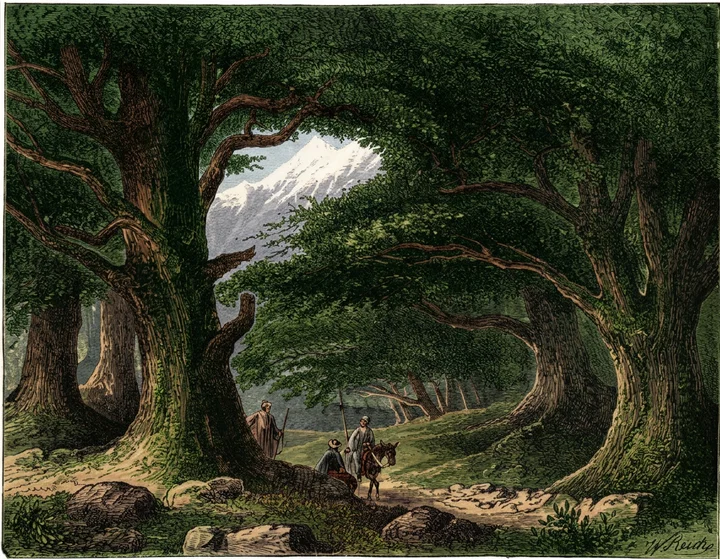
I have space to notice but a few of Lebanon’s interesting features, yet must not pass by its forests of cedar, which were anciently its glory. So far as can be ascertained at the present time, this tree is confined to the valley of the Kedisha River, which enters the sea at the port of Tripoli; and although two or three centuries ago there could be counted 400 trees, the number is now reduced to less than a dozen. It is thought from the “size and general appearance of those that remain, that they existed in Biblical times.” If this tree constituted Lebanon’s chief glory, surely it is passing away.
The cedar is mentioned in many Scripture texts, but reference is not always to the cedar of Lebanon, which is esteemed above all others for its great durability, its commanding hight, and a breadth many times even greater than its hight, thus indicating great depth of root. And thus it is that the Scriptures so frequently compare the righteous to the cedar of Lebanon,—they are “fixed as the hills in strength.”
The great durability of this wood adapts it to building purposes, and so it was sought for by men of wealth in all the adjacent countries. Sometimes, too, it was conveyed long distances by water. You remember that it was from these forests that King Solomon obtained cedar for his palaces, as also cedar and stones for the temple. Please read the entertaining description of the building of the temple in Kings and Chronicles.
The glory of Lebanon has departed. And the holy and beautiful house, builded of its stones and cedars, with its worshipers—where are they? Let the Saviour answer.—“Behold your house is left unto you desolate.” Matt. 3:28. And again, as he viewed the temple in company with his disciples, he said, “Verily, I say unto you, There shall not be left here one stone upon another, that shall not be thrown down.” Matt. 24:2.
May we learn wisdom from the things others have suffered, lest we be left to grope our way in darkness.
M. J. C.