MORE ABOUT GEYSERS

9%

S. D. A. Publishing Association · Battle Creek, Mich. · Jun 12, 1889

FromThe Youth’s Instructor, Vol. 37, No. 24.

Read the full edition

MORE ABOUT GEYSERS.

YOU have already had printed in the INSTRUCTOR many interesting things about geysers, though to describe them all would require many pages of this paper; for they are to be found in various parts of the earth, and in some places are very numerous. The first published record of this phenomenon was in Iceland, some hundreds of years ago, and was a description of a spouting spring near Haukadal. It was named the Geyser, this word meaning, in the Icelandic language, “rager,” or “spouter.” For a long, long period there was no record of any other than the Icelandic geyser. Since others have been discovered, this has been the generic name for all intermittent spouting springs.
Restored with AI
In the southwestern part of Iceland there are, one writer has said, “in a circuit of two miles, over a hundred hot springs, fifty or more of them in a space of a few acres. They are of different sizes, and exhibit various degrees of activity.” The principal ones among them are the Great Geyser and the Strokr. There are, besides, many vast, extinct geysers there, the water having forced a passage elsewhere, perhaps to build spouters in other localities.
It would interest you to know the “mechanism and development” of geysers; but it would require more space to explain them than can be used for this purpose in one article. I will simply say they are their own architects, as you may have opportunity to learn at some future time.
In the North Island of New Zealand, in the celebrated Lake District, is a region of hot springs, exceeding by far in extent and variety any except those of our own country. There is also in their vicinity a collection of boiling mud-pools very similar to those on the Yellowstone River above the falls; and the gay colors of the Yellowstone mud springs are sometimes seen in the New Zealand mud springs. The principal group of the New Zealand mud springs are located in a ravine about a quarter of a mile long. Dr. Hochstetter says of them:— “Inside, this ravine looks like the inside of a volcanic crater. The bare, rocky walls, threatening every moment to break loose, loom up like dismal specters. The bottom of the ravine is of fine mud, scattered with blocks of silicious deposit, like cakes of floating ice after a thaw. Here a big caldron of mud is simmering; there lies a deep basin of boiling water; next to this is a terrible hole, emitting hissing jets of steam and further on are mud-cones from two to five feet high, vomiting hot mud from their craters with dull rumblings, and imitating on a small scale the play of large fire volcanoes.”
As I have told you in a former article, it is not a quarter of a century since it was discovered that in the northwestern part of Wyoming Territory there exist some of the most beautiful, wonderful, and stupendous natural phenomena yet discovered. This is the grand geyser region of Fire Hole River, included within the Limits of our Great National Park. One writer has said that, “in a valley of a dozen miles long and two or three wide is an exhibition of boiling and spouting springs on a scale so stupendous that if all the corresponding phenomena of all the rest of the world could be brought into an equal area, the display would be as nothing in comparison.”
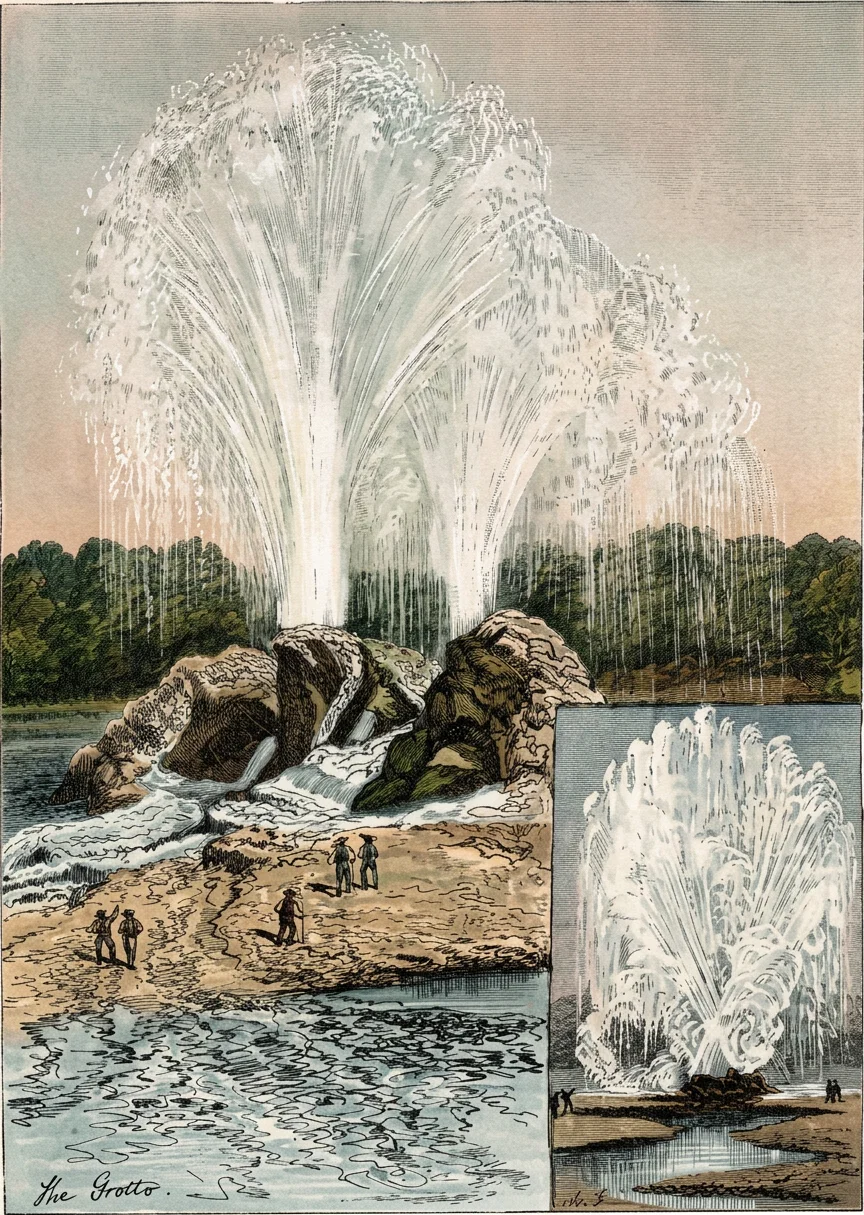
Each geyser has some characteristic that suggested a name to its discoverer, and they are called by such names as Old Faithful, Grand Geyser, Sentinel, Beehive, Saw-mill, Comet, Punch Bowl, Soda Geysers, Horn Geyser, The Grotto, Fan Geyser, etc., etc. Of the spoutings and maneuvers of some of these you have already had a description. I will only give you a word picture of the Fan Geyser, the one represented in our engraving, which is situated on the opposite side of the river, a little below the Grotto. It is stated of this that, “it has a double orifice, which discharges five radiating jets to the height of sixty feet, the falling drops and spray giving the appearance of a feather fan. The effect is very beautiful. Its eruptions are frequent, lasting usually from ten to thirty minutes.
“A vent connected with this geyser, about forty feet distant, expels dense masses of vapor fifty or sixty feet high, accompanied by loud, sharp reports, during the time the geyser is in action. Lieutenant Duane describes the curious action of these vents as follows:—
“‘First the steam would rush from the upper crater, roaring violently; then this would suddenly cease, to be followed by a fan-like jet of water rising from the lower crater to the height of over forty feet, playing perhaps two minutes; then this would suddenly stop flowing, and the steam would rush forth again for a time. Occasionally the small crater threw a transverse stream, alternating with the others; and thus they played on for hours, after which all would subside to a gentle bubbling.’”
What wonders the book of nature reveals to us! and what pleasure it would afford most any of us to behold with our own eyes the wild, the curious and beautiful, the grand and sublime scenes therein displayed. Although but few have this privilege, we all have the assurance that if we reach the immortal shore, we shall have an eternity to look upon the glory of God’s creation. May it be your lot and mine to be there. M. J. C.