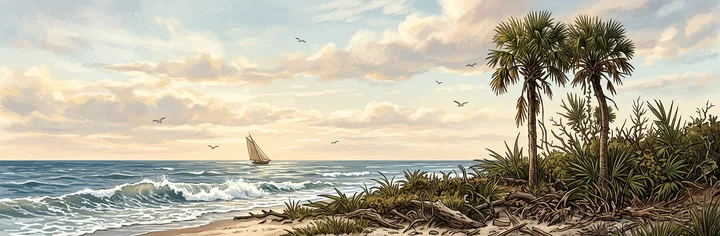
WASHED by the waters of the Gulf of Mexico on the south and west, and by the Atlantic Ocean on the east, there lies in the extreme southern part of the United States a most interesting region of country. Its peculiar shape—that of a long, narrow peninsula on the east, and a long, narrow stretch of territory from east to west on the north—gives it a greater extent of seacoast than any other division of the Union excepting Alaska.
Unless, as some claim, John and Sebastian Cabot's explorations in America in 1497 extended to this peninsula, it was first visited by an old Spaniard, one Juan Ponce de Leon, who sailed from Porto Rico for the Bahama Islands in 1512, in pursuit of a fountain whose waters would restore to the aged the bloom and vigor of youth.
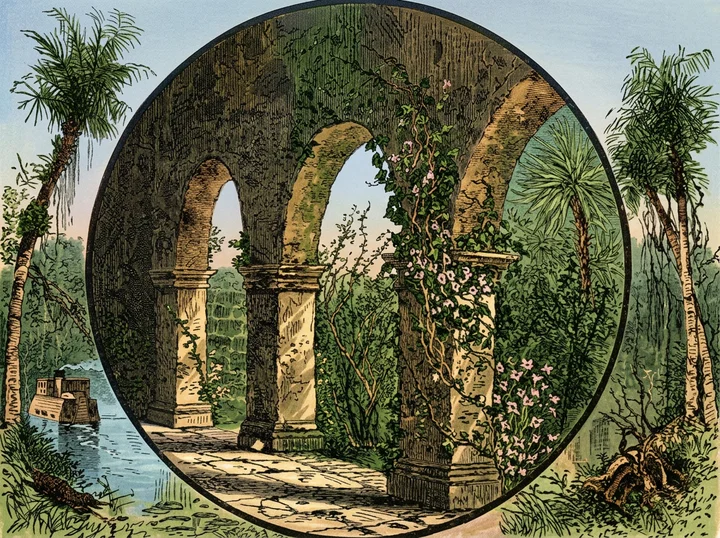
Not realizing his expectations there, Leon, with his expedition, sailed in a northwesterly direction until he reached the eastern coast of the peninsula, where he landed at what is now St. Augustine, in the month of April, upon Easter Sunday. This day being called by the Spaniards Pascua Florida, and because he saw the land everywhere dotted with wild-flowers, he gave to the newly-formed territory the name of Florida.
Here Leon industriously pursued the same ignis fatuus,—the rejuvenating fountain, or the elixir of life,—suffering all kinds of hardships as he traveled southward by land and water the whole length of the peninsula on the east, even to the Tortugas Islands in the Gulf of Mexico. But after all his toil and perplexity, being unsuccessful in his Utopian enterprise, he returned to Spain a disappointed man.
Although Leon's hopes regarding the fountain were blasted, he did not yield to despondency, and we find that a few years afterward the king of Spain made him king of Florida, provided he would plant a colony there. This he undertook, bringing with him a party of emigrants to locate in these wilds, and to render such assistance as was needed to get possession of the territory.
The efforts of this expedition to subjugate the Indians was of short duration; for the men were soon driven back to their ships, and Leon received a wound from which he shortly afterwards died upon the island of Cuba, whither the expedition had fled.
During the years that immediately followed, the Spaniards made other unsuccessful attempts at subduing the Indians and gaining a foothold in the territory, until in 1565, they succeeded, under one Don Pedro Menendez, in founding St. Augustine. This occurred fifty-five years before the Pilgrims landed at Plymouth Rock, making this the oldest town in the United States.
But to accomplish his purpose, Menendez was guilty of the most fiendish cruelty. A party of Huguenots who had been given permission to come from France had planted a colony, building a fort near St. Augustine. During a heavy thunder shower, Menendez entered their fort on the land side, which they had left unguarded, thinking there was no danger from the enemy except by way of the sea, and there, while the occupants were peacefully sleeping, this monster murdered them in cold blood. A few made their escape to the woods.
However, retribution soon followed this diabolical act, and although Menendez escaped with his own life, and ruled St. Augustine some twelve years thereafter, many of his own men were as cruelly killed by the swords of the Spaniards or the clubs of the Indians.
And thus this ancient town, which was at the beginning baptized with the blood of martyrs, has been drenched with blood for three centuries; “for it has been watered with its own blood more than any other city, and its inhabitants have acknowledged more foreign rulers and various flags than any other city.”
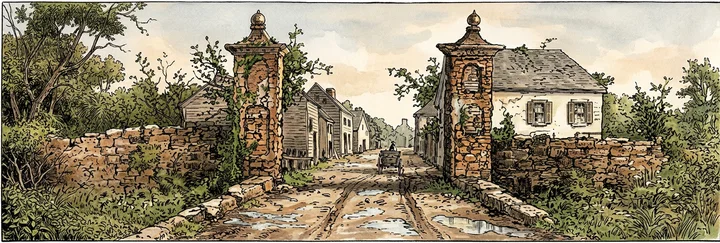
St. Augustine is built upon a narrow peninsula, formed by the Matanzas River on the east and the St. Sebastian on the south and west. It was built as a military town, and was protected on the north by a wall which stretched across the peninsula. This wall is now in ruins, but the old entrance through it, or the old famous City Gate, has been remarkably preserved. A view of it is given in the lower part of our engraving. “With its lofty, ornamented towers and sentry boxes, it is a picturesque and imposing edifice.” Between St. Augustine's harbor and the ocean lies the Anastasia Island, upon which is located a lighthouse.
One familiar with the city, after an extended acquaintance from personal observation, says that “its appearance is as quaint and peculiar as its history is bloody and remarkable. Nothing like it is seen in this country, and having been built by a people so entirely different in manners and customs than our own, it has been surrounded with an interest not shared by any other city in the land.” However, “the large influx of wealthy settlers from the North has greatly altered the character of the place within a few years, but the smart modern villas still have the air of foreign intruders, and the quaint, romantic old city retains at once its individuality and unlikeness to anything else in America.”
“Its principal building material is a unique conglomerate of fine shells and sand, known as coquina rock, found in large quantities on Anastasia Island. It is easily cut in blocks to be laid in courses, and is perhaps covered over with stucco.
“The streets are quite narrow; one which is nearly a mile long being but fifteen feet wide, and one on which a principal hotel stands being but twelve feet, while the widest is but twenty-five feet. An advantage of these narrow streets in this warm climate is, that they give shade, and increase the draft of air through them as through a flue. Indeed, some of the streets seem almost like a flue, rather than an open way; for many of the houses, with high roof and dormer windows, have, along their second stories, hanging balconies, which seem almost to touch each other over the narrow street; and the families sitting in these of a warm evening can chat confidentially, or even shake hands with their over-the-way neighbor.”
“The principal streets were formerly well paved or floored with shell concrete, portions of which are still to be seen above the shifting sand; and this flooring was so carefully swept, that the dark-eyed maids of old Castile, who then led in society here, could pass and repass without soiling their satin slippers. No rumbling wheels were permitted to crushp. 198 the firm road-bed, or to whirl the dust into the airy verandas, where, in indolent repose, sat the Spanish dons and dames.”
“In the buildings of the town are some remains of elegance, as well as of much antiquity. The cathedral is unique, with its belfry in the form of a section of a bell-shaped pyramid, its chime of four bells in separate niches, and its clock, together forming a cross. The oldest of these bells is marked 1682.”
“The ‘Plaza de la Constitution’ is a fine public square in the center of the town, on which stand the ancient markets, and which is faced by the cathedral, the old palace, the convent, and other fine structures. In the center of the plaza stands a monument erected in 1812 in honor of the Spanish Liberal Constitution;” and “on the eastern side is a soldier's monument, erected in 1872 by the Ladies' Memorial Association in memory of those who gave their lives in defense of the Confederate States.”
The most interesting features of old St. Augustine are “the Sea Wall and Ft. Marion. The wall is built of coquina, with a granite coping four feet wide, and is nearly a mile in length, protecting the entire ocean front of the city. It furnishes a delightful promenade, and is usually thronged on moonlight evenings. Near its south end are the old United States Barracks. At its north end, commanding the sea front, is old Ft. Marion, probably the most picturesque structure in America. Like the Sea Wall and most other edifices in St. Augustine, it is built of the coquina quarried on Anastasia Island, and the construction of it occupied one hundred and sixty-four years, having been commenced in 1592 and completed in 1756. The labor of building it was performed almost entirely by negro slaves, Indians, and prisoners of war; and every stone of it was cemented with the sweat of toiling sufferers.”
“While in the possession of the British, this was said to be the prettiest fort in the king's dominions; and with its esplanade, moats, barbicans, drawbridges, massive arched entrance, dark passages, vaulted casements, ornate sentry-boxes, frowning bastions, and mysterious dungeons—in which were found, in 1835, two skeletons in cages, victims probably of some inquisitorial cruelty—it is still a strangely attractive and interesting spot. For modern warfare it is quite useless, and not being kept up for military purposes, it is fast crumbling to decay.”
Much more of interest might be told of St. Augustine, the city so much visited by northern invalids; but its chief attractive feature is its nearly perfect climate the greater part of the year. Taken all together, it is a city that one reluctantly leaves after forming an extended acquaintance with it.
M. J. C.