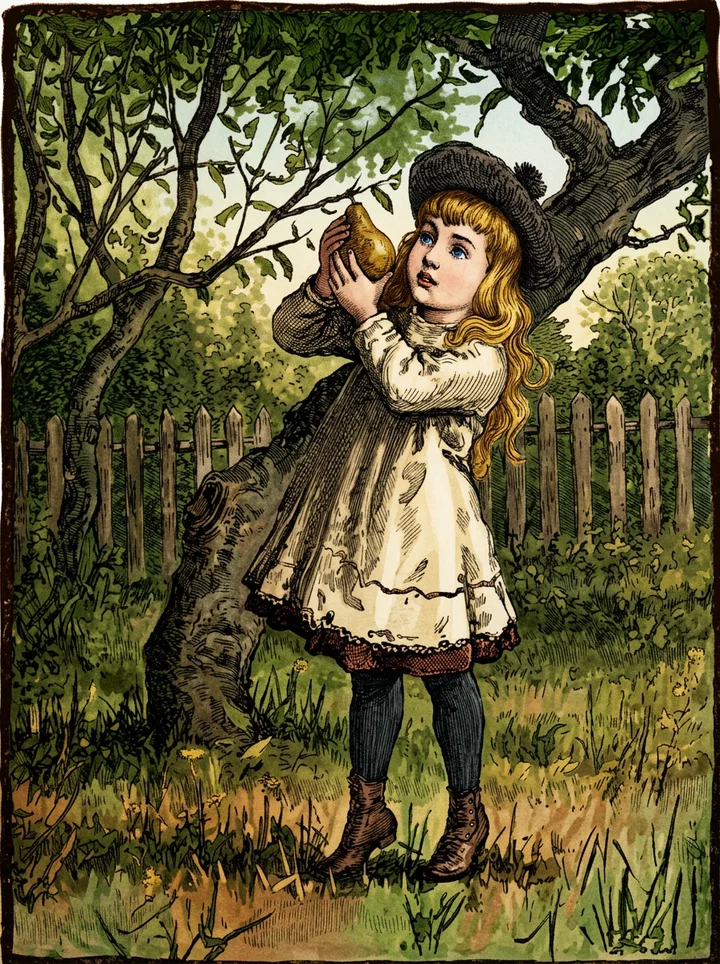
Margie Hall was nearly nine years old; she had bright blue eyes, long, sunny hair that curled about her shoulders, and such a merry laugh it made everybody feel happy just to hear Margie laugh.
Margie lived with her papa and mamma in a cozy little house, not far from the mills, where her papa worked all day to earn money to buy food and clothes for Margie and her little brother and sister younger than she. The Hall's didn't keep help, and Margie often helped her mamma with the work. Mrs. Hall wanted Margie to learn how to do all kinds of house-work and sewing, so that she could do for herself when she grew to be a woman and had a home of her own, or if she should have to take care of herself.
Margie was always willing to help, and loved to bake and get supper for papa; but she had one habit that caused her much trouble, and made her mamma very sad,—sometimes she was very apt to slight little things, especially if she was in a hurry to go and play; often she left the dishes half wiped, and then they were sticky; or if she swept up the kitchen for her mamma, she would leave dust under the table and stove and behind the door. “Nobody will see it,” she would say.
One morning Margie's papa called her earlier than usual to help him; for her mamma was sick, and could not get up. How glad Margie was she had learned how to wash dishes and tidy up the rooms! She felt quite important left in sole charge of the house, the children, and her sick mamma.
“You'll see how near like mamma I can do things,” she said to her papa, as he kissed them all good-by. Charging the younger ones to “be good and mind Margie and not to bother mamma,” he left them for the day, while he went to the mill.
“The first part of the work Margie did up very nicely. She made a cup of tea and toasted a slice of bread for mamma, which her mamma said was “as good as she could make.” Then she told Margie she might take the children out under the trees as soon as she finished her work, and if the house was still, perhaps she could get a nap, and then feel better.
Now came Margie's great temptation. She was in a great hurry to be out under the leafy trees. “I won't scour the knives this time; mamma won't see 'em, and I'll do it after dinner,” she thought, putting them away half-wiped. Now she must brush up, and then she'd be all through. It didn't take her long to brush up in the middle of the room, push the scattered playthings into one corner, promising herself to put them up before any one came. Putting on her sun-hat, and taking a little book she had lately received for a birthday present, she was soon out under the trees, playing tag with the little ones.
For some reason she soon tired of play, so she took out her book to read. It was a pretty book, with a blue cover almost the color of Margie's eyes, while the gold letters matched her hair; her aunty, who was a missionary way off in China, had sent her the book, and written she wanted Margie to read one verse every day. “I guess I'll read the one for my birthday first,” thought Margie, who was anxious to please her aunty whom she had never seen, but had heard much about, and thought she must be just the “bestest woman, next to mamma, that ever lived.” She turned the leaves until she came to the verse for May 30. That was her birthday, and the verse was marked; these were the words: “Whatsoever thy hand findeth to do, do it with thy might!” In fine print under it were these lines:—
“He who sweeps a room as to his God, Maketh it and the act sublime.”
What could it mean? Was just doing little things working for God? Margie had been taught to love Jesus, and she wanted to serve him, but she never had thought doing little things was working for him. What if God knew how she slighted her work that day! She wasn't at all sure what the verse meant, but the thoughts of the unscoured knives and the untidy, half-swept kitchen worried her. She would ask mamma, anyway!
Margie tiptoed into the darkened room. Mamma was asleep; she must wait. She took a look at the kitchen.
“Pretty dirty under that stove and the table,” something said so plainly Margie almost thought some one spoke.
“I don't believe that's what the verse means,” said another voice.
“Better be on the safe side. It isn't doing things with your might to leave them this way,” said the first voice.
“I'm going to sweep, anyway,” said Margie, taking up her broom, and carefully brushing up every speck of dust; then she got out the knives and scoured them. “There, I feel better, anyway,” said Margie, as she went out to play again, and she had a jolly time playing hide-and-seek.
When her mamma wakened, she felt much better, and was quite willing to explain the verse to Margie. She told her “whatsoever” meant anything we had to do, no matter how small a matter, and “doing it with all thy might” meant doing it just as well as one could, whether it was learning lessons, doing dishes, being kind, or going as a missionary like aunty.
Margie never forgot her verse, and when she was tempted to slight things as of little consequence, she would think “whatsoever.”
Thus she grew up beloved and trusted, because she was faithful in small things.—Daughters of America.