AFTER the death of Moses, Joshua was appointed leader of Israel in his stead. “And Joshua, the son of Nun, was full of the spirit of wisdom; for Moses had laid his hand upon him, and the children of Israel hearkened unto him, and did as the Lord commanded Moses.”
The Lord by Moses had brought Israel up near to Jordan at a point “over against Jericho,” and now he commanded Joshua to take all the people and go over to possess the land he had given them. Accordingly Joshua sent officers all through the camp, ordering them to prepare food to take with them; for “in three days they should pass over Jordan.”
While this preparation was being made, he sent two men as spies into Canaan, to ascertain what difficulties lay in the way of their entering upon their inheritance. The spies went directly to the city of Jericho, it being the nearest city, and they stopped at an inn kept by a woman named Rahab.
Word soon reached the ears of the king of Jericho that there were spies in the city from among the Israelites, and he commanded that the city gates should be closed at once, lest the spies should make their escape. The king also learned at whose inn they were stopping, and he sent to have Rahab deliver them up; for the people feared the Israelites. They had heard of the mighty works their God had wrought for them in delivering them from Egyptian bondage, and now the fact that spies from among them had entered Jericho, the king felt quite sure foreboded no good to themselves. He wished them delivered up that he might destroy them, thinking thereby to intimidate their leaders, and put an end to their encroachments upon his domains.
Not so Rahab! What she had learned of God's dealings with the Israelites had convinced her that they worshiped the true God, and that nothing would prosper in the hands of any who should think to oppose his work. Therefore, instead of giving the spies into the hands of the king, she hid them among the stalks of flax that she had spread upon her flat roof to dry.
Rahab admitted to the officers that two strangers had been at her house; but she said they went out about the time of the shutting of the gates; she did not know from whence they were, neither whither they had gone. She gave the officers permission to search her house, to see for themselves that the men were not secreted therein. She advised them to pursue after them quickly, and very probably they could overtake them.
In this Rahab told that which was false; but we must remember that she was a heathen woman, just then beginning to get a little light of the true God. She had faith to believe the spies were God's servants, and she felt that she was responsible for their lives. God does not countenance lying in any one, and he can always overrule events to his own glory, without the practice of deception on the part of his people. No doubt Rahab learned this afterward.
After the officers had gone in pursuit of the spies, Rahab went up on to the roof of her house, which was built upon the city wall, and acknowledged to the men her belief in the Israelite's God, and that she believed Jericho would soon be delivered into their hands. And for the kindness she had shown them, she wished that when that event did occur, they would remember her and her father's house. They then covenanted together,—she to keep their secret, and they to deliver her, with her relatives, when they should come into possession of the city.
Rahab instructed the spies to go at once and hide themselves in a mountain near by, until the officers should return from pursuing after them. The gates of the city being closed, she let the spies down from a window over the wall, by a scarlet cord; the same cord to be fastened in her window, that no mistake might be made as to which was her dwelling, in the confusion of destroying the city.
The spies followed Rahab's directions, returning to Joshua at the proper time, telling him all they had learned of Canaan. Then, at Joshua's request, the people all went to the bank of the Jordan, where they remained three days in making preparations to cross the river. The Lord was going to perform a great miracle for them, and it was necessary that they should be cleanly in person and penitent at heart before he could meet them. They therefore spent the three days in washing their clothing, and in humbling their hearts and seeking pardon for their sins.
The time for passing over the river having arrived, the priests carried the ark before the people, and as soon as their feet dipped into the water, the water parted before them, and they went on dry ground to the middle of the stream. In this position they remained while the people all passed over into the promised land. Then the priests followed, the waters closing as soon as they had passed out.
Having reached Canaan, the children of Israel first encamped at a place which they named Gilgal, in the eastern part of Jericho. Here, as Joshua was one dayp. 118 walking around the city, probably wondering how they should attack it, there appeared to him a very wonderful person, who introduced himself as the “Captain of the Lord's host.” He had come to encourage Joshua, and to show him how he was to conquer his enemies.
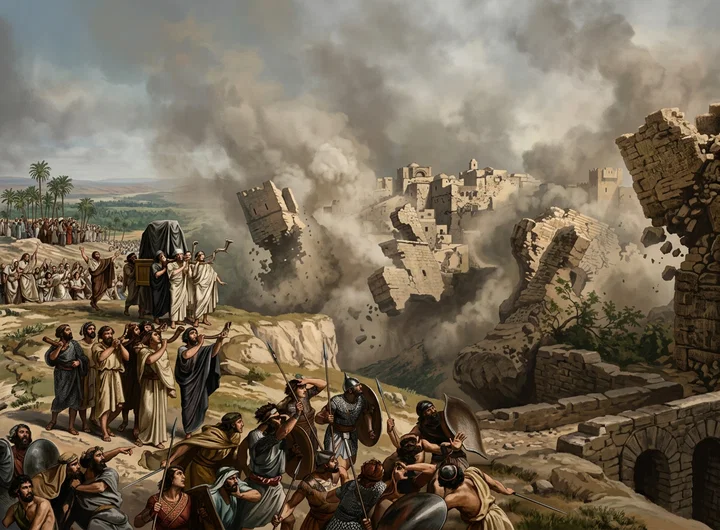
Now Joshua understood that the people of Jericho had closed the city gates, so that none could go out or come in; but the angel who appeared to him instructed him how he could take it. “All these men of war, or soldiers,” he said, “should march around the city every day for six days; and some of the priests should carry the ark around with them. Seven more priests should go before the ark, and blow on trumpets made of rams' horns. But on the seventh day, the children of Israel should march around Jericho seven times, and the priests should blow on trumpets. When the men of Israel should hear a long blast on the trumpets, they were all to give a great shout, and the Lord said the wall of the city should fall down flat, so that they could go up into the city.”
The people did as the Lord commanded, and the result was the fall of Jericho, as was predicted. They remembered their promise to Rahab and her relatives, because she entertained the spies, and ever after she lived with the Israelites.
Rahab chose “that good part” when she cast her lot with the people of God; for with the exception of herself and relatives, every inhabitant of the city was burned alive. So it will be with the inhabitants of the earth in a little while,—all who do not link themselves with the truth which is to ripen the harvest of the earth, will be destroyed. Shall any of us be so unwise as to be caught in the snare Satan has set for the people of this time? Arise, O sleeper, and make your salvation sure. M. J. C.