ARCTIC EXPLORATIONS

5%

S. D. A. Publishing Association · Battle Creek, Mich. · Nov 13, 1889

FromThe Youth’s Instructor, Vol. 37, No. 46.

Read the full edition

ARCTIC EXPLORATIONS.

Were I to ask our geography students, What is the earth's axis? or, What are the poles of the earth? I am sure that a great chorus of voices would answer correctly at once. You would also tell me that the portion of the earth's surface for a certain distance from the poles is called the Polar Region; the one at the north being limited by the Arctic Circle, is called also the Arctic Region, and the one at the south, by the Antarctic Circle, is called the Antarctic Region.
These circles, on the map, give the limit of the polar regions, yet owing to certain local causes, some points within the Arctic Circle are milder by several degrees than other points considerably farther south than this boundary line.
Although the Arctic zone is so cold that the waters are solid ice a great part of the year, for the last three or four centuries many attempts have been made by brave seamen and men of science to explore it; not by all, we trust, simply for the gratification of curiosity, but many go in order that the world may have the full benefit of any knowledge or advantage they may gain. If you will compare a map of to-day with one of one or two hundred years ago, you will form some idea of the success that has attended their efforts at discovery.
Restored with AI
One motive which induced Europeans to risk their lives in the perilous voyages consequent upon the exploration of the frozen seas of the North, was to discover a more direct passage to India, which was in their minds a land of unimaginable riches. First they thought to find a northeast passage,—by the coast of Norway, thence eastward through the Polar Sea along the coast of Asia.
In the 16th century well-manned vessels were sent upon such an expedition; and although the original object was not gained, it opened the way to commercial relations with Russia, and an experience was gained which proved beneficial in succeeding Arctic voyages.
Fifty years later, Englishmen had their attention directed to a northwest passage. If you have access to a map of the northern hemisphere, you will notice that there are three openings into the Arctic Sea, two of them from the Atlantic,—one between Greenland and Norway, one through Davis Strait and Baffin's Bay; the third is from the Pacific Ocean through Behring's Strait. The northwest passage, they hoped to find, would lead them west from England through the Atlantic, northwest through Davis Strait and Baffin's Bay, west through the Polar Sea, thence south through Behring's Strait into the Pacific Ocean, when they would have made the voyage to India in much less time than by the old route.
The main object with too large a class has been to try to reach the pole, or to discover an open polar sea, which in their imagination exists somewhere beyond any discovery which has yet been made. Many brave men have sacrificed their lives in these enterprises, and probably as many more in search of their lost countrymen.
One vessel forced a passage from the Pacific Ocean through Behring's Strait, the Arctic Ocean, and on even to the Atlantic Ocean; but the voyage was almost as hazardous as would be a ride through the rapids of Niagara River. Of what advantage to commerce is a northwest passage through such perilous seas?
All efforts of search within the Antarctic Circle have proved so unfruitful that but little is known of it. No one has been able but once to penetrate those vast ice-fields beyond the 78th degree of latitude; and south of about 65 degrees not so much as a moss or a lichen has been seen. One has written of this region, “There are no hunters there, like the Eskimos, to chase the seal or walrus; no herdsmen, like the Lapps, to follow the reindeer to the ocean's edge, and not a single land quadruped exists beyond 56 degrees,—all is one dreary, uninhabitable waste.”
I haven't space to give you the causes of this difference in temperature between the northern and southern zones, but your school and library books will instruct you what they are. A number of books have been written upon the subject of Arctic exploration, in which are given some thrilling incidents of the hardships and sufferings endured by explorers. Most of these you will find not only entertaining, but instructive in a knowledge of the Arctic region.
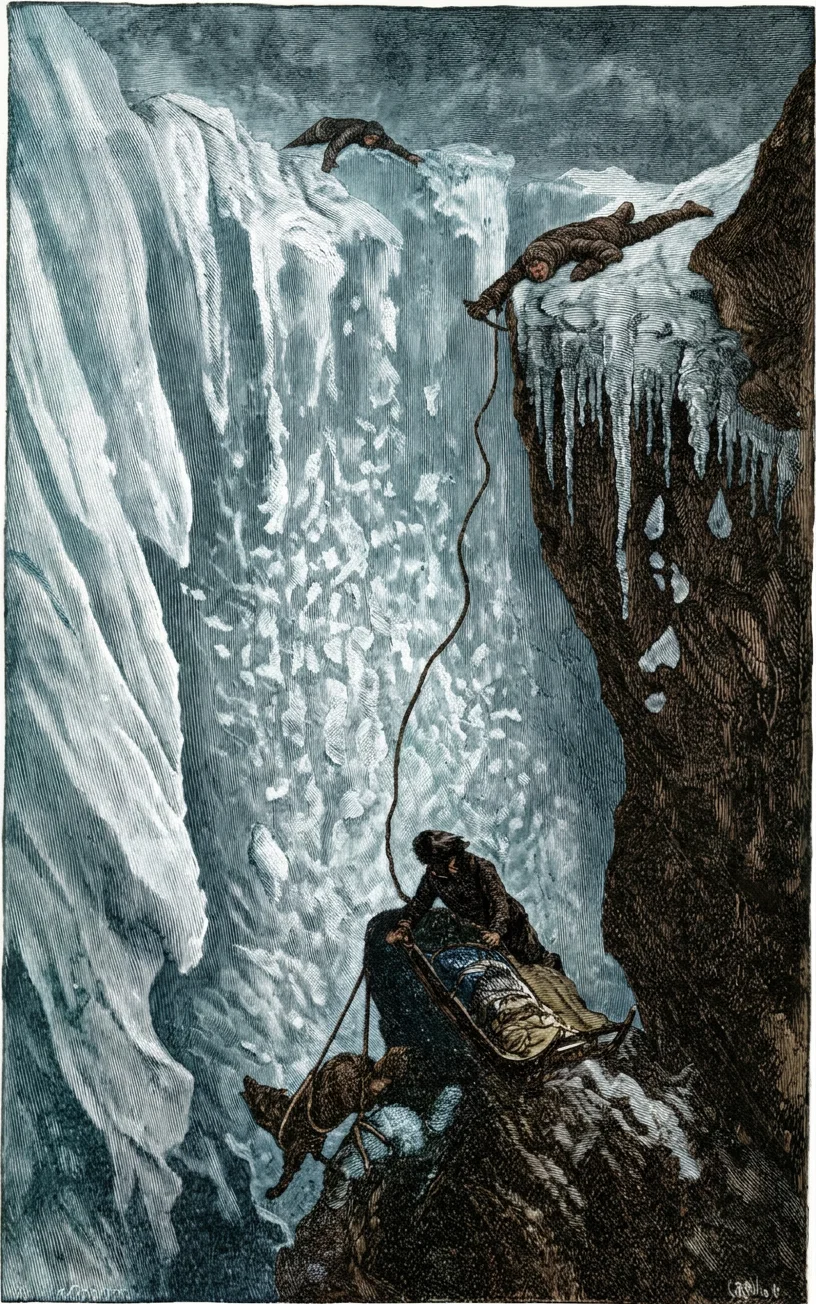
The cut accompanying this article represents a scene which transpired on an island some two degrees north of Nova Zembla. The party shown in the picture belonged to an Austro-Hungarian expedition, which set out on June 13, 1872, for a two and a half years' voyage of discovery among the icebergs of Nova Zembla. Among the crew, which numbered twenty-four, were Germans, Italians, and Hungarians.
Their vessel made good time through the North Sea, along the coast of Norway, until they reached the icebergs of Nova Zembla, when, as they advanced northward, it was greatly retarded in its progress by the continual crowding of ice-floes against it. In the meantime, too, they noticed that the channel through which they were guiding their ship was all the time narrowing up; and by the time they had reached the north of Nova Zembla, about the 20th of August, they were entirely shut in. But it was among these icebergs that they saw some of the beautiful and wonderful sights so common in this region, occasioned by the reflection of the sun's rays upon the fog and ice-glaciers.
Their vessel gradually drifted northward with the ice that imprisoned them, whither they knew not. The sea beyond and around them was grinding, and at times projecting great masses of ice, leaving chasms that threatened to engulf them, while the ice was, at times, pressing so hard against the ship that it seemed that it must collapse. The party packed their sledges, got their boats, clothing, and everything ready to leave the ship at a moment's notice, should it be necessary.
The vessel was drifted to about eighty degrees north latitude, when, although they had given up all hope of making any discoveries, they were joyfully surprised at the sight of land,—land discovered for the first time. In honor of their emperor they at once named it Franz-Josef's land.
The party spent the following fall and winter in making sledge journeys over this newly-found territory, and it was while making one of these trips that the accident occurred that is shown in the picture. As told by another, the story is as follows:—
“The party, after a brief halt, were just setting out again (in the fissures of what is known as Middendorf Glacier), when the snow gave way beneath the sledge-runners, and driver, dogs, and vehicle were precipitated into some unknown depth below. Payer [one of the commanders of the vessel] first heard the confused shouting of the man, mingled with the barking and howling of the dogs from the bottom of the crevasse below. ‘All this,’ says he, ‘was the impression of a moment, when I felt myself dragged backward by the rope. Staggering back, and seeing the dark abyss beneath me, I could not doubt that I should be precipitated into it the next instant. A wonderful providence arrested the fall of the sledge; at about thirty feet it struck just between the sides of the crevasse, just as I was being dragged to the abyss by its weight. The sledge having jammed itself in, I lay on my stomach close to the awful brink, the rope which attached me to the sledge tightly strained, and cutting deeply into the snow.’
“By incredible tact and perseverance, Payer at last freed himself from the sledge, and set about recovering the store of lost provisions, the manuscripts, which could never be replaced, and above all, about the rescue of the fallen comrade who was the ‘pride and gem of the party.’ Being the only one of the party accustomed to glaciers, Payer was of necessity almost alone in his exertions. Rushing back to the tent where most of the men had remained, he hurriedly explained what had happened, and all hastened to the scene of disaster. They found their poor comrade nearly dead from the cold, but sufficiently conscious to be pulled to the top of the ice-cliff over which he had fallen. The dogs were found uninjured, and quietly sleeping near him, but celebrated their release by joyful demonstrations.”
Satisfied that Franz-Josef's land could never be made available to mankind, and having become wearied with waiting two long years for their vessel to become released from the ice, the Austro-Hungarian party unitedly agreed, on the 20th of May, 1874, to abandon their ship, the Tegetthoff, and turn their faces homeward. It was not without feelings of regret that they parted with the ship, which had afforded them a home so long, and with some of their goods which they had to leave to share the fate of the ship. Pictures of relatives and friends they left hanging upon the frozen walls. Boats, sledges, and everything they could make available they took with them. They could not make room for their dogs, and rather than leave them to starve, they thought it an act of mercy to kill them.
I cannot tell of all they endured on their homeward route; but in time they were taken on a vessel, and all arrived home safely. M. J. C.