The beautiful chapel, or hall, shown in our engraving, was erected by Henry the Seventh, a sovereign of England, in 1503, and is a part of the noble old pile of buildings known as Westminster Abbey, in London. Henry VII. was one of the most wicked kings that ever swayed a royal scepter. His throne was established in blood, and his power was maintained at the sacrifice of many a noble life.
Entering the abbey from the west, we pace the long nave, with its vaulted passages, somber and still in their ancient splendor, past the tombs of England’s most honored sons, till at last we reach the eastern end, and stand before the entrance to the magnificent chapel of Henry the Seventh. “A flight of steps leads up to it, through a deep and gloomy, but magnificent, arch. Great gates of brass, richly and delicately wrought, turn heavily upon their hinges, as if proudly reluctant to admit the feet of common mortals into this most gorgeous of sepulchers.”
“On entering, the eye is astonished by the pomp of architecture, and the elaborate beauty of sculptured detail. The very walls are wrought into universal ornament, incrusted with tracery, and scooped into niches, crowded with the statues of saints and martyrs. Stone seems, by the cunning labor of the chisel, to have been robbed of its weight and density, suspended aloft, as if by magic, and the fretted roof achieved with the wonderful minuteness and airy security of a cobweb.
“Along the sides of the chapel are the lofty stalls of the Knights of the Bath, richly carved of oak, though with the grotesque decorations of Gothic architecture. On the pinnacles of the stalls are affixed the helmets and crests of the knights, with their scarfs and swords; and above them are suspended their banners, emblazoned with their armorial bearings, and contrasting the splendor of gold and purple and crimson, with the cold gray fret-work of the roof. In the midst of this grand mausoleum stands the sepulcher of its founder,—his effigy, with that of his queen, extended on a sumptuous tomb, and the whole surrounded by a superbly wrought brazen railing.”
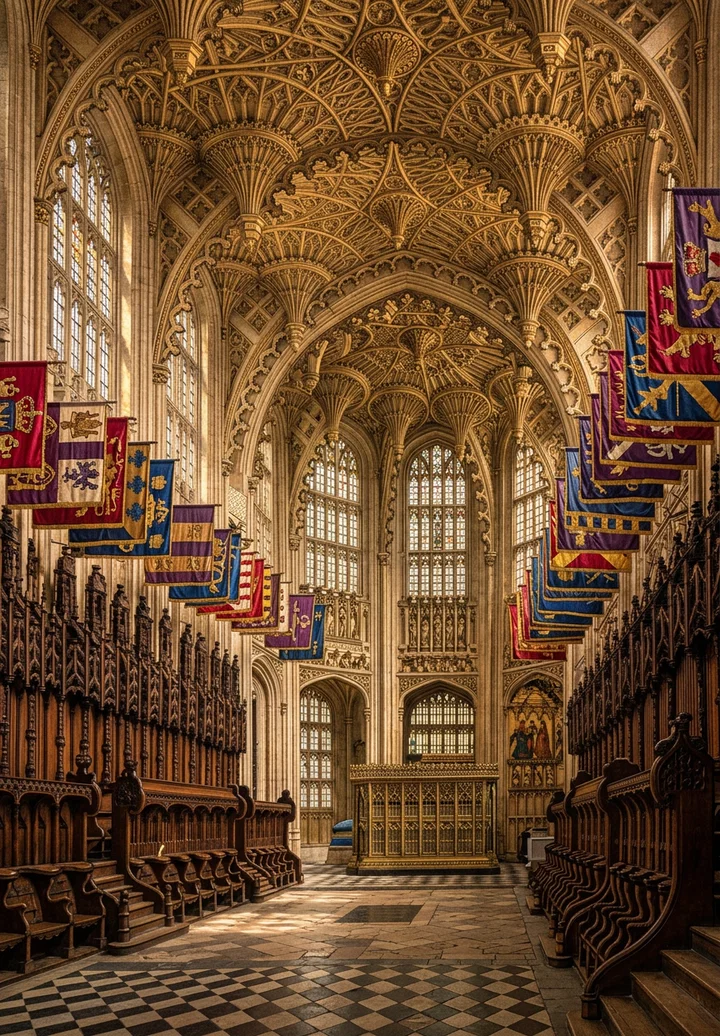
Irving continues: “There is a sad dreariness in this magnificence; this strange mixture of tombs and trophies; these emblems of living and aspiring ambition, close beside mementoes which show the dust and oblivion in which all must sooner or later terminate. Nothing impresses the mind with a deeper feeling of loneliness than to tread the silent and deserted scene of former throng and pageant. On looking round on the vacant stalls of the knights and their esquires, and on the rows of dusty but gorgeous banners that were once borne before them, my imagination conjured up the scene when this hall was bright with the valor and beauty of the land, glittering with the splendor of jeweled rank and military array, alive with the tread of many feet and the hum of an admiring multitude. All had passed away; the silence of death had settled again upon the place, interrupted only by the casual chirping of birds which had found their way into the chapel and built their nests among its friezes and pendants,—sure signs of solitariness and desertion. When I read the names inscribed on the banners, they were those of men scattered far and wide about the world, some tossing upon distant seas, some under arms in distant lands, some mingling in the busy intrigues of courts and cabinets,—all seeking to deserve one more distinction in this mansion of shadowy honors, the melancholy reward of a monument.”
Thus the world’s great men strive to make themselves a name that they may not be forgotten by those who shall live after them. Perishable honors! Monuments to fame oft crumble to dust, and the hardest stone is ground to powder by the wear of ages.
There are beautiful buildings in this world, erected by proud and powerful monarchs; but did you never think how much more beautiful will be the dwellings in the city of God? The beauty of earth we can know, for we have words by which to describe all the loveliness ever seen by man; but the golden city is beyond description. The heart of man cannot conceive the beauty of that place. We may lay the precious stones side by side, and reflect them in a golden mirror, but the life, the soul, of the picture is not there. “The glory of God did lighten it, and the Lamb is the light thereof.”
This is the home for which we are looking, and it is almost here. The years of waiting are nearly run, and the great, glad eternity is soon to burst upon us. Are we ready to change our earthly home, however beautiful, for the glorious one prepared for us in heaven?
MARY STEWARD.