THE pert little songster shown in the accompanying engraving is the wagtail, an inhabitant of portions of Europe and the British Isles. It is related to the larks, which it somewhat resembles, and is a common sight in the fields and along the river courses of the Old World. In describing this bird, a French naturalist, Andre Theuriet, remarks:—
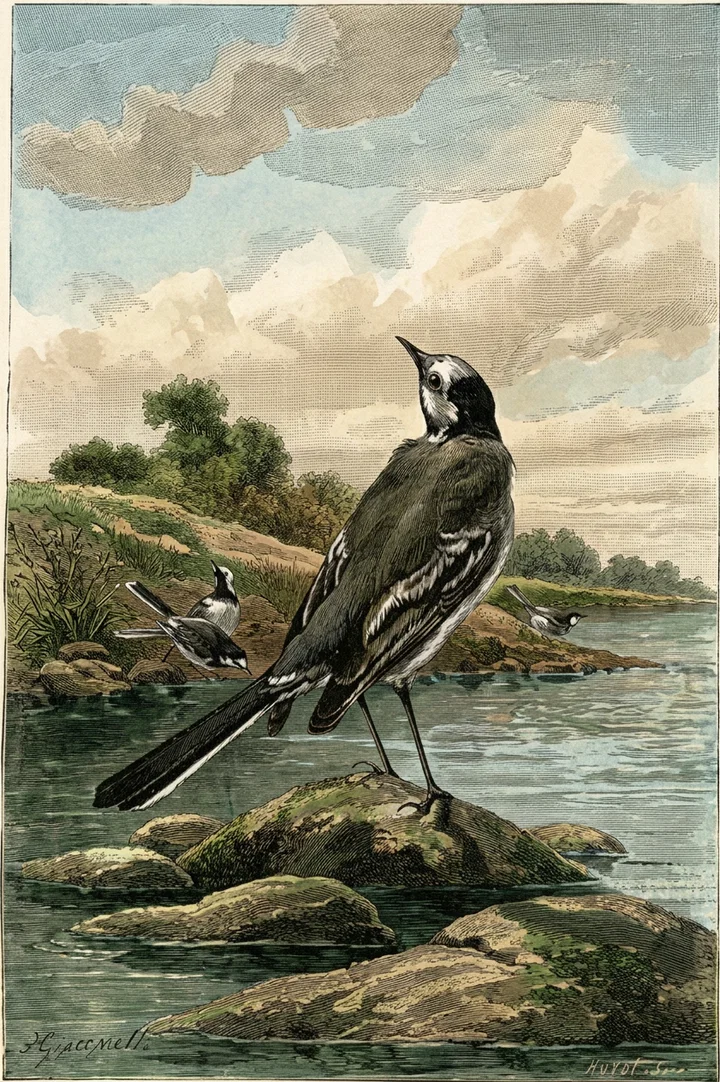
“The plumage of the wagtail is yellow, with an olive brown tint. It dwells in prairies where cattle come to graze, or it flutters about in the fields, following the laborers. It has a fine bill, thin, long feet, and a long tail which it is incessantly wagging. It is a great devourer of flies and gnats, having a weakness for large blue-bottle flies.
“The wagtail is sedentary in its tastes, and does not leave us even in the bad season. In winter it gets nearer to the villages, seeks shelter near the banks of ponds which freeze only rarely, and there, in spite of cold, it sings a low, soft, discreet strain. As soon as the month of March brings back the season of field labor and sowing, you can see the wagtail following the laborer who is pushing his plough, or perching on mounds of fresh soil, where it is sure to find an ample provision of worms.
“In April it begins to build its nest in the fields or sometimes in the roots of some tree on the banks of a rivulet. The nest, placed on the ground, consists of dried grasses and small roots, lined on the inside with feathers and hair. The female lays six or seven eggs; they are of a whitish hue with yellowish spots. When the young ones are fledged, towards mowing-time, the father and mother take them to some new-mown fields where cattle are taken to pasture.
“Then begins an idyllic life for the wagtail. The big, russet-colored oxen are lying about on the short grass of the pasture-commons; around them swarms of flies are buzzing, and to the right and left, bands of long-tailed birds dart on the insects, without being in the least frightened by the neighborhood of the weighty ruminants. Some of the wagtails are daring enough to perch on the black horns of the cows. Others follow the sheep dispersed about the commons, following the lead of the shepherd, who walks ahead, wrapped in his cloak.
“In the eighteenth century, when naturalists yet lent to the animals they were studying the sentimental ideas that were then the fashion, they pretended that wagtails were so fond of the shepherd as to warn him when a wolf or a sparrow-hawk was drawing near. This story is as ingenious and pretty as it is unlikely. Wagtails care little about the wolf, of whom they have nothing to fear; as to the hawk, they are very much agitated when they see it soaring above the pasture commons; it is therefore only interest for their own preservation and not friendship for the shepherd, who does not fear the bird, which causes their warning; for a hawk will attack birds but never flocks of sheep.
“All day long the wagtail will follow the herds in their evolution. Now evening draws near: the shadows of the elms lengthen on the plains; light mists arise in the background; the moon shows her crescent above the dusky woods; the shepherd is blowing his horn to call his scattered sheep; pushed by the dogs, the flocks rush forward, on the dusty road, bleating noisily; the bellowing cows turn their heads towards their stables, and in the rear, hopping over tufts of grass, wagging their tail and uttering low, shrill cries, the wagtails accompany the herd to the extremity of the fields.”