Hans Peterson was born with a love for music. His grandfather had been a musician, and had made him a present of a beautiful cornet and a music book. These were Hans's only treasures. His father had laughed when Hans came home from the farm with a great brass instrument, and said he wished grandfather had given him a saw and an ax instead; for he could see little sense in a boy's having a cornet. Hans's mother was dead, and he and his little sister lived with their aunt. Hans's aunt was not a cross woman, but she also thought that a cornet was of little value to a boy. Besides, it nearly drove her wild to hear the horrible sounds that Hans made in learning to play. In fact, the whole neighborhood around was disgusted with the cornet.
Hans used to take it out to the barn, and while other boys were playing marbles, or teasing the cats and dogs, or spending their time in running after circuses, Hans was “hardening his lip” on the brass mouth of his instrument, puffing and blowing till his face was as red as his rich young blood could make it.
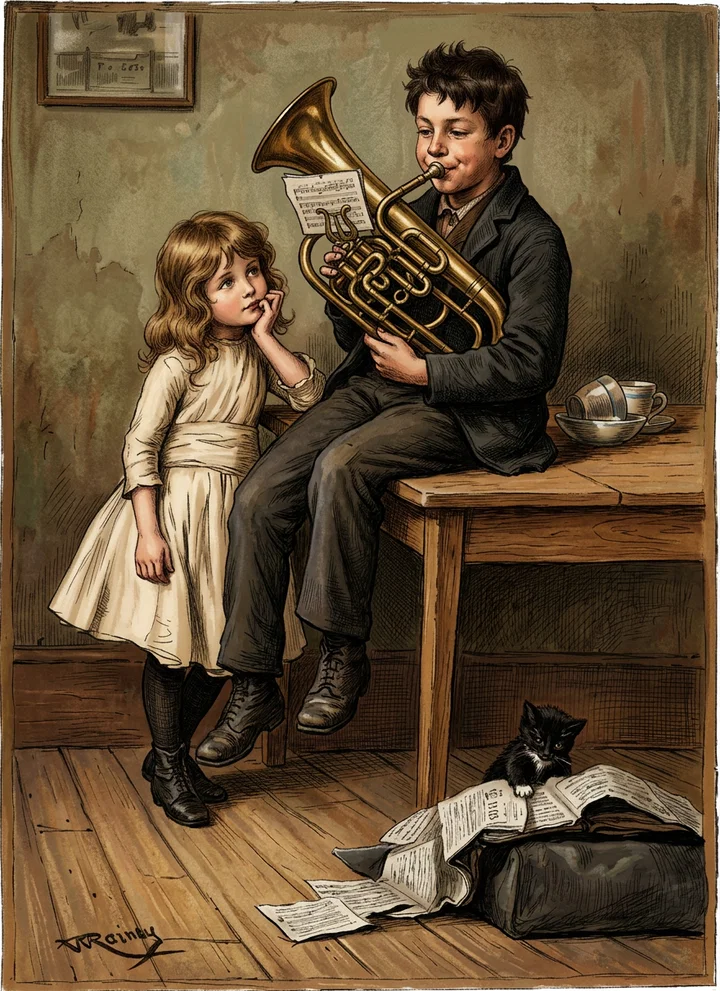
But at last he mastered the scale, and then simple melodies, and then more difficult pieces. But all the time Hans was looked upon by his father and his aunt as a person to be reproved. They scolded him for loving music, and told him he would never amount to anything in the world. This made Hans feel very sad. Sometimes he would go to the barn, and lie down on the straw and cry, and sometimes his little sister, who loved music too, would come to him, and tell him not to feel bad, and then the cry would end up with a “play” on his cornet.
“It's in me,” said Hans to himself, “and it's got to come out. Didn't grandfather tell me about Remenyi when he was a little boy?” “What's that you are saying?” asked Rita. “I was saying that grandpa told me about a great musician, who, when he was a little boy, used to get up in the night to play, because his father didn't like to hear him play. One night the father even beat him with his violin, but you see after awhile he became a great musician. Say, Rita, I believe God put the love of music into me. And how can it be so bad when heaven is going to be full of fine music? “Don't you remember that picture in ‘Pilgrim's Progress’ where the heavenly hosts had trumpets, playing on them? And the Bible speaks of having harps, and of the music that will sound like the rolling of the ocean. Grandpa told me to stick to it; for if God meant me to be a player on an instrument, he would give me perseverance and patience.”
Hans did pray to God to help him to do right, and tried to be faithful in doing up his chores and in his school work, but as soon as he was free, he always went to the barn to play. Hans did not care to romp much with the boys, and did not learn their slang words or rough ways. As he played on his cornet, now making the tones rich and full, and then softening them to a sweet lullaby, he learned the meaning of some of the best thoughts of those who had written the music, and these good thoughts of gentle things made him gentler and finer. Sometimes it seemed to him as if his very heart-thoughts went into the tone of his instrument, and his prayers and longings quivered in the notes.
Though the neighbors had at first found much fault with Hans, they after awhile began to feel pleasant towards him; for he was always modest, kind, and thoughtful. Little children loved him, and the old people knew who it was that helped them over the slippery walks, or carried their heavy baskets from the market.
Hans had two home friends that he prized very much. One was his little sister and the other was the pet kitten. Little Rita was very fond of her brother, and often stood and listened to his playing. One day when the children were home alone together, he brought his cornet over to the kitchen, and played for her all the afternoon.
Kittie was fond of music too, it seemed, and did her share of playing with Hans's music book. Neither of the children noticed how she tore leaf after leaf from the book, till a great many leaves were ruined. When Hans saw it, at first he felt very much vexed, but in a moment he said, “Poor kittie, she didn't know any better.”
That night a stranger came home with Hans's father. After awhile he began to talk about music; and Hans kept his ears open, and his father bade him bring his cornet, and play for them. This surprised Hans, but he did as he was told, and the stranger said Hans played well.
Then he took the cornet and played himself. Hans was delighted, and felt that he never would be satisfied till he could do as well.
The stranger seemed much pleased with Hans, and offered to help him. Hans's father looked pleased too, and patted Hans on the head, saying, “After all, may be you will make something yet.”
“Yes, it's in the boy,” said the stranger, “and boys or men or women will always do best at what they love best. It seems to me a wrong to the gifts God has given, to force a person into an employment that he is not fitted for by nature, and to discourage him from doing the thing for which he has a gift. There are many people who have an idea that men cannot glorify God, with certain talents he has given, but I think that is a mistake. The Bible says, ‘Neglect not the gift that is in you.’ If we devote our talents to the service of God, he can make them useful to his cause.”
“The other evening I was at the great hospital for the poor, and a celebrated cornetist was there, giving the people pleasure by his playing, and not only giving them pleasure, but helping them toward health and toward God. ‘Every good and perfect gift is from above, and cometh down from the Father of lights.’”
People thought Hans a very “lucky” boy to have so good a chance to learn music, but he had worked and prepared himself for the chance. The work we prepare ourselves for will come to us. Let no little boy or girl imagine that things happen to us without any reason; for God is in heaven, and he gives us what we are fitted for, in his own good time.
Some day, perhaps, you may have the pleasure of hearing Hans play on his cornet; for he is the kind of boy that is likely to be heard from. FANNIE BOLTON.