THIS is the master artist, the very king of singing birds. It is small in size, grayish white and reddish brown in garb; it makes no outward show, and ought never to be seen but from a distance. It needs the soft twilight of the moon, the mystery of the leafy forest, or the darkness of the night; but beneath that more than humble garb is hidden a poet’s nature, a most passionate soul, served by a most marvelous instrument.
It makes its appearance at the end of April. It comes from the land of the ever fiery sun; there it learned those warm, metallic notes which seem to us the echo of the bright, glowing East. The extent of its voice is surprising, and yet more marvelous is the robust constitution of the frail little bird that can sing on, night after night. This artist requires a special food: no seeds, no watery, debilitating fruit, but live flesh. It lives exclusively on worms, insects, and the larvae of ants. By means of this strengthening nourishment, its muscles acquire a wonderful strength, and its voice unequaled volume and sound.
It chooses some sonorous glade or some solitary old tree in which to give its concert, and twilight or the silent night for the hour. Everything in this bird betrays an artist’s temperament, even the refined arrangement of its nest, composed outwardly of leaves that are superposed like the petals of a rose, and lined on the inside with long, slender, narrow blades of grass, artistically interwoven. The female nightingale lays three or five shining, greenish-brown eggs, and while she is brooding, the male is perched on a neighboring tree, charming the long hours with exquisite melodies.
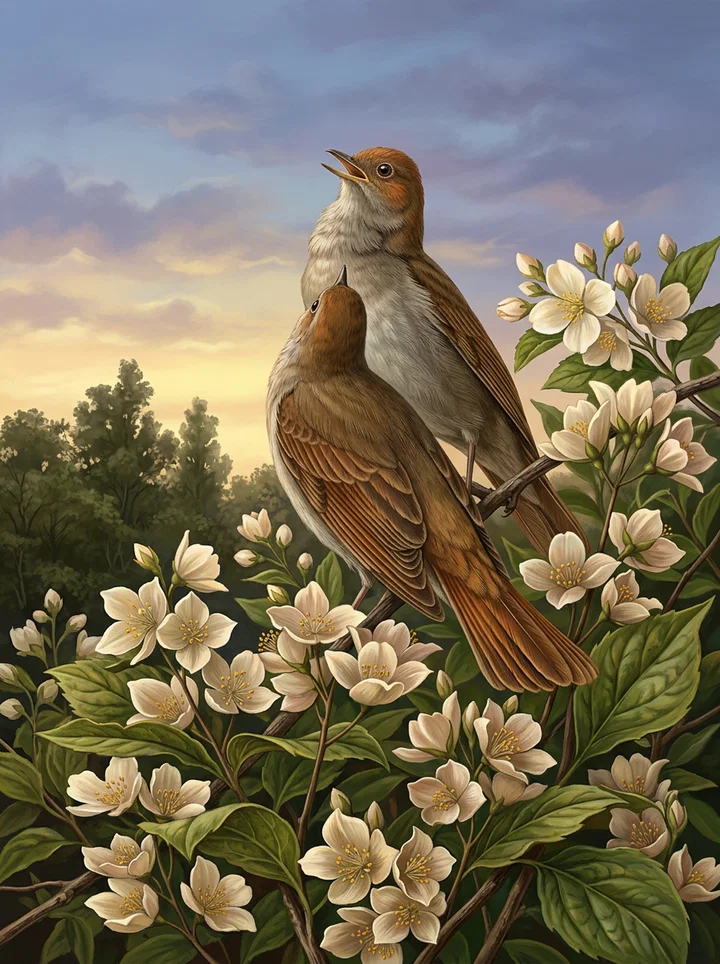
It is the passionate hymn of a fiery soul. This ever-varying, masterly melody is truly enchanting. It expresses every emotion; melancholy and joy, tenderness and passion. The song begins with some bright, rapid, thrilling trills; then it changes slowly into a coaxing, tender lullaby; then the strain is broken by two deep, grave notes, which die away like long sighs; then, again suddenly the tone of the artist changes; brilliant, trills, staccati, sparkling, sonorous flourishes, succeed each other rapidly,—and then again they all blend in a dim, dreamy, melody. In that original strain, you seem to inhale the perfume of the lily of the valley and of sweet-scented forest flowerets, the sap of budding leaves, the gushing joy of life in its full bloom.
The divine strain itself lasts but a short time every year. After midsummer the nightingale sings no more. The young are hatched, and the cares and preoccupations of material existence put a stop to the poet’s inspiration. Their notes are now harsh, being a sort of plaintive, jarring, snapping noise. These last sounds seem intended for menace and defiance. The representation is over, the footlights are put out, the marvelous artist leaves the scene of his triumphs, and carrying his starving brood away with him, he takes his flight towards neighboring fields and bushes, where he will find a more plentiful provision of worms. When you meet him by chance in the autumn, fluttering wildly across some solitary foot-path, you will scarcely recognize in that silent bird, with its livery of a dull brownish-gray, the dazzling singer of those spell-bound May nights. It is then like those artists so animated and dazzling, apparently so young and brilliant when seen in the costume of the stage, the dim perspective of the background, and the sparkling footlights, and whom you are surprised to find so faded and old-looking, when you see them leave the theater, clad in an old overcoat, tramping along pitifully in the mud.—Song Birds and Seasons.