Rising in the eastern part of Switzerland, the Rhine flows north to Lake Constance, thence west between Switzerland and Germany, and then northwest through Germany and Holland to the North Sea. It is about nine hundred miles long; and from Basel to the sea, which is some six hundred and thirty miles, allows uninterrupted navigation.
Its banks present every variety of scenery,—rugged rocks, dense forests, fertile valleys, fruitful vineyards, sometimes perched among lofty crags where industry has won a domain amid the fastnesses of nature, romantic roads, beautiful springs of mineral water, populous cities, flourishing towns, ancient castles, and romantic ruins, with which a thousand legends are connected.
From remote antiquity the Rhine has been associated with momentous events in the history of the nations that dwell along its shores. It has witnessed scenes of Roman conquest and defeat, of chivalric exploit in feudal times, and of wars and negotiations in modern times.
“Under the Romans, various important points on the west bank of the Rhine were fortified, in order to guard the stream and prevent the incursions of the German tribes. But the latter still occasionally came across in boats, and slaughtered the Roman settlers. Hence Julius Cæsar at length found it necessary to terrify the heroic intruders.” He crossed the Rhine with a powerful army, and took possession of the country. The time of occupancy by the Romans was an era of great splendor, but it was succeeded by ages of barbarian turbulence. The craggy peaks on both banks became the sites of castles of feudal chiefs, who waged constant war among themselves, and laid the passing stranger under heavy black-mail.
At length a time came when such perversion of power could no longer be tolerated, and a confederacy of traders and merchants was formed, which proclaimed war against the robbers, destroyed their strongholds, and abolished the system of tolls and taxation.
But during this barbarian ascendency, several ecclesiastical cities had grown up, which enjoyed independence and security under their prince-bishops. Mayence, Cologne, Trèves, and Aix-la-Chapelle were the principal cities thus distinguished. These, also, in course of time, “lost their ancient privileges; the wars of the French Revolution changed their fortune, and consigned them to one or another of the modern European sovereignties.”
Following the course of the river from its source, we traverse a lovely Swiss valley for about fifty miles, and finally emerge into an expanse of the river, which forms a lake forty-four miles long and nine miles wide at its broadest part. The Romans called this lake “Lacus Brigantinus;” the modern Germans call it the Boden-Sea; the French and English know it as Lake Constance.
Leaving the lake at the picturesque old town of Stein, we soon reach Schaffhausen, a place of about twelve thousand inhabitants. It still retains many of the mediæval features of a Swabian village of the empire. The principal building is the cathedral, a basilica after the early Roman style. The town is commanded by the castle of Munoth, which consists of a round tower of several stories, containing a winding incline plane instead of a staircase, with walls sixteen feet thick and bomb-proof vaults. The view from the top is very fine.
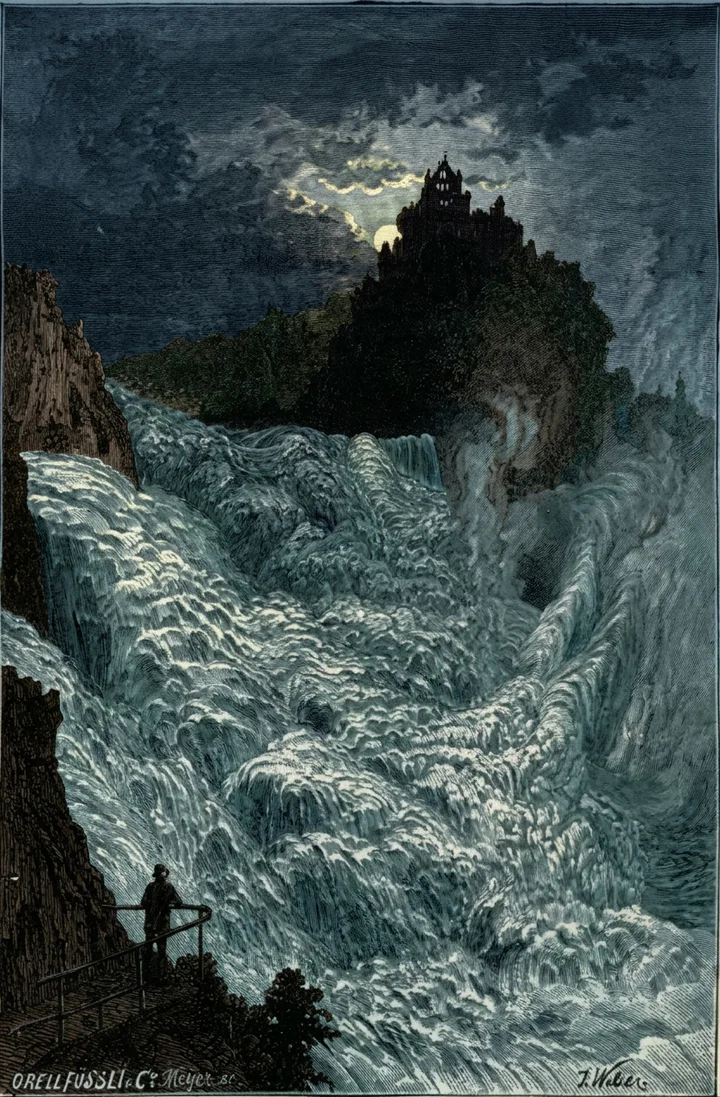
Near Schaffhausen are the Falls of the Rhine, shown in our picture. In point of volume, they are the most imposing falls in Europe. “The river is precipitated in three leaps over a rocky ledge of irregular form, which, with the whirlpools and the rapids, form a cataract of about one hundred feet. Before eight in the morning and after three in the afternoon, innumerable rainbows are formed by the sunshine in the clouds of silvery spray. One of the best surveys of the falls is obtained from Schloss Laufen, which is picturesquely situated on a wooded rock immediately above the falls. Foot-paths lead through the grounds to the most important points of view, from one of which (an iron platform projecting over the foaming abyss and close to the stupendous scene) the vast volume of emerald-green water is seen descending with a roar like thunder, apparently threatening to overwhelm the spectator, and constantly bedewing him with spray. The finest view is obtained from Schlösschen Wörth, situated on an island opposite the falls.”
There are a great many places of interest along the Rhine, but only a few of them can be noted here. Among the principal towns below the falls just described, is Basel, where our office of publication is situated.
Strasburg is a quaint old town, with its cathedral, one of the most imposing edifices in Europe, in which is the wonderful clock made by Schwilgue. “This clock attracts spectators at all times, especially at noon. On the first gallery an angel strikes the quarters on a bell in his hand, while a genius at his side reverses his sand-glass every hour. Higher up, around a skeleton which strikes the hours, are grouped figures representing boyhood, youth, manhood, and old age (the four quarters of the hour). Under the first gallery the symbolic deity of each day steps out of a niche, Apollo on Sunday, Diana on Monday, and so on. In the highest niche, at noon, the twelve apostles move round a figure of the Saviour. On the highest pinnacle of the side tower, which contains the weights, is perched a cock, which flaps its wings, stretches its neck, and crows, awakening the echoes of the remotest nooks of the cathedral. The mechanism also sets in motion a complete planetarium, behind which is a perpetual calendar. The most wonderful feature of this piece of mechanism is that it is calculated to regulate itself, and adapt its motions to the revolution of the seasons for an almost unlimited number of years.”
Worms is a place of peculiar interest to all Protestants, as the scene of Luther’s great triumph over Catholic power. A grand statue has been erected here to his memory. The artist has caught the spirit of the man in his marble representation. With a scroll in his hand and his face upturned to heaven, he seems to be invoking the divine aid, and one can almost hear his fervent appeal: “Here I stand; I can do no other; may God help me. Amen.” Around his statue are grouped the most prominent of his fellow-laborers, and the generous supporters of the Reformation.
The most interesting portion of Rhine scenery beginsp. 78 near Mayence, at its confluence with the river Main, and extends to the Drachenfels, near Bonn, a distance of over one hundred miles, following the windings of the river. At Mayence there is a statue of Gutenberg, the inventor of movable types.
St. Goar is one of the finest of the Rhenish towns, and derives a look of importance from the extensive ruins of Rheinfels, which rise high above the town. Immediately above St. Goar rises the imposing rocks of the “Lorelei.” “The well-known legend of the nymph who had her dwelling on the rock, and, like the sirens of old, enticed sailors and fishermen to their destruction in the rapids at the foot of the precipice, has long been a favorite theme with poet and painter. Heine’s beautiful ballad is still deservedly popular.”
Bonn is the birthplace of Beethoven, one of the world’s greatest musical composers. And who has not read the pathetic poem, “Bingen on the Rhine?” Bingen is a beautiful, quiet spot. No wonder the heart of the brave soldier turned back to so sweet a home and the many loved ones there, as he lay “dying in Algiers.”
“The towns and villages of the Rhine are remarkably uniform in their general aspect and character. Each consists of a row, or parallel rows, of houses exceedingly ancient in appearance, surrounded by walls of defense, those being very low, and in most cases in a state of rugged decay. Each town has its church, whose spire is a chief object rising from the cluster of encircling human dwellings. These communities are the miserable remains of burghs which flourished hundreds of years ago, under the auspices or despotism of the feudal chief whose castles crown the neighboring heights. What now remain are only the residences of the humble farmers of the district, and of the cultivators of the vines of the Rhine, that grow on the adjacent hills. The precipices, which sometimes rise to the height of seven hundred feet, are formed into terraces like steps of stairs, one terrace above another. The vines to be cultivated on these terraces are planted in baskets of mold forced into the clefts of the rocks, or supported by the walls which form the divisions between the terraces. Unless great care were taken in thus preserving the baskets of mold, the whole would be washed away by the winter torrents, and the poor families who own them would be ruined in an hour.”
Some one, in traveling along the Rhine, has left us this prosy description: “Two long rows of peaked hills, all alike, dwindling in perspective, a river between them, and every one with its ruined castle perched upon the top.” A more poetical remembrance is in the following lines from Byron:—
“Chiefless castles breathing stern farewells From grey but leafy walls, where Ruin greenly dwells. And there they stand, as stands a lofty mind, Worn, but unstooping to the baser crowd; All tenantless, save to the crannying wind, Or holding dark communion with the cloud. There was a day when they were young and proud: Banners on high, and battles passed below; But they who fought are in a bloody shroud, And those which waved are shredless dust ere now, And the bleak battlements shall bear no future blow.”
MARY STEWARD.