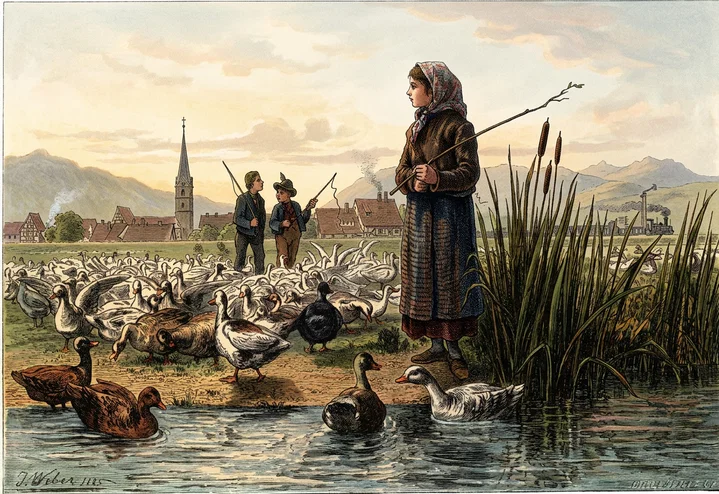
GRETA, THE GOOSE-GIRL.
“Ah, me!” sighed the good mother Gretchen, “what will become of us all I cannot tell, with the poor father ill with the fever, and the hungry geese cackling to be taken out. If only thy brother Fritz were here, all would be well; but he must be away a-soldiering, and I suppose it is needless to fret because all the others are girls.”
“Mother, why cannot I take the geese to the meadows? I know the way quite well,” spoke out sturdy little Greta.
“No, no! my child. I cannot let thee wander all day after those restless creatures, but then—if the flocks are not taken out, our neighbors will get some one else to tend them, and we can ill afford to lose the money.”
There seemed to be no other way out of the difficulty, so the mother consented to let Greta act as gooseherd.
Her sisters tried to dissuade her, saying, “Thy friends will laugh at thee;” but Greta replied: “They are not friends if they despise me for trying to help father and mother, and moreover it is honest work.”
Hans Burger and his family lived in a pretty village near the Rhine, just far enough from the railroad and great city of Strasburg not to be disturbed by their bustle and noise.
It is customary in some parts of Germany where geese are raised, for each owner to mark his flock, just as sheep are marked; then every day during the summer all the flocks in the village are driven out to the gänseanger, or green spot, by the person they employ, who is called the gooseherd.
Greta, having gained permission to take her father’s place, drove her flocks out of the village. She made a picture which would have charmed the eye of an artist if he could have seen her surrounded by her feathery flock.
Her hair was neatly plaited beneath a peasant cap. The apron which covered her blue dress contained two pockets; these held her midday lunch and her knitting. She was not idle, but knit industriously and thought of many queer things as she watched her cackling charge.
The showers which occasionally caught her without shelter did not make her complain, but cheerfully and faithfully she performed the work she had set herself to do.
When the village boys tried to tease her, calling her “goose girl,” and made coarse jokes, she kept silence, which was far better than to have answered them in the same strain. Greta very wisely thought, “I must respect myself if I would have others respect me.”
Twice that summer the flocks were plucked, and the soft feathers and quills were taken to the city and sold. The cool autumn days brought new strength to Greta’s father, and he was able to care for the geese himself.
Greta’s loving service, so cheerfully and willingly performed, cheered the hearts of her father and mother. When she related the experiences of the day, her father would say, proudly, “Thou hast done well; Fritz could have done no better.”
She had done what she could, and had her reward.
—The Well-Spring.