LACE WINGS is the name of the little insect shown in the picture on this page. He is often called the ant-lion, or, if a more scientific name is wished, Myrmeleon. The ant-lion, in its perfect state, much resembles a small dragon-fly, and has good power of flight. It goes through all the changes incident to insect life, from the egg, the pupa, and the larva, to the perfect insect.
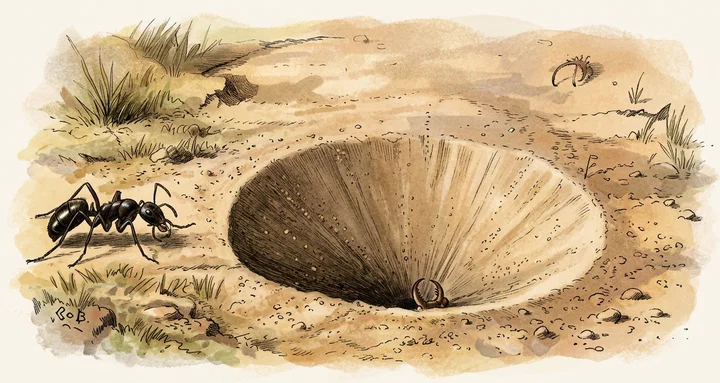
It is while in the larva stage that the habits of the ant-lion attract the most attention, for it has a singular way of gaining a livelihood. As it has feeble powers of locomotion, it resorts to artifice to capture its prey. The ant-lion deftly digs a pit, two inches in diameter and one inch deep, first striking a circle and then throwing the sand from the center, always far enough out to avoid making a ridge around the edge of the pit. This he is enabled to do by means of his flat head and jaws, which he pushes under several grains of sand, and jerking backward, throws them into the air.
When the pit is finished, the ant-lion stations himself at the bottom, entirely concealing himself, except his jaws, as is shown in the picture, and there he awaits some unwary insect. The sides of the pit have been made as steep as sand can be piled up, and the slightest movement at the top sends a small avalanche of sand down to notify the ant-lion of an intruder.
The ant-lion at once begins to throw out sand and deepen the pit, thus blinding the insect, and causing it to slide down the steep walls to meet grim fate. The captor seizes it, and holding it above his head, sucks out its blood; then, throwing the dead body out of its hole, it seeks to repair damages.
A naturalist gives the following account of the habits of an ant-lion which he had in captivity:—
“After eating, he became more timid, and sometimes would not take a second insect. If, however, several were put into the pit at once, he would bite one after another until all were killed, before deciding on which to begin. I fed him two or three times a week, usually with house-flies, cutting their wings off, and letting him take them in his own way. In October, having occasion to travel some distance, I put him in an ounce bottle half filled with sand, corked him up, and carried him with me in my bag. In about a week I gave him a large house-fly, which he did not catch, not having room enough to make a pit-fall. I gave him no more food till the next March. . . .”
About the first of March, when flies began to be plenty, I commenced to feed him again. He found it rather awkward to catch insects in the bottle, as there was not room enough to make a pitfall, and his inability to move forward made it hard for him to seize an insect, unless he met it directly between his jaws. He soon, however, made pitfalls half an inch in diameter, which answered the purpose.
“Sometimes he lay on the surface of the sand, with a few grains scattered over his back to conceal him from notice, and his jaws extended on the surface. If a fly was put into the bottle, it would circle around it, close to the glass, and usually run over the ant-lion’s back. He would jerk up his head and attempt to seize it, which he seldom succeeded in doing the first time. If he caught a leg or a wing, he was unable to move nearer, and shorten his hold, and the fly escaped. He would often throw up the sand, and try to undermine the fly. He would sometimes work an hour in these ways before the fly would get into a favorable position. I fed him every day or two until May 15th, when he spun a spherical cocoon around him, and remained inclosed until June 26th, a very hot day, when he came partly out, and leaving the pupa skin half in the cocoon, appeared as a perfect fly, but did not spread his wings completely.” W. L. K.