ROUND THE WORLD.—16

9%

S. D. A. Publishing Association · Battle Creek, Mich. · Jun 11, 1890

FromThe Youth’s Instructor, Vol. 38, No. 24.

Read the full edition

ROUND THE WORLD.—16.

FROM SOUTH AFRICA TO CEYLON.
At Port Durban, Natal, on the 11th of January, the steam is hissing through the valves from the engine-room of the steamship Umtata. Her cables are hauled in and coiled on the windlasses, and all is ready for sea. She is bound for Calcutta, the great metropolis of India. Her hull stands high out of the water, as she goes in ballast, having no cargo, only a little sand to hold her steady in the water. The owner expects her to come back in three months, freighted with coolies, to supply the demand for labor in the growing colony. The captain mounts the bridge, and the pilot comes aboard. A few minutes later, and the tale-teller rings out, “Stand by,” and almost immediately after, “Half speed ahead.” The steam hisses louder than before, but the cylinders do not move, and the propeller refuses to turn. “What is the matter?” is the question on every lip; but nobody seems to know, when the chief engineer comes on deck, and informs the managers that there is something in the high pressure cylinder, and that they will have to “lie by” till morning. The order is given to make fast, and all not on duty soon “turn in” to their bunks, wondering if the “old kettles,” as a sailor derisively terms the boilers, will blow up; for mariners of the old school, accustomed to set the white wings of their craft, and go as the breeze will blow them, look down with a sort of conservative pride and lordly disdain upon the science of modern days, which sends ships through the water, whether Neptune wills it or not. But there is nothing to break the stillness of the dark watches save the sound of the engineers’ and firemen’s hammers, as they labor patiently to take the cylinder to pieces and rectify the defect.
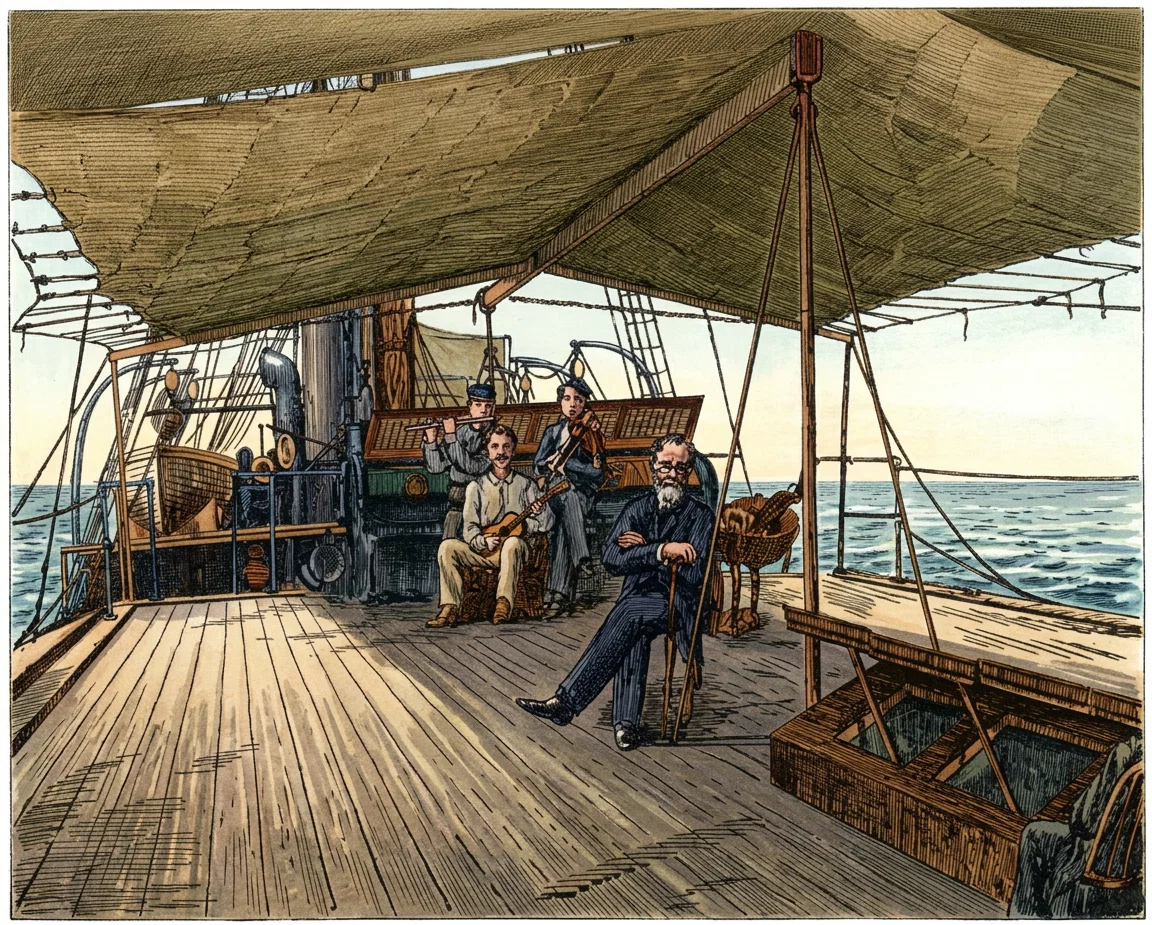
“UMTATA” QUARTER DECK IN THE TROPICS.Restored with AI
“UMTATA” QUARTER DECK IN THE TROPICS.
At early dawn we are awakened by the grating of the cables, as they are drawn through the hawse pipes. Then there is a trembling vibration, and the ship quivers from deck to keel; the water is stirred into a thick foam at the stern, for the screw is in motion, and the good ship is off. The sun is just rising, and the vessels at anchor as yet show no signs of life. It would be hard to realize anything more sleepy-looking than a number of vessels in port at early dawn, before the stevedores have commenced their labors. The Umtata glides quickly down the Bluff Channel, past the great white light-house, and out to the anchorage. The tale-teller rings once again, steam is shut off, and the pilot descends a rope ladder into his boat, and with a “Good-by,” and “Wish you a pleasant voyage,” his men bend to their oars, and the Umtata puts to sea. When well away from the land, which soon fades in the distance, her head is turned, and a straight course is steered to the northward, up the Mozambique Channel.
Life at sea varies almost as much as on land, according to the place and the people. It is almost like being in two different spheres, to take a trip on a large ocean “liner,” and then another in a tramp boat, built for freight and not passengers. In the one the cold, stiff rules of society prevail almost as much as ashore, excepting that as people grow seasick, they generally become confidential. In this class of boats there are many passengers who have never been to sea before, or away from their native land,—young men just starting out in life to seek a home and fortune in foreign climes. But those who travel in vessels of the latter description are mostly men who have seen the world, and are as much at home afloat as ashore, and know how to make themselves comfortable and to pass away time on board.
There were only two passengers on the Umtata besides the doctor and his assistant, who were going out to take charge of the coolies on the home trip. Head winds and heavy seas made slow running for a few days, but as the ship neared the head of the channel, the weather moderated. On January 19, we passed between two small islands known on the marine charts as Joanna and Mayotta. There are no inhabitants on them, save some black fishermen. Once past them, we are in the Indian Ocean. There are many of these islands in the Indian and Pacific Oceans, some of them having no inhabitants at all. On many of them the British government has placed goats, and in a cave with a conspicuous landmark, left provisions, so that if a vessel is wrecked or cast ashore, her seamen will not perish.
For the greater part of the voyage, the sea was as smooth as a mill-pond. It looked like one great sheet of glass, more smooth than many of the little lakes that dot the surface of North America. After leaving the land, we passed but one ship; that was on January 22, and she was at quite a distance from us. A sail in the offing causes great excitement at sea, when one has not been sighted for a long time. Every one is on the bridge, and telescopes and opera glasses are in demand. Four flags were run up her main mast halyard, which were made out to be M S N J. This was the official number of her name, which we found to be the Malba. We ran up our’s, and then watched to see if they would speak us again. Up went three more flags, B W F, which means, “Any news?” But as we did not happen to have the morning papers, we put D on our halyards, which means “no.”
One day we lay to for awhile, to clean the salt out of the boilers, and while thus delayed, amused ourselves fishing for sharks. One came alongside, and a piece of fat pork on a grappling hook was let down for his dinner. But he was too wary, and would not bite, although he kept swimming around it. The weather is delightful. Under the awnings one can lie at ease, and enjoy the cool, crisping breezes which hover around the bosom of the ocean, and as they dance along, seem to keep music with their invisible feet. Glowing and varied are the hues which the waves take from the rosy clouds, while the sunsets are of that perfect nature read of in books, but seldom witnessed except in these seas. On a moonlight night it is pleasant to sit on deck, and often the question goes round, “Who wouldn’t sell a farm and go to sea?”
When it rains in the tropics, the water comes down in sheets; a black line is seen on the horizon, and before there is time to do anything but run from the deck to the cabin, the squall is down. This is the unpleasant part of traveling in these seas, as all the ports and skylights must be kept closed, and the heat is almost suffocating. In hot weather, when it is dry, no one thinks of sleeping below; a hammock or a cushion on the deck is all that is necessary to make life comfortable.
As the ship passed directly under the sun, we can say that there has been a time in our lives when we have been without a shadow. On the last day of January the skipper said he could smell the spices blowing off from the coast of Ceylon, but the rest of us failed to detect anything unusual. In the night, however, we awakened, rubbed our eyes, and beheld in the distance the light-house, which was the beacon of the small port of Point de Galle. P. T. M.