NATURE never grows monotonous. In all her productions there is a pleasing variety of structure that renders this department of study a fascinating one. Even in the trap of so repulsive a creature as the spider is shown the nicest care in adaptability and execution of design. The web of the geometric spider is a familiar example. You have undoubtedly often watched the little builder throw out his lines, make them taut, and spin thereon his wheels within wheels, laying a clever snare for unwary flies or other winged insects.
Often on a dewy morning the grass plots seem to be half covered with irregular cobwebs. A close examination of one of these discloses a tube at one corner of the web, near the opening of which a wary little housekeeper sits. When the spider feels something alight on the web, she runs out and snatches it, and carries it into the tube to eat.
The water spider spins a little balloon of silk, which she fastens onto some aquatic plant, and, filling it in a curious way with air, lives in it, feeding upon the insects that prey upon water plants.
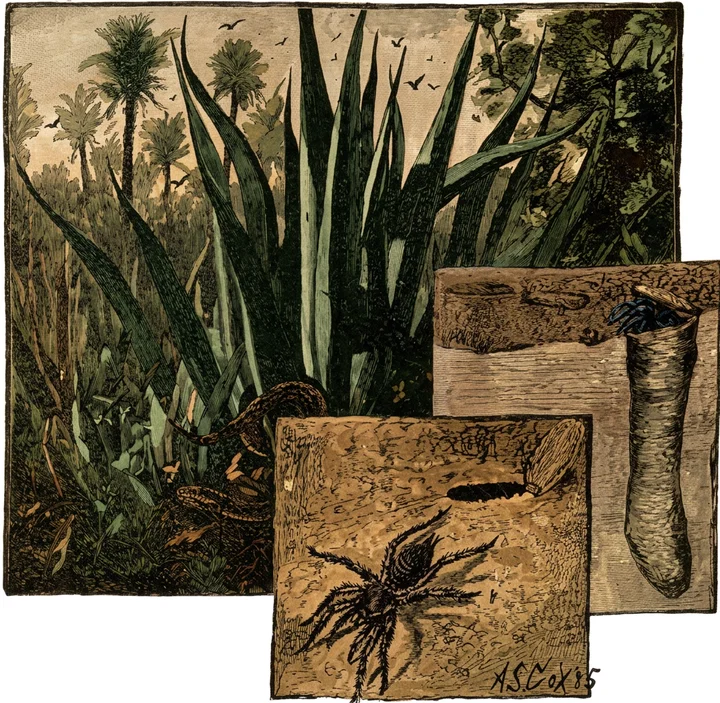
One of the most curious webs is that spun by the trap-door spider. The American species of this insect is found in New Mexico, Arizona, and California. Several species are also found in Southern Europe. The accompanying picture shows this spider, together with a sectional view of his home.
The holes made by this spider are nearly an inch wide, and from two inches to a foot in length. The spider digs this hole in fine soil, which afterwards assumes a brick-like hardness. At the top of the hole is fastened a cover that fits as tight as the cork to a bottle. The inside of the hole is smoothly lined with silk, even to the little cover that shuts so nicely over the opening. This cover is very cleverly fastened to the opening by a few threads that make an admirable hinge. When alarmed, the spider retreats to her hole, and seizing the door with her front pair of feet, so cleverly braces herself against the walls of the tube with the others that it is impossible to lift the cover without tearing it from the tube.
One species of trap-door spider digs a branch tube, connecting it with the main one a little below the surface, and closing the opening at the junction by another trap-door, so hung that it can close either passage.
Still another species builds a straight tube, with two doors, one a little below the surface, so that when an enemy tries to dig the spider out from above, she can close the lower door, making it appear like an empty nest. The spiders live in these nests most of the time, generally coming out at night to catch insects, which they carry to their nest to eat.
The naturalist Moggridge once caught one of the American species, and put her in a pot of earth, to watch her habits. She at once set about loosening the earth, and carrying it away piece by piece. In an hour she had dug a hole half as large as a walnut.
At another time he was fortunate enough to catch a spider at work making a door. “She spun a few threads across the hole, then gathered up with her front legs and palpi an armful of dirt, and laid it on top of the threads. She then got under the pile, into the tube; but the motions of the dirt showed that she was still at work on it, and next morning the underside had been thickly covered with web, and the whole separated from the mouth of the tube except at one side, where the usual hinge was left. The new door was at first soft, but in two or three days hardened, and appeared exactly like an old door.”
These spiders are in the habit of covering the door with moss, the more cleverly to conceal the nest from their enemies. Curious to know what the spider would do, Mr. Moggridge at one time scraped the moss from the door of this spider, and dug the ground up all around it. On visiting the nest the next morning, he found that the spider had carefully replaced the moss, thus making the nest show conspicuously on the bare ground. W. L. K.