(Concluded)
Of all kinds of forest vegetation, the pine tribe is the most widely diffused, and the most generally useful. Some species or other may be found from the snows of Lapland to the hottest regions of the Indian Archipelago, and from the level of the sea to the highest limit of trees on the great mountain ranges. Figuratively it is said of the cedar that its branches shall cover the earth; literally we find its range of distribution coextensive with the surface of the globe. But though thus mingling with the box tree and the myrtle tree in their chosen haunts, and there beautifying the place of God's sanctuary, and making the place of his feet glorious, there are special regions where the pine forms the sole arboreal vegetation. As the palm is the symbol of the tropics, so the pine is the symbol of the north temperate zone. The palm flourishes in the summer of the world; the pine tree in the winter. Beauty and fruitfulness are represented in the one; strength and patient endurance in the other. The pine is eminently typical of a bleak and inhospitable climate. It is associated entirely in our minds with the gray skies and the rude winds of the North. It forms an essential element in the grandest mountain scenery, and enters into the composition of some of the most magnificent scenic pictures which the great Artist has painted on the canvas of this world, for the admiration of his creatures. In it we have the highest moral ideal of trees, which is dependent upon their right fulfilment of their appointed functions amid the greatest difficulties. Not in rich soil, and amid soft breezes and warm sunbeams, and with the blue smile of unchanging skies resting upon it day after day, does it grow up in pampered and luxurious selfishness; but on the bare steep sides of rocks, where the soil is of the scantiest, amid the rack of gloomy, homelessp. 3 clouds, and the howling of bitter winds, poverty-stricken, hunger-pinched, and tempest-tortured, it maintains its proud dignity, grows strong by endurance, and symmetrical by patient struggle. It seems intended and created by God for the covering of those wild and lonely spots where no other tree could live.
To the offices which, in such bleak and elevated situations, the pine performs, may be traced much of the beauty and fertility of the earth, and much even of the happiness of man. Standing on the mountain tops, its fringed forests catch and condense the passing clouds, which distil from their branches into the shaded soil, and, percolating through moss and grass into the heart of the rocks, flow down by an appointed channel—a rejoicing stream into the valleys. The pine is, therefore, the earth's divining rod, that discovers water in the thirsty desert,—the rod of Moses, that smites the barren rock, and causes the living fountain to gush forth. When the pine forests on the mountain heights are cut down, the springs and rivulets of the low grounds are exhausted, and the climate is rendered hotter and drier. The destruction of the grand pine woods that once clothed the Apennines, has rendered the Papal States a region of poverty, disease, and wretchedness. In Greece the traveler looks in vain for the old legendary fountains, rivers, and lakes, with which the classic poets had made him familiar. Palestine has become a parched and sterile land on account of the disforesting of its mountains and hills. Not more poetically than truthfully, then, did the old Chinese philosophers say that “the mightiest rivers are cradled in the leaves of the pine.” On the mountain heights, too, in the united strength of its serried phalanxes, the pine is a natural fascine or fortification against the ravages of the elements. The ban forests of Switzerland stay the progress of glaciers, and arrest the headlong fall of the avalanche, protecting the inhabitants of the valley from the fearful ice bolts of the mountain. On the Norwegian hills, the pine forests wage successful war with the bitter winds of the pole; and in their sheltered rear the fruits of a milder climate ripen, and the toils of a happier land are carried on. Against the fierce storms of the Bay of Biscay, the pines of the Landes offer an effectual barrier; and meadows and pastures, forming the support of an industrious peasantry, now appear where sand-dunes once filled the air with their choking clouds, and spread desolation over the far horizon. The pine is, therefore, necessary to the equilibrium of nature. If ignorantly and wantonly removed from the situations where God has so wisely and graciously placed it, his beneficent arrangements for the good of man would be frustrated.
And most admirably has God endowed the pine with strength and capacities of endurance unequalled. Every part of its organization bears testimony to the favor with which he regards it. The peculiarities which attach to the tribe, in their manifest intention and actual result, plainly bespeak a plan or purpose in the mind of the Creator. The whole framework of each species is molded to suit the unfavorable conditions amid which it grows. Its roots adapt themselves to the shallowness of the soil, which usually rests on very hard rocks; for, instead of going down vertically, like the roots of other trees, they extend more in a horizontal direction, under and over the ground, which they clasp with an intricate network of extremely strong, knotted fibers, composed of threadlike cells. They thus make up for want of depth in the soil by the extent of it which they embrace; and by this contrivance the trees are securely rooted, and capable of growing even in the bleakest situations—on the ledges of precipices, and on the most barren mountain heights. The trunk is protected from the keen cold to which it is exposed, by the thickness and roughness of its bark, and by the resinous substances, richly productive of caloric, with which all its parts are strongly impregnated. And it is a remarkable circumstance that the bark is always thicker and rougher in the direction of the prevailing storms. On their northern sides the trees are also covered—on the same principle as arctic animals are furnished with warm furs—with a thick coating of gray lichens; and a knowledge of this curious provision of nature has often been taken advantage of, as a compass to guide the lost wanderer through the pathless primeval forests.
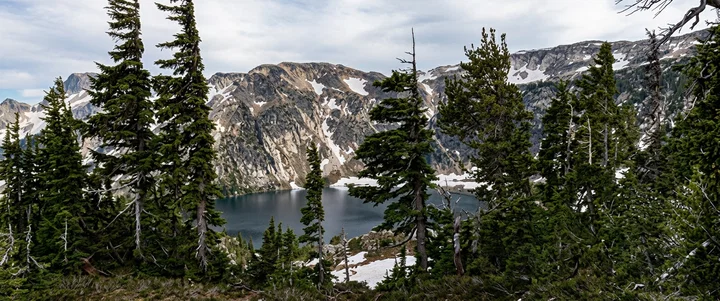
The pyramidal form of the pine is also admirably adapted to its exposed and stormy haunts, as it gives less resistance to the force of the wind than the round, cushioned shapes of trees growing in sheltered places. It is besides designed to catch the falling snow, and by thus investing itself with an ermine robe during the severe and long-protracted frost, to prevent the very rapid loss of heat which its dark verdure would otherwise occasion. It has, moreover, an esthetic significance, reminding us of order in the midst of disorder, and formality in the midst of the rudest chaos. Its regular conical growth affords a pleasing contrast to the wildness and irregularity of the scenery in which it abounds, and introduces an element of education and precision into those outer regions of nature, that seem to have got beyond, or overgrown, her orderly control. Rising tall and straight, “in serene resistance, self-contained,” from the rifts of inaccessible peaks; marshaled in stern and serried ranks on the ledges of perpendicular precipices; standing lonely and unawed—like the Wettertannen of the Swiss Alps—in the midst of fearful horizons of snow mountain and glacier, over the far-off edges of which, where the sunshine lingers behind on the green uplands, the oak and chestnut timidly peer, as if afraid to venture farther,—in such circumstances it speaks of law where all seems lawlessness, and of a conserving power where everything seems to yield to disintegration and ruin.
Especially is the traveler struck with the formal, educated look of the tree in the Araucarias that cover the wild slopes of the Chilean Andes, and in the Norfolk pines, whose branches, all of the same length, grow thickly out all around the trunk from the root to the top, appearing like stately columns resting on rifted rocks, perpetually dashed by the fierce spray of the Southern Ocean.
The leaves of plants which grow entirely under water are cut into long linear segments, in order that the flow of the stream may pass through them without injuring them; so in like manner the leaves of the pine tribe are exceedingly tough and narrow, in order that the wind may blow freely among them without separating them from the tree, or tearing them in pieces. In aerial as well as in aquatic currents, we find the same modification of form and structure in the organisms that grow in them. Though the leaves of the pine are thus smaller and narrower than those of any other kind of tree, they are compensated for this by their immense number and persistent nature. They cling to the tree through summer's sun and winter's frost; and thus each branch bears upon it always the accumulated foliage of five or six summers. By this immense and continuous multiplication of leaf-surfaces, working day and night, summer and winter, those subtle processes by which, through the agency of the leaf, air, dew, and sunshine become changed into solid wood are carried on more rapidly in the pine than in trees whose individual leaves are broader, but less numerous, and liable to the interruption of winter's desolation. No tree, for the reason above assigned, grows more rapidly than the pine; and, liable as it is to continual accidents, such a provision is necessary to make up for its losses, and to keep its ranks always unbroken in the guardian battlements and watch-towers of the world. Such modifications are strikingly expressive of ideas in the Creator's mind, embodiments of his thoughts and purposes. By these wonderful modifications of form and structure, then, have the pine trees been planned to flourish on the barest soil, in the coldest atmosphere, on the stormiest heights. Noble Gothic spires, they tower up in arborescent music to heaven, and carry up the religion of the landscape in unfading verdure, and unceasing fragrance, and untiring patience, to the throne of Him before whom the mountains and the hills break forth into singing, and all the trees of the field clap their hands.—Hugh MacMillan, in “Bible Teaching in Nature.”